

Solving Linear Equations
Solve linear equations in one variable, including variables on both sides and the distributive property.
Students solve one-variable linear equations by maintaining equivalence, including distribution, combining like terms, and variables on both sides.
Lesson plan and worked examples by TEKSForge · not a TEA-issued lesson. Videos by independent educators.
Learn the concept
Preserve equality
An equation states that two expressions have equal value. Adding, subtracting, multiplying, or dividing both sides by the same permissible value preserves the solution set. Simplify each side first and apply distribution to every term.
Collect and isolate
After distribution, combine like terms. Collect variable terms on one side and constants on the other, then divide by the coefficient. A negative outside parentheses changes every sign: .
Check the original
Substitute the proposed solution into the original equation, including all parentheses. If variable terms cancel, a true statement means infinitely many solutions and a false statement means no solution.
Visualize the concept
Original TEKSForge instructional diagrams, designed for this TEKS skill and clearly distinguished from released STAAR artwork.

Study released STAAR visuals
Use the original graphs, tables, and diagrams from released STAAR questions to practice reading labels, values, and relationships before answering the items below.
Released STAAR Algebra I EOC · 2026 · Item 17 · 2 points
Worked example
Solve .
- Distribute: .
- Subtract from both sides: .
- Add 8 and divide by 2: , so .
- Check: and .
Watch the lesson
Texas public-school, Texas educator-created, and TEKS-aligned lessons, hosted by their creators. Each card names its source.
Algebra 1 Linear Equations and the Distributive Property
Five Minute Math · Aaron Daffern, Dallas ISDDistribute, collect variables, and preserve equality when solving one-variable equations.
Watch on YouTubeTry it yourself
TEKSForge practice · unscored
1. Solve .
Show answer and reasoning
Subtract and 3 to obtain . Divide by 3; substitution gives 28 on both sides.
2. Solve .
Show answer and reasoning
Divide both sides by −2 to obtain , then subtract 3. Check: .
Released STAAR practice
Texas Education Agency · released EOC items · explanations adapted from TEA rationales. Original graphs, tables, and diagrams are shown where the released item includes one.
Released STAAR Algebra I EOC · 2019 · Item 3 · 1 point
Which value of makes the equation true?
- 3.5
- −1
- −0.5
- 4
Show STAAR answer and explanation
4
Distribute 1.25 to both terms: . Add 12.5 to both sides to get , then divide by 5: .
3.5: The 1.25 was multiplied by but not by −10, giving and . Distribute to every term in the parentheses.
−1: The distribution was correct, but 12.5 was subtracted from the right side instead of added, giving . Undo −12.5 by adding 12.5 to both sides.
−0.5: The 1.25 wasn't distributed to −10, and then 10 was subtracted instead of added. Distribute to every term, then use inverse operations.
Released STAAR Algebra I EOC · 2019 · Item 42 · 1 point
What is the solution to ?
Show STAAR answer and explanation
-38
Distribute: . Add to both sides: . Add 8: . Divide by −2: .
38: Check the last step: means you divide by a negative, so .
-30: Remember the negative sign distributes to the 8 too: .
Released STAAR Algebra I EOC · 2022 · Item 42 · 1 point
What is the solution to ?
Show STAAR answer and explanation
13
Distribute: . Subtract : . Add 112: . Divide by 26: .
4.5: The 4 was multiplied by but not by 56.5. Distribute to both terms: .
Released STAAR Algebra I EOC · 2022 · Item 51 · 1 point
What is the solution to this equation?
- 7.5
- 15
- 5
- Not here
Show STAAR answer and explanation
5
Distribute: . Combine like terms: . Add and subtract 5: , so .
15: The signs were lost when distributing, so every term became positive. Keep the subtraction: and .
7.5: The 2 was distributed only to the 40, giving . Multiply the 2 by both terms inside the parentheses.
Not here: A solution is listed. Distribute carefully, combine like terms, and you get .
Released STAAR Algebra I EOC · 2021 · Item 10 · 1 point
What is the solution to ?
- −2
- 2
Show STAAR answer and explanation
−2
Distribute: , so . Then , so .
2: The solution is negative: .
: Check the distribution and combine constants before dividing by 12.
: The variable terms and constants must be collected on opposite sides.
Released STAAR Algebra I EOC · 2021 · Item 54 · 1 point
What is the solution to this equation?
- 32
- 46
- −6.4
- −40.75
Show STAAR answer and explanation
32
Distribute: . Add and subtract 28: , so .
46: Check the distribution on the left: .
−6.4: Collect variable terms on one side and constants on the other before dividing by 4.
−40.75: The constants are , and the coefficient is .
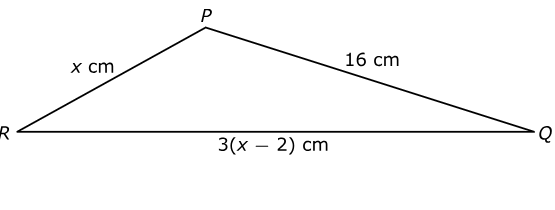
Released STAAR Algebra I EOC · 2026 · Item 17 · 2 points
The perimeter of triangle is centimeters. What are the lengths of and in centimeters?
Show STAAR answer and explanation
cm and cm
The perimeter equation is , which simplifies to , so . Therefore cm and cm.
Released STAAR Algebra I EOC · 2025 · Item 29 · 1 point
What value of makes the equation true?
Show STAAR answer and explanation
Distribute −4: . Add to both sides: . Subtract 6: , so .
: Only the first term in the parentheses was multiplied by −4, giving .
: Only the first term was multiplied, and by 4 instead of −4.
: Inverse operations were not used when moving terms across the equal sign, giving .
Released STAAR Algebra I EOC · 2025 · Item 46 · 1 point
Which value of makes this equation true?
Show STAAR answer and explanation
Multiply both sides by 10: , so . Subtract and add 12: , so .
: Only the first term in each set of parentheses was multiplied, giving .
: Terms were moved across the equal sign without inverse operations, giving .
: The denominators were added to the constants instead of multiplied, and terms were moved without inverse operations.
Released STAAR Algebra I EOC · 2026 · Item 36 · 1 point
What value of makes this equation true?
- –11
- –24
Show STAAR answer and explanation
–24
Distribute: . Subtract and 6 from both sides: .
–11: Only the first term in each set of parentheses was multiplied, giving .
: Terms were moved across the equal sign without inverse operations, giving .
: Only the first terms were multiplied, and terms were moved without inverse operations, giving .
Learning objectives
By the end of the lesson, students can:
- Simplify each side using the distributive property and like terms.
- Use inverse operations on both sides to isolate the variable.
- Check a solution by substitution and explain each equivalence-preserving step.
Instructional sequence
- 1
Engage
5 minUse a balance to ask why the same operation must be applied to both sides of an equation.
- 2
Direct instruction
12 minModel simplify each side → collect variable terms → collect constants → divide by the coefficient. Distribute to every term before moving anything.
- 3
Faded example
13 minSolve together, gradually hiding steps until students supply the operation and resulting equation.
- 4
Error analysis
12 minDiagnose incomplete distribution, sign errors, and dividing only one side; then check corrected solutions by substitution.
- 5
Closure
8 minComplete one mixed equation independently and annotate the reason for each step.
Misconceptions to address
Teacher move: Show the underlying operation performed on both sides; the shortcut is a record of that operation.
Teacher move: Use an area model or arrows to show distribution to every term.