

Domain and Range
Identify domains and ranges of functions and find corresponding values from rules and graphs.
Students connect domain inputs to range outputs by evaluating rules and reading the horizontal and vertical extent of graphs.
Lesson plan and worked examples by TEKSForge · not a TEA-issued lesson. Videos by independent educators.
Archived course: TEKS code and readiness label from TEA's 2013 Algebra II key. Algebra II is not one of Texas's current required STAAR EOC assessments, and this lesson does not change the Biology and Algebra I Study Plans.
Learn the concept
Inputs and outputs
The domain consists of allowed inputs, usually x-values. The range consists of actual outputs, usually y-values. A point means that input a corresponds to output b.
Evaluate the whole rule
To find , replace every x with a, simplify the entire numerator, and then divide. Finding an output is not the same as solving for an input.
Read the extent of a graph
Scan left to right for the domain and bottom to top for the range. A closed endpoint is included; an open endpoint is excluded unless another point supplies that coordinate. An open right endpoint can give an upper bound without a greatest domain element.
Study released STAAR visuals
Use the original graphs, tables, and diagrams from released STAAR questions to practice reading labels, values, and relationships before answering the items below.
Archived released STAAR Algebra II EOC · 2013 · Item 47 · 1 point
Worked example
For , find the output for input 4. Then find the domain of the line segment with closed endpoints and .
- Substitute: .
- Simplify: .
- The segment covers all horizontal coordinates from to 9 and includes both endpoints.
The output is 3.8; the segment has domain and greatest domain value 9.
Watch the lesson
Texas public-school, Texas educator-created, and TEKS-aligned lessons, hosted by their creators. Each card names its source.
Algebra 2 Identifying Parent Functions
UT IPSI · Kid2Kid / Texas Education AgencyReview graph features and input-output relationships before reading domain and range.
Watch on YouTubeTry it yourself
TEKSForge practice · unscored
1. Find if .
Show answer and reasoning
.
2. A line segment runs from an open point to a closed point . State its domain and range.
Show answer and reasoning
Domain: ; range: .
Project the segment onto each axis. The closed point includes 7 and ; the open point excludes 1 and 8.
Released STAAR practice
Texas Education Agency · archived 2013 released EOC items · scored with TEA's answer key; step-by-step explanations written by TEKSForge because this release has no rationales. Original graphs, tables, and diagrams are shown where the released item includes one.
Archived released STAAR Algebra II EOC · 2013 · Item 24 · 1 point
If 5 is an element in the domain of , what is the corresponding element in the range? Record your answer.
Show STAAR answer and explanation
3.25
Evaluate the function at the domain value: .
13: 13 is the numerator; divide by 4 to get the range value 3.25.
Archived released STAAR Algebra II EOC · 2013 · Item 47 · 1 point
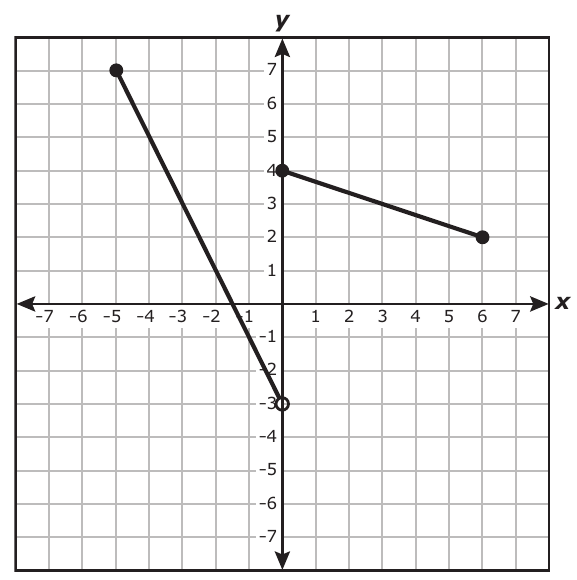
What is the greatest value in the domain of the function graphed on the grid?
- 2
- 6
- 4
- 7
Show STAAR answer and explanation
6
The domain is the set of x-values. The graph runs from the closed dot at to the closed dot at , so the greatest x-value is 6.
2: 2 is the y-value of the right endpoint, which belongs to the range.
4: 4 is a y-value, where the right segment meets the y-axis.
7: 7 is the greatest y-value, part of the range rather than the domain.
Learning objectives
By the end of the lesson, students can:
- Distinguish domain values from range values.
- Evaluate a function at a specified input.
- Read graph endpoints to identify domain limits.
Instructional sequence
- 1
Engage
5 minSort ordered-pair coordinates into inputs and outputs.
- 2
Direct instruction
10 minModel substitution using parentheses and the order of operations.
- 3
Guided practice
13 minEvaluate rational linear rules and compare input-output pairs.
- 4
Compare and verify
15 minProject graph points onto each axis and discuss endpoint inclusion.
- 5
Closure
7 minExplain the greatest domain value and complete the exit ticket.
Misconceptions to address
Teacher move: Domain uses horizontal coordinates; locate the farthest-right point.
Teacher move: A fraction bar groups the numerator; finish the division.