

Modeling with Systems
Represent constraints with systems of equations and inequalities.
Students translate real-world limits into systems of equations and inequalities, defining variables, reading diagrams carefully, and including the constraints a context implies.
Lesson plan and worked examples by TEKSForge · not a TEA-issued lesson. Videos by independent educators.
Archived course: TEKS code and readiness label from TEA's 2013 Algebra II key. Algebra II is not one of Texas's current required STAAR EOC assessments, and this lesson does not change the Biology and Algebra I Study Plans.
Learn the concept
Define first
Name each variable and its unit, such as “a = number of adult tickets” or “w = width in feet.” Clear definitions prevent mixing quantities that cannot be added, such as feet and square feet.
Translate each limit
“At most” and “no more than” mean ≤. “At least” and “no less than” mean ≥. “Less than” and “more than” are strict, so use < or >. Each separate condition in the context becomes its own equation or inequality.
Use the diagram and context
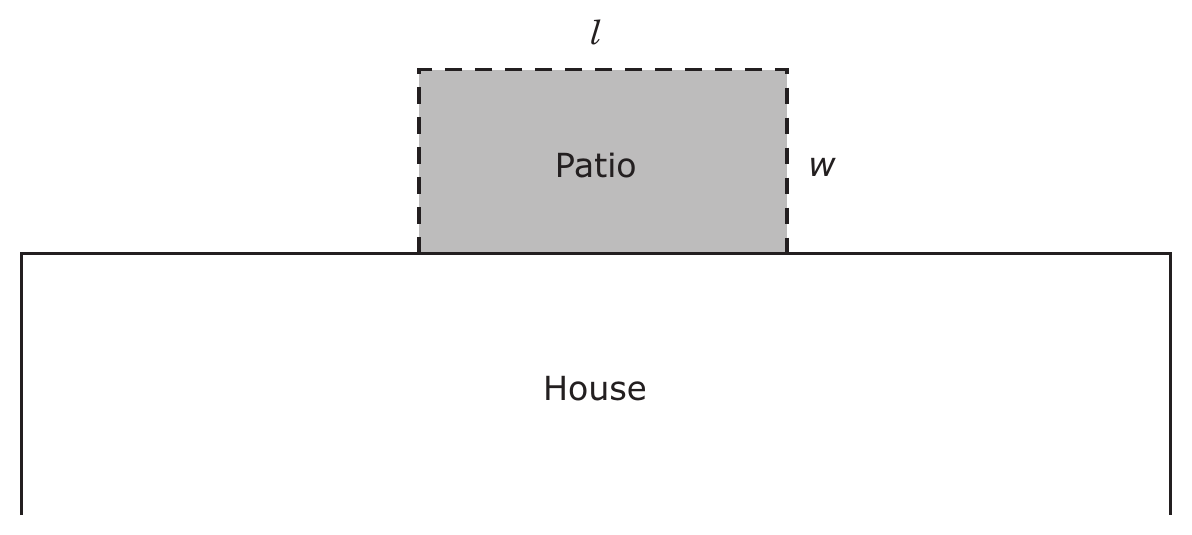
For a rectangle fenced on three sides, the fence may be or , depending on which side is open. Area is . Lengths and counts cannot be negative, and counts of objects must be whole numbers.
Study released STAAR visuals
Use the original graphs, tables, and diagrams from released STAAR questions to practice reading labels, values, and relationships before answering the items below.
Archived released STAAR Algebra II EOC · 2013 · Item 3 · 1 point
Worked example
A school sells adult tickets for 8 dollars and student tickets for 5 dollars. It can sell at most 300 tickets and needs at least 1,800 dollars. Write the system.
- Let a be the number of adult tickets and s the number of student tickets.
- The ticket limit gives .
- The revenue goal gives .
- Counts cannot be negative: and .
, , ,
Watch the lesson
Texas public-school, Texas educator-created, and TEKS-aligned lessons, hosted by their creators. Each card names its source.
Algebra 2 Formulating Systems of Equations
UT IPSI · Kid2Kid / Texas Education AgencyDefine variables and write systems that model the conditions in real-world situations.
Watch on YouTubeTry it yourself
TEKSForge practice · unscored
1. A rectangular garden uses a house wall as one length and fencing on the other three sides. There are at most 50 feet of fencing. Write the fencing constraint.
Show answer and reasoning
The fence covers one length and two widths. “At most” includes 50, so the symbol is ≤.
2. A bakery makes muffins, m, taking 2 minutes each, and cookies, c, taking 1 minute each. It has at most 120 minutes and needs at least 30 items. Write the system.
Show answer and reasoning
and
One inequality limits time and the other sets the minimum number of items. Both variables must also be nonnegative whole numbers.
Released STAAR practice
Texas Education Agency · archived 2013 released EOC items · scored with TEA's answer key; step-by-step explanations written by TEKSForge because this release has no rationales. Original graphs, tables, and diagrams are shown where the released item includes one.
Archived released STAAR Algebra II EOC · 2013 · Item 3 · 1 point
The rectangular patio shown in the diagram is enclosed on three sides by a fence. The area is no more than 400 square feet, and the total length of the three fenced sides is no more than 60 feet. Which system of inequalities can be used to find values of , the patio's length, and , the patio's width, that satisfy these conditions?
- and
- and
- and
- and
Show STAAR answer and explanation
and
Only one length and two widths are fenced, so the fence constraint is . Rectangular area is , and ‘no more than 400’ means .
and : This counts all four sides of the rectangle, but the house replaces one length of fence.
and : ‘No more than’ requires ≤, not ≥, for both the fence length and area.
and : This counts four fenced sides and reverses both upper-bound inequalities.
Archived released STAAR Algebra II EOC · 2013 · Item 34 · 1 point
The hypotenuse of a right triangle is 17 inches long. A leg of this triangle, , is 1 inch less than twice the length of the other leg, . Which system of equations can be used to determine the lengths of the 2 legs of this right triangle in inches?
- and
- and
- and
- and
Show STAAR answer and explanation
and
The Pythagorean theorem gives . “1 inch less than twice x” is . (The legs are 8 and 15 inches.)
and : says a sum equals 1, not that y is 1 less than twice x.
and : The legs of a right triangle do not add to the hypotenuse; use the Pythagorean theorem.
and : Both equations misstate the relationships in the problem.
Learning objectives
By the end of the lesson, students can:
- Define variables with units before writing any equation or inequality.
- Translate phrases such as “no more than,” “at least,” and “less than” into inequality symbols.
- Use a diagram to decide which measurements belong in each constraint.
Instructional sequence
- 1
Engage
5 minShow a rectangle fenced on three sides against a wall. Ask which sides the fence actually covers.
- 2
Vocabulary sort
10 minSort phrases into ≤, ≥, <, >, and = categories, then write one example for each.
- 3
Guided modeling
15 minModel a ticket-sales problem: define variables, write the count and revenue constraints, then add nonnegative constraints.
- 4
Diagram practice
13 minPairs write area and fencing constraints for three-sided and four-sided enclosures, justifying each term from the diagram.
- 5
Closure
7 minStudents explain one constraint in words and complete the exit ticket.
Misconceptions to address
Teacher move: “No more than” allows the limit itself, so use ≤. Test the value 60 to show it is allowed.
Teacher move: Read the diagram. A side against a wall or building is not fenced, so the perimeter expression changes.