

Testing Solutions to Systems
Use graphs and substitution to test whether ordered pairs satisfy a system of inequalities.
Students decide whether proposed solutions satisfy every condition in a system of inequalities, using substitution, graphs, and the practical limits of a context.
Lesson plan and worked examples by TEKSForge · not a TEA-issued lesson. Videos by independent educators.
Archived course: TEKS code and readiness label from TEA's 2013 Algebra II key. Algebra II is not one of Texas's current required STAAR EOC assessments, and this lesson does not change the Biology and Algebra I Study Plans.
Learn the concept
Every condition must hold
A system of inequalities lists several conditions at once. An ordered pair is a solution only when it makes every inequality true. Checking one condition is not enough.
Use the graph
Solutions lie where the shaded regions overlap. A solid boundary includes its points; a dashed boundary does not. If a point is near a boundary, use substitution to decide.
Context limits
In many situations, variables count objects, so they must be nonnegative whole numbers. A point can satisfy the algebra but still be unreasonable, such as making 6.5 bracelets.
Study released STAAR visuals
Use the original graphs, tables, and diagrams from released STAAR questions to practice reading labels, values, and relationships before answering the items below.
Archived released STAAR Algebra II EOC · 2013 · Item 11 · 1 point
Worked example
A budget gives , and a design rule gives . Test and .
- For : and . Both are true.
- For : , but is false.
- Only the pair that passes both checks is a solution.
is a solution; is not.
Watch the lesson
Texas public-school, Texas educator-created, and TEKS-aligned lessons, hosted by their creators. Each card names its source.
Algebra 2 Solving Systems of Equations Using Graphs
UT IPSI · Kid2Kid / Texas Education AgencyUse graphs to find and check solutions that satisfy every equation in a system.
Watch on YouTubeAlgebra 1 STAAR Practice Solutions for Systems of Inequalities (A.3H - #4)
Five Minute Math · Aaron Daffern, Dallas ISDDecide which ordered pairs lie in the solution region of a system of inequalities.
Watch on YouTubeTry it yourself
TEKSForge practice · unscored
1. Is a solution to and ?
Show answer and reasoning
Yes
, and . Both inequalities are satisfied.
2. Why might be unreasonable when x counts shirts and y counts hats?
Show answer and reasoning
A store cannot sell half a shirt.
The variables count whole items, so a solution must use whole numbers even if the fraction satisfies the inequalities.
Released STAAR practice
Texas Education Agency · archived 2013 released EOC items · scored with TEA's answer key; step-by-step explanations written by TEKSForge because this release has no rationales. Original graphs, tables, and diagrams are shown where the released item includes one.
Archived released STAAR Algebra II EOC · 2013 · Item 11 · 1 point
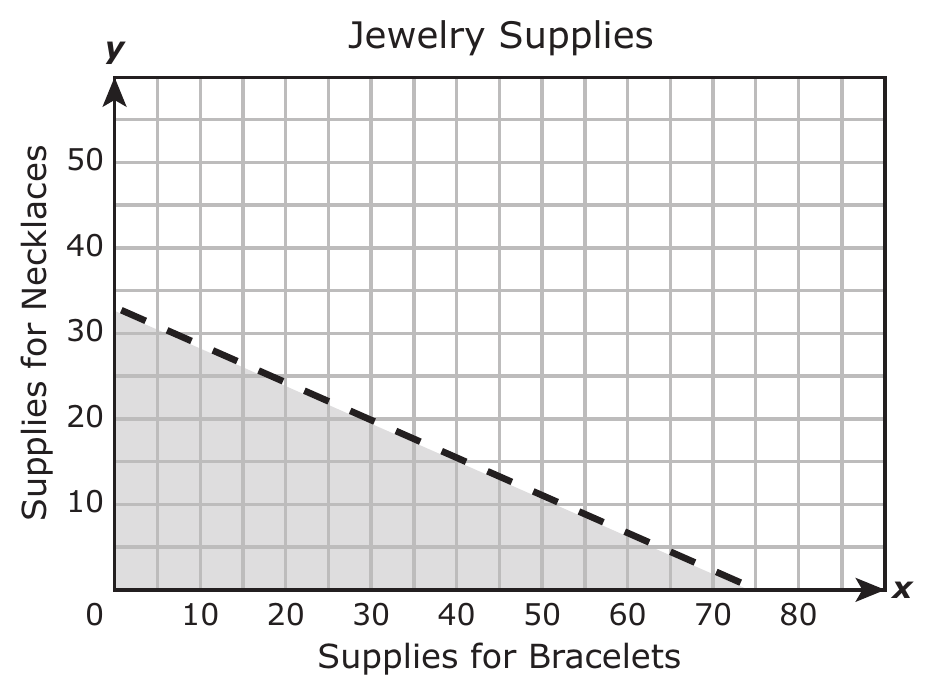
A craftsman wants to spend less than $300 on supplies for making bracelets and necklaces. Supplies for 1 bracelet cost $4, and supplies for 1 necklace cost $9. The relationship is shown in the graph. The craftsman wants to make at least 10 more bracelets than necklaces. Which of the following is a reasonable solution?
- 25 bracelets and 20 necklaces
- 30 bracelets and 15 necklaces
- 40 bracelets and 20 necklaces
- 15 bracelets and 25 necklaces
Show STAAR answer and explanation
30 bracelets and 15 necklaces
For 30 bracelets and 15 necklaces, the cost is , and . It satisfies both conditions.
25 bracelets and 20 necklaces: The cost is within budget, but 25 − 20 = 5, so there are not at least 10 more bracelets than necklaces.
40 bracelets and 20 necklaces: The bracelet difference is 20, but the cost is , which exceeds $300.
15 bracelets and 25 necklaces: There are 10 fewer bracelets than necklaces, not at least 10 more.
Archived released STAAR Algebra II EOC · 2013 · Item 37 · 1 point
Each year an architecture firm employs senior interns and junior interns. Senior interns receive $400 per week, and junior interns receive $300 per week. This year a minimum of 7 but no more than 13 interns will be hired. The amount spent per week on interns cannot exceed $4,000. Which statement about this situation is not true?
- The architecture firm can employ 13 junior interns.
- The architecture firm can employ 4 senior interns and 7 junior interns.
- If both types of interns are hired, the firm will spend a minimum of $2,200 per week on interns.
- If both types of interns are hired, the firm will spend a maximum of $3,800 per week on interns.
Show STAAR answer and explanation
If both types of interns are hired, the firm will spend a maximum of $3,800 per week on interns.
The constraints are and . With both types hired, 7 senior and 4 junior interns cost dollars, which is allowed. The maximum is therefore $4,000, not $3,800, so statement D is not true.
The architecture firm can employ 13 junior interns.: This is true: 13 junior interns cost $3,900, within the budget and the 13-intern limit.
The architecture firm can employ 4 senior interns and 7 junior interns.: This is true: 11 interns cost dollars.
If both types of interns are hired, the firm will spend a minimum of $2,200 per week on interns.: This is true: the cheapest mix of at least 7 interns with both types is 1 senior and 6 junior interns, costing $2,200.
Learning objectives
By the end of the lesson, students can:
- Test ordered pairs in every inequality of a system.
- Locate solutions in the overlapping region of a graph and interpret dashed and solid boundaries.
- Judge whether a mathematical solution is reasonable in context.
Instructional sequence
- 1
Engage
5 minGive a shopping budget and a quantity rule. Ask whether a proposed purchase follows both rules.
- 2
Direct instruction
10 minModel substituting an ordered pair into each inequality and recording ✓ or ✗ for each one.
- 3
Graph check
12 minLocate test points on graphs, focusing on the overlap and on points along dashed or solid boundaries.
- 4
Reasonableness
12 minSort solutions that satisfy the algebra but fail the context, such as negative or fractional item counts.
- 5
Closure
6 minStudents justify one accepted and one rejected pair in the exit ticket.
Misconceptions to address
Teacher move: A solution to a system must satisfy every inequality. Use a checklist and require a check for each one.
Teacher move: A dashed line represents a strict inequality, so its points are not included.