

Composite Transformations
Describe translated function graphs using function notation.
Students describe translated graphs with function notation, tracking a key point to write and explaining why horizontal shifts appear opposite inside parentheses.
Lesson plan and worked examples by TEKSForge · not a TEA-issued lesson. Videos by independent educators.
Archived course: TEKS code and readiness label from TEA's 2013 Algebra II key. Algebra II is not one of Texas's current required STAAR EOC assessments, and this lesson does not change the Biology and Algebra I Study Plans.
Learn the concept
Horizontal shifts
In , the graph moves right c units when c is positive. In , it moves left c units. The change is inside the function because it affects the input.
Vertical shifts
In , every output increases by d, so the graph moves up d units. Subtracting d moves the graph down.
Track one key point
Find a matching point on both graphs. The horizontal change gives c, and the vertical change gives d. If a vertex moves from to , then .
Study released STAAR visuals
Use the original graphs, tables, and diagrams from released STAAR questions to practice reading labels, values, and relationships before answering the items below.
Archived released STAAR Algebra II EOC · 2013 · Item 10 · 1 point
Worked example
Graph g has vertex (1, 2). Graph h has the same shape and vertex (−3, 5). Write h(x) in terms of g(x).
- Horizontal change: −3 − 1 = −4, so the graph moves left 4.
- A left shift of 4 is written inside as .
- Vertical change: 5 − 2 = 3, so add 3 outside.
- Check: .
Watch the lesson
Texas public-school, Texas educator-created, and TEKS-aligned lessons, hosted by their creators. Each card names its source.
Algebra 2 Identifying Parent Functions
UT IPSI · Kid2Kid / Texas Education AgencyRecognize parent-function graphs before describing their transformations.
Watch on YouTubeAlgebra 2 Connecting Quadratic and Square Root Functions
UT IPSI · Kid2Kid / Texas Education AgencyCompare related function graphs and the changes that connect them.
Watch on YouTubeTry it yourself
TEKSForge practice · unscored
1. Describe the graph of .
Show answer and reasoning
The graph of g moves right 2 and down 6.
Subtracting 2 inside moves the graph right. Subtracting 6 outside lowers every output by 6.
2. Graph h is graph g shifted left 5 and down 1. Write h(x).
Show answer and reasoning
A left shift appears as adding inside the function; a downward shift appears as subtracting outside.
Released STAAR practice
Texas Education Agency · archived 2013 released EOC items · scored with TEA's answer key; step-by-step explanations written by TEKSForge because this release has no rationales. Original graphs, tables, and diagrams are shown where the released item includes one.
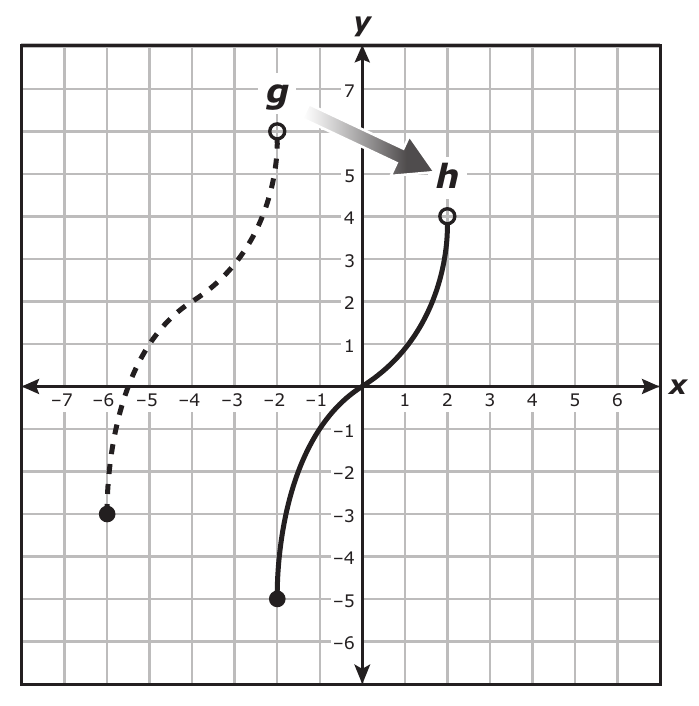
Archived released STAAR Algebra II EOC · 2013 · Item 10 · 1 point
The graph of function was obtained from the graph of function using a composite transformation, as shown. Which equation can be used to describe in terms of ?
Show STAAR answer and explanation
Each point on g moves 4 units right and 2 units down to reach h. A right shift of 4 uses , and a downward shift of 2 subtracts 2 outside the function.
: shifts left, and adding 2 shifts up; both directions are reversed.
: The vertical shift is correct, but moves the graph left rather than right.
: The horizontal shift is correct, but adding 2 moves the graph up rather than down.
Archived released STAAR Algebra II EOC · 2013 · Item 29 · 1 point
For the functions and , which statement is true if ?
- The graph of is the result of the graph of being translated right 14 units and down 12 units.
- The graph of is the result of the graph of being translated left 14 units and down 12 units.
- The graph of is the result of the graph of being translated right 14 units and up 12 units.
- The graph of is the result of the graph of being translated left 14 units and up 12 units.
Show STAAR answer and explanation
The graph of is the result of the graph of being translated left 14 units and down 12 units.
Adding 14 inside the function, , shifts the graph left 14 units. Subtracting 12 outside the function shifts it down 12 units.
The graph of is the result of the graph of being translated right 14 units and down 12 units.: inside the function shifts left, not right.
The graph of is the result of the graph of being translated right 14 units and up 12 units.: Both directions are reversed: inside moves left and outside moves down.
The graph of is the result of the graph of being translated left 14 units and up 12 units.: Subtracting 12 outside the function moves the graph down, not up.
Learning objectives
By the end of the lesson, students can:
- Describe the graph of as a horizontal and vertical translation of g.
- Track a key point to find the horizontal and vertical shifts between two graphs.
- Write the transformed function in terms of the original function.
Instructional sequence
- 1
Engage
5 minShow the same graph in two positions. Ask how to describe the move with only one point.
- 2
Direct instruction
10 minUse a table to show that needs inputs 3 units larger, which moves the graph right.
- 3
Guided practice
12 minTrack vertices or corners from g to h and record the horizontal and vertical changes.
- 4
Write and verify
12 minWrite h(x) in function notation, then substitute a key x-value to confirm the matching output.
- 5
Closure
6 minComplete the exit ticket using a mapping table.
Misconceptions to address
Teacher move: Inside the function, the input changes. To get the same output, x must be 2 larger, so the graph moves right 2.
Teacher move: A vertical shift changes outputs, so it is added outside: .