

Conics from a Double Cone
Describe a conic section as the intersection of a plane and a double cone.
Students classify nondegenerate conic sections by how a slicing plane intersects a double cone, emphasizing the two nappes of a hyperbola.
Lesson plan and worked examples by TEKSForge · not a TEA-issued lesson. Videos by independent educators.
Archived course: TEKS code and readiness label from TEA's 2013 Algebra II key. Algebra II is not one of Texas's current required STAAR EOC assessments, and this lesson does not change the Biology and Algebra I Study Plans.
Learn the concept
A curve from an intersection
A conic section is the curve where a plane intersects the surface of a double cone. The upper and lower halves are called nappes. Here the plane does not pass through the vertex, so the sections are nondegenerate.
Slices meeting one nappe
A plane perpendicular to the cone’s axis produces a circle. Tilting that plane while keeping a bounded section on one nappe produces a noncircular ellipse. A plane parallel to a slant edge produces a parabola when it cuts one nappe and avoids the vertex.
Slices meeting both nappes
A plane cutting both nappes produces a hyperbola. A plane parallel to the axis and offset from it is one example. The resulting two branches belong to one conic in the slicing plane, not to two separate planes.
Study released STAAR visuals
Use the original graphs, tables, and diagrams from released STAAR questions to practice reading labels, values, and relationships before answering the items below.
Archived released STAAR Algebra II EOC · 2013 · Item 36 · 1 point
Worked example
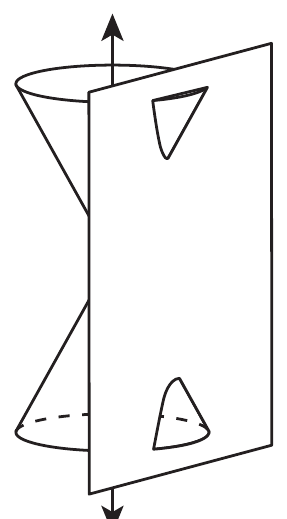
A plane runs parallel to the axis of a double cone, is offset from the axis, and intersects both nappes without passing through the vertex. Classify the section.
- The plane avoids the vertex, so the section is nondegenerate.
- It cuts both nappes rather than making a closed curve on one nappe.
- The two intersections form two branches in the slicing plane.
The section is a hyperbola.
Watch the lesson
Texas public-school, Texas educator-created, and TEKS-aligned lessons, hosted by their creators. Each card names its source.
Algebra 2 Identifying Parent Functions
UT IPSI · Kid2Kid / Texas Education AgencyReview the quadratic parent’s parabola shape as a prerequisite; use the cone model for the other conic sections.
Watch on YouTubeTry it yourself
TEKSForge practice · unscored
1. A plane perpendicular to the axis cuts one nappe away from the vertex. What section results?
Show answer and reasoning
A circle.
The perpendicular slice stays at a constant distance along the axis and produces a circular cross section.
2. A plane avoids the vertex, is parallel to a slant edge, and cuts just one nappe. What section results?
Show answer and reasoning
A parabola.
Parallelism to a generator, or slant edge, characterizes the nondegenerate parabolic slice.
Released STAAR practice
Texas Education Agency · archived 2013 released EOC items · scored with TEA's answer key; step-by-step explanations written by TEKSForge because this release has no rationales. Original graphs, tables, and diagrams are shown where the released item includes one.
Archived released STAAR Algebra II EOC · 2013 · Item 36 · 1 point
A plane intersects a double cone as shown. What conic section is created by this intersection?
- Circle
- Ellipse
- Hyperbola
- Parabola
Show STAAR answer and explanation
Hyperbola
The plane is parallel to the axis of the double cone and cuts through both nappes (the upper and lower cones). A plane that intersects both nappes creates a hyperbola, which has two separate branches.
Circle: A circle comes from a plane perpendicular to the axis that cuts only one nappe.
Ellipse: An ellipse is a closed curve formed on one nappe; this plane cuts both nappes.
Parabola: A parabola comes from a plane parallel to a slant edge of the cone, cutting only one nappe.
Learning objectives
By the end of the lesson, students can:
- Identify the axis, vertex, and nappes of a double cone.
- Classify a section by the orientation of its slicing plane.
- Explain why a hyperbola has two branches.
Instructional sequence
- 1
Engage
5 minImagine sliding a plane through a double cone.
- 2
Direct instruction
10 minName the axis, vertex, slant edge, and nappes.
- 3
Guided practice
13 minCompare nondegenerate slices producing the four conic types.
- 4
Compare and verify
15 minSort descriptions and justify each choice by nappe count and plane angle.
- 5
Closure
7 minExplain a two-nappe slice on the exit ticket.
Misconceptions to address
Teacher move: A steeper slice may produce a parabola or cut both nappes to make a hyperbola.
Teacher move: One plane intersects both nappes, creating two branches in that same plane.