

Conic Parameter Changes
Relate changes in the parameters of a conic equation to changes in its graph.
Students use square roots of ellipse denominators to locate intercepts and predict how exchanging parameters changes orientation.
Lesson plan and worked examples by TEKSForge · not a TEA-issued lesson. Videos by independent educators.
Archived course: TEKS code and readiness label from TEA's 2013 Algebra II key. Algebra II is not one of Texas's current required STAAR EOC assessments, and this lesson does not change the Biology and Algebra I Study Plans.
Learn the concept
Read denominators by variable
For with positive p and q, the center is the origin. The horizontal semiaxis has length p and the vertical semiaxis has length q.
Derive intercepts
Set to get . Set to get . The larger semiaxis gives the major-axis direction; full axis lengths are and .
Exchange the parameters
Swapping the denominators exchanges the horizontal and vertical semiaxis lengths but preserves the center and both lengths. With unequal lengths, a horizontal ellipse becomes vertical or vice versa. Equal denominators already describe a circle.
Study released STAAR visuals
Use the original graphs, tables, and diagrams from released STAAR questions to practice reading labels, values, and relationships before answering the items below.
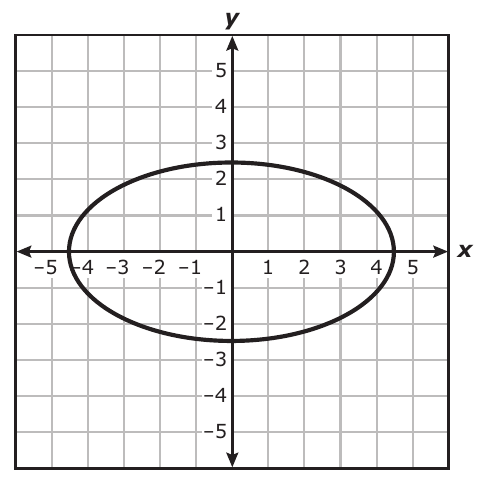
Archived released STAAR Algebra II EOC · 2013 · Item 14 · 1 point
Worked example
Compare with .
- The original intercepts are and .
- The new intercepts are and .
- The center stays and the semiaxis lengths stay 8 and 3, but their directions exchange.
The horizontal ellipse becomes a vertical ellipse with major-axis length 16 and minor-axis length 6.
Watch the lesson
Texas public-school, Texas educator-created, and TEKS-aligned lessons, hosted by their creators. Each card names its source.
Algebra 2 Functions and Their Inverses
UT IPSI · Kid2Kid / Texas Education AgencyReview how swapping coordinates reflects a relation across y = x; apply the same point swap to centered ellipses.
Watch on YouTubeTry it yourself
TEKSForge practice · unscored
1. Find the intercepts of .
Show answer and reasoning
and .
Take the square root of each denominator for the corresponding intercept magnitudes.
2. If the denominators in are swapped, does the graph become a circle?
Show answer and reasoning
No; it becomes a vertical ellipse.
The new semiaxes are 2 horizontally and 6 vertically. A circle would require equal denominators.
Released STAAR practice
Texas Education Agency · archived 2013 released EOC items · scored with TEA's answer key; step-by-step explanations written by TEKSForge because this release has no rationales. Original graphs, tables, and diagrams are shown where the released item includes one.
Archived released STAAR Algebra II EOC · 2013 · Item 14 · 1 point
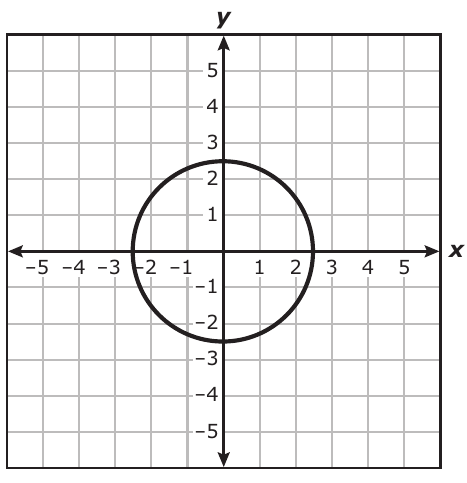
An equation in the form is graphed. If the values of and remain the same, which graph best represents ?
- Graph F
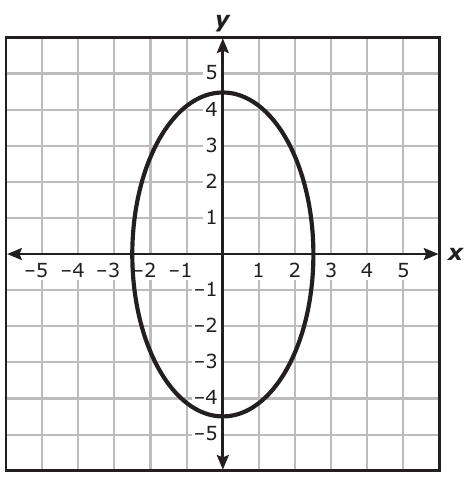
- Graph G
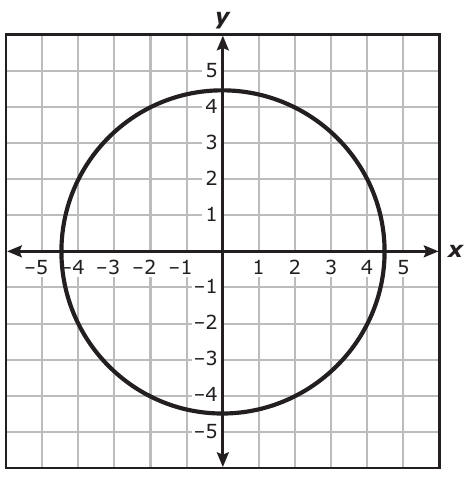
- Graph H
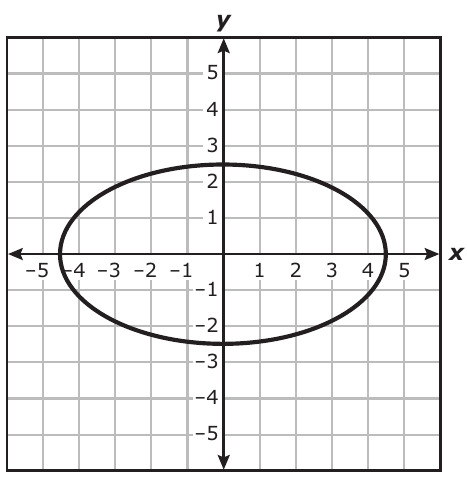
- Graph J
Show STAAR answer and explanation
Graph F
The original ellipse has x-intercepts near and y-intercepts near , so and . Swapping the denominators puts under and under , so the new ellipse has x-intercepts near and y-intercepts near : the vertical ellipse in Graph F.
Graph G: A circle needs equal denominators. Swapping a and b keeps them unequal, so the graph remains an ellipse.
Graph H: Graph H is the original ellipse. Swapping the denominators exchanges the horizontal and vertical intercepts.
Graph J: This circle uses about 2.5 in every direction; the y-intercepts should move out to about .
Learning objectives
By the end of the lesson, students can:
- Find horizontal and vertical intercepts of a centered ellipse.
- Distinguish semiaxis lengths from their squares.
- Predict the result of swapping ellipse denominators.
Instructional sequence
- 1
Engage
5 minCompare a wide ellipse with a tall ellipse.
- 2
Direct instruction
10 minSet one coordinate to zero to derive each pair of intercepts.
- 3
Guided practice
13 minSketch centered ellipses from their denominators.
- 4
Compare and verify
15 minSwap denominators and track which intercepts change.
- 5
Closure
7 minExplain orientation without relying on appearance alone.
Misconceptions to address
Teacher move: The denominator is a squared semiaxis; take its positive square root.
Teacher move: The values remain unequal, so only their coordinate directions change.