

Equivalent Quadratic Forms
Analyze and rewrite quadratic functions, including vertex form.
Students move between vertex form and standard form , using expansion and the vertex to decide when two quadratic rules describe the same graph.
Lesson plan and worked examples by TEKSForge · not a TEA-issued lesson. Videos by independent educators.
Archived course: TEKS code and readiness label from TEA's 2013 Algebra II key. Algebra II is not one of Texas's current required STAAR EOC assessments, and this lesson does not change the Biology and Algebra I Study Plans.
Learn the concept
Read vertex form
In , the vertex is and the axis of symmetry is . If , the parabola opens upward; if , it opens downward. Larger values of make the parabola narrower.
Expand to standard form
To expand , first square: . Then distribute 2 to every term and combine constants. Equivalent forms always keep the same leading coefficient.
Return to vertex form
For , the vertex x-coordinate is . Substitute h to find . You can also complete the square. Expand your answer to verify it matches the original rule.
Study released STAAR visuals
Use the original graphs, tables, and diagrams from released STAAR questions to practice reading labels, values, and relationships before answering the items below.
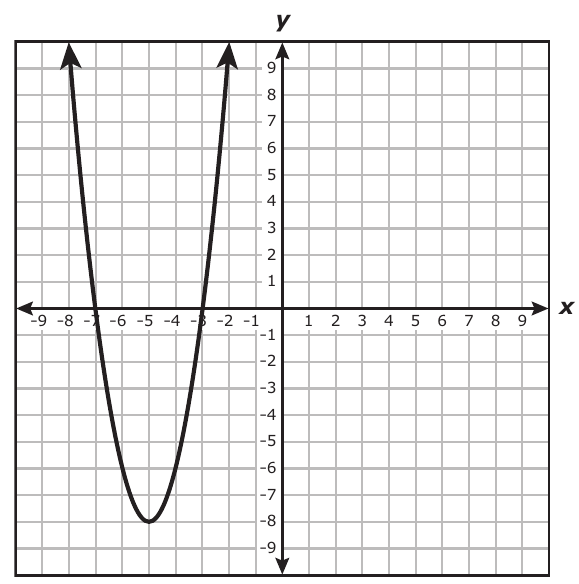
Archived released STAAR Algebra II EOC · 2013 · Item 16 · 1 point
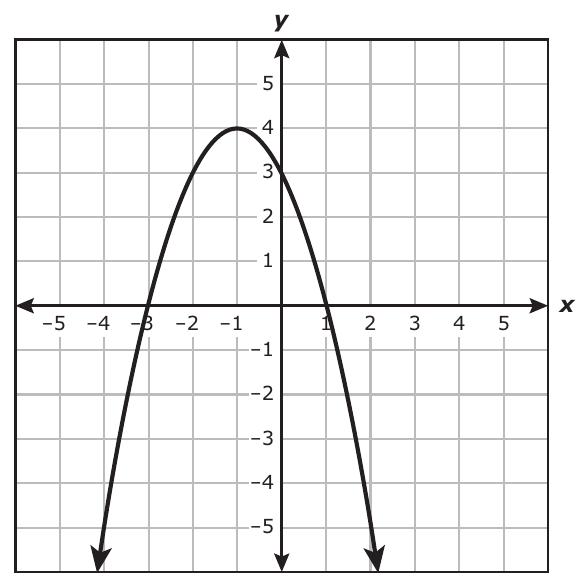
Archived released STAAR Algebra II EOC · 2013 · Item 48 · 1 point
Worked example
For what value of c are and the same graph?
- Square the binomial: .
- Distribute 3: .
- Subtract 7: .
- Both rules now have the same a and b, so their constants must match.
Watch the lesson
Texas public-school, Texas educator-created, and TEKS-aligned lessons, hosted by their creators. Each card names its source.
Algebra 2 Connecting Standard Form to Vertex Form
UT IPSI · Kid2Kid / Texas Education AgencyRewrite quadratic functions between standard and vertex form and connect both forms to the graph.
Watch on YouTubeAlgebra 2 Analyzing Attributes of Graphs of Quadratic Functions
UT IPSI · Kid2Kid / Texas Education AgencyIdentify the vertex, axis of symmetry, and other key attributes of quadratic graphs.
Watch on YouTubeTry it yourself
TEKSForge practice · unscored
1. Expand into standard form.
Show answer and reasoning
. Multiplying by −1 gives , and adding 4 gives .
2. Find the vertex of .
Show answer and reasoning
. Then .
Released STAAR practice
Texas Education Agency · archived 2013 released EOC items · scored with TEA's answer key; step-by-step explanations written by TEKSForge because this release has no rationales. Original graphs, tables, and diagrams are shown where the released item includes one.
Archived released STAAR Algebra II EOC · 2013 · Item 2 · 1 point
For what value of will the graphs of and be the same?
- 63
- −180
- 99
- 144
Show STAAR answer and explanation
144
Expand the vertex form: . Therefore .
63: This would make the constant term 63, but expanding gives 162 − 18 = 144.
99: This subtracts 18 from 117 rather than from .
−180: The squared binomial produces a positive constant before subtracting 18, not a negative constant.
Archived released STAAR Algebra II EOC · 2013 · Item 16 · 1 point
A quadratic function is graphed on the grid. If this function is written in the form , what is the value of ?
- −3
- −8
- 5
- 2
Show STAAR answer and explanation
2
The vertex is , so . The graph crosses the x-axis at : , so and .
5: 5 comes from the vertex x-coordinate, ; it is not a.
−3: −3 is an x-intercept, not the stretch factor. A negative a would make the parabola open downward.
−8: −8 is k, the y-coordinate of the vertex.
Archived released STAAR Algebra II EOC · 2013 · Item 48 · 1 point
A function is graphed on the grid. Which function is best represented by this graph?
Show STAAR answer and explanation
The parabola opens downward with vertex , so . Check the y-intercept: , and the zeros and also match the graph.
: This has vertex , to the right of the y-axis.
: This has its vertex at , not −1.
: This has vertex , not .
Learning objectives
By the end of the lesson, students can:
- Identify the vertex, axis of symmetry, and direction of opening from vertex form.
- Expand vertex form accurately into standard form.
- Use to rewrite standard form in vertex form.
Instructional sequence
- 1
Engage
5 minDisplay and on one graph. Ask why only one parabola appears.
- 2
Direct instruction
12 minName the vertex, axis, and leading coefficient in vertex form. Model squaring the binomial before distributing a.
- 3
Guided practice
13 minExpand three vertex-form rules, then compare the leading coefficient and constant with standard-form rules.
- 4
Reverse the process
13 minFind and to rewrite a standard-form rule. Confirm the result by graphing both forms.
- 5
Closure
7 minStudents match equivalent pairs and complete the exit ticket.
Misconceptions to address
Teacher move: Vertex form subtracts h. Since when , the vertex x-coordinate is 9.
Teacher move: Square the binomial with an area model: . The middle term is required.