

Formulating Quadratic Models
Write quadratic equations and inequalities that model real-world situations.
Students formulate quadratic equations and inequalities from products, consecutive integers, and changing rectangular dimensions.
Lesson plan and worked examples by TEKSForge · not a TEA-issued lesson. Videos by independent educators.
Archived course: TEKS code and readiness label from TEA's 2013 Algebra II key. Algebra II is not one of Texas's current required STAAR EOC assessments, and this lesson does not change the Biology and Algebra I Study Plans.
Learn the concept
Represent the quantities
Consecutive integers are and . Consecutive odd integers, or consecutive even integers, are and , with the appropriate parity restriction on x.
Products create quadratics
A rectangular area is length times width. If a diagram adds x to one dimension and to the other, add each change to its own original dimension before multiplying.
Translate the comparison
“Is” gives an equation. “At most” and “cannot exceed” give ; “at least” gives . Include contextual restrictions such as for an expansion.
Study released STAAR visuals
Use the original graphs, tables, and diagrams from released STAAR questions to practice reading labels, values, and relationships before answering the items below.
Archived released STAAR Algebra II EOC · 2013 · Item 45 · 1 point
Worked example
A 24-foot by 40-foot garden is enlarged by adding x feet to its width and 2x feet to its length. The new area cannot exceed 1,600 square feet. Write an inequality.
- Let x be the nonnegative number of feet added to the width.
- The new width is and the new length is .
- Multiply the dimensions: .
- Use ≤ because the area cannot exceed the stated limit.
, with .
Watch the lesson
Texas public-school, Texas educator-created, and TEKS-aligned lessons, hosted by their creators. Each card names its source.
Algebra 2 Interpreting Quadratic Graphs
UT IPSI · Kid2Kid / Texas Education AgencyConnect quadratic models and their contextual features to graphical representations.
Watch on YouTubeTry it yourself
TEKSForge practice · unscored
1. The product of two consecutive positive odd integers is 195. Let n be the smaller integer. Write an equation.
Show answer and reasoning
, with n a positive odd integer.
The integers differ by 2, and product means multiplication. The model is satisfied by 13 and 15.
2. A 9-meter by 16-meter rectangle gains 2t meters in width and t meters in length. Write a model requiring area greater than 220 square meters.
Show answer and reasoning
, with .
Each change stays with its stated dimension. “Greater than” uses a strict inequality.
Released STAAR practice
Texas Education Agency · archived 2013 released EOC items · scored with TEA's answer key; step-by-step explanations written by TEKSForge because this release has no rationales. Original graphs, tables, and diagrams are shown where the released item includes one.
Archived released STAAR Algebra II EOC · 2013 · Item 23 · 1 point
The product of 2 consecutive odd integers is 483. If represents the smaller integer, which equation can be used to find both integers?
Show STAAR answer and explanation
Consecutive odd integers differ by 2, so the larger integer is and their product is . The integers are 21 and 23.
: is the next integer, which is even when x is odd.
: is even when x is odd; consecutive odd integers are 2 apart.
: Neither factor is x, the smaller integer, and these factors differ by only 1.
Archived released STAAR Algebra II EOC · 2013 · Item 45 · 1 point
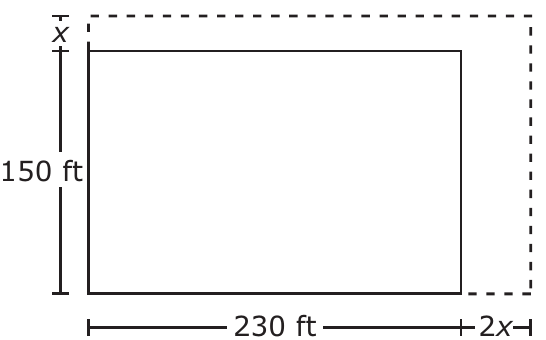
A rectangular parking lot measures 150 feet by 230 feet. The owner of the parking lot will expand the lot's size by adding feet and feet to its dimensions, as shown. If the total area of the parking lot cannot exceed 40,000 square feet, which inequality can be used to find all possible values of ?
Show STAAR answer and explanation
The figure adds to the 230-foot length and to the 150-foot width, so the new area is . “Cannot exceed” means less than or equal to.
: The figure adds 2x to the 230-foot side and x to the 150-foot side, not the reverse.
: “Cannot exceed” means , not .
: Both the side lengths and the inequality symbol are reversed.
Learning objectives
By the end of the lesson, students can:
- Represent consecutive odd or even integers with expressions two apart.
- Write area products using the dimensions indicated by a diagram.
- Translate contextual limits into quadratic inequalities.
Instructional sequence
- 1
Engage
5 minList consecutive odd integers and compare their spacing with consecutive integers.
- 2
Direct instruction
12 minDefine variables and translate products into equations.
- 3
Guided practice
13 minLabel original and expanded rectangle dimensions before writing area expressions.
- 4
Model comparison
13 minCompare models that swap dimension changes or reverse an inequality.
- 5
Closure
7 minStudents explain every factor and inequality symbol in the exit ticket.
Misconceptions to address
Teacher move: Adding 1 changes parity. Consecutive odd integers differ by 2.
Teacher move: It sets an upper limit, so use less than or equal to.