

Biomolecules
Relate the structure of carbohydrates, lipids, proteins, and nucleic acids to their functions in cells.
Students connect the monomers and chemical structures of carbohydrates, lipids, proteins, and nucleic acids to their cellular functions, then use those connections to explain real examples.
Lesson plan and worked examples by TEKSForge · not a TEA-issued lesson. Videos by independent educators.
Learn the concept
Four molecule groups
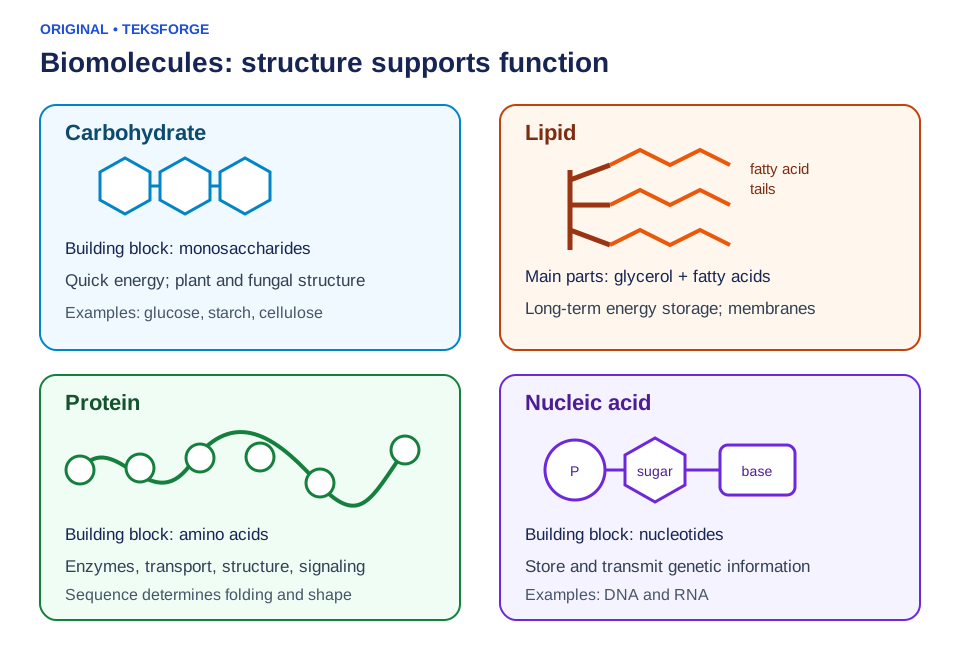
Carbohydrates are built from monosaccharides and supply energy or structure. Lipids include fats made from glycerol and fatty acids; they store energy and form membranes. Proteins are chains of amino acids that fold into enzymes, transporters, and structures. Nucleic acids are nucleotide chains that store or transmit genetic information. Lipids are not repeating-monomer polymers like proteins or nucleic acids.
Structure explains function
A phospholipid has a water-attracting head and water-avoiding tails. In water, these molecules form a bilayer with the tails facing inward. A protein's amino-acid sequence controls interactions that produce its three-dimensional shape; an enzyme needs an appropriate active-site shape to bind its substrate.
Reason from evidence
When a question describes a molecule, identify its building units and then connect them to the stated job. Energy storage alone does not distinguish carbohydrates from lipids; look for information about sugars, fatty acids, or membrane structure.
Visualize the concept
Original TEKSForge instructional diagrams, designed for this TEKS skill and clearly distinguished from released STAAR artwork.
Study released STAAR visuals
Use the original graphs, tables, and diagrams from released STAAR questions to practice reading labels, values, and relationships before answering the items below.
Released STAAR Biology EOC · 2019 · Item 40 · 1 point
Released STAAR Biology EOC · 2019 · Item 50 · 1 point
Released STAAR Biology EOC · 2021 · Item 31 · 1 point
Released STAAR Biology EOC · 2024 · Item 41 · 1 point
Released STAAR Biology EOC · 2025 · Item 44 · 1 point
Worked example
A molecule has a polar head and two nonpolar tails. How does its structure support its cellular job?
- Recognize the head-and-tail structure of a phospholipid.
- In water, polar heads face the watery surroundings and nonpolar tails cluster away from water.
- Two layers form a membrane barrier that separates the cell from its surroundings.
It is a phospholipid whose structure enables membrane bilayer formation.
Watch the lesson
Texas public-school, Texas educator-created, and TEKS-aligned lessons, hosted by their creators. Each card names its source.
Biology: Structure and Function of Biomolecules
UT IPSI · Kid2Kid / Texas Education AgencyCompare the building blocks, structures, and cellular functions of biomolecules.
Watch on YouTubeTry it yourself
TEKSForge practice · unscored
1. A chain of amino acids speeds a cellular reaction. Which biomolecule group is it?
Show answer and reasoning
Protein
Amino acids are protein monomers. A catalytic protein is an enzyme; its folded structure supports substrate binding.
2. Why is DNA classified as a nucleic acid rather than a protein?
Show answer and reasoning
DNA is made of nucleotides, not amino acids.
DNA has a sugar-phosphate backbone and nitrogenous bases. The base sequence stores information; proteins instead use an amino-acid sequence.
Released STAAR practice
Texas Education Agency · released EOC items · explanations adapted from TEA rationales. Original graphs, tables, and diagrams are shown where the released item includes one.
Released STAAR Biology EOC · 2022 · Item 31 · 1 point
Which statements best compare a function of proteins and lipids in a human cell?
- Proteins provide energy for cellular processes. Lipids catalyze chemical reactions inside the cell.
- Proteins catalyze chemical reactions inside the cell. Lipids allow for the transport of certain molecules into and out of the cell.
- Proteins allow for the transport of certain molecules into and out of the cell. Lipids store genetic information for cells.
- Proteins store genetic information for cells. Lipids provide energy for cellular processes.
Show STAAR answer and explanation
Proteins catalyze chemical reactions inside the cell. Lipids allow for the transport of certain molecules into and out of the cell.
Many proteins are enzymes, which catalyze reactions. Lipids make up the cell membrane, which controls which molecules move into and out of the cell.
Proteins provide energy for cellular processes. Lipids catalyze chemical reactions inside the cell.: Proteins (as enzymes), not lipids, catalyze chemical reactions.
Proteins allow for the transport of certain molecules into and out of the cell. Lipids store genetic information for cells.: Lipids store energy, not genetic information.
Proteins store genetic information for cells. Lipids provide energy for cellular processes.: Nucleic acids, not proteins, store genetic information.
Released STAAR Biology EOC · 2019 · Item 40 · 1 point
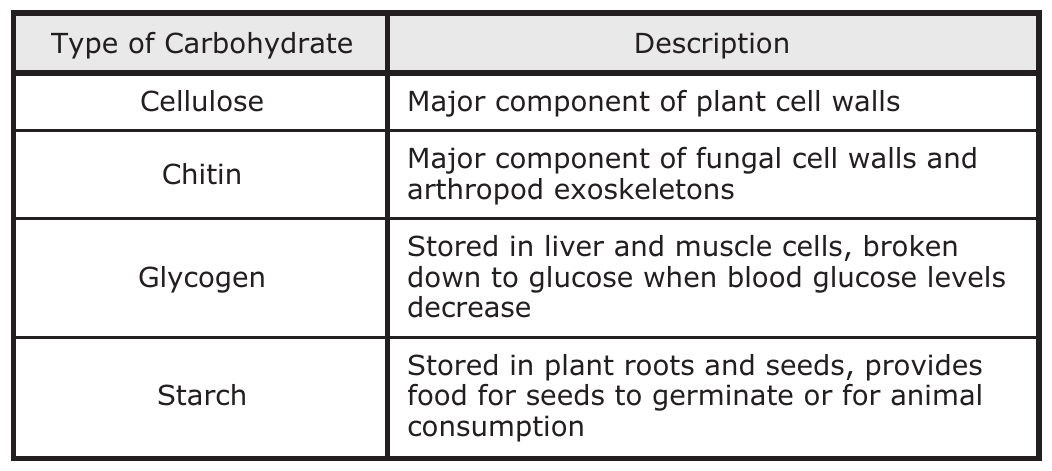
A table of four types of carbohydrates is shown. Which list correctly matches the functions to the types of carbohydrates?
- Energy: glycogen and starch. Structure: cellulose and chitin
- Energy: cellulose and chitin. Structure: glycogen and starch
- Energy: chitin and glycogen. Structure: cellulose and starch
- Energy: cellulose and starch. Structure: chitin and glycogen
Show STAAR answer and explanation
Energy: glycogen and starch. Structure: cellulose and chitin
Glycogen and starch store energy. Cellulose and chitin build structures like cell walls and exoskeletons.
Energy: cellulose and chitin. Structure: glycogen and starch: Cellulose and chitin are structural, and glycogen and starch store energy. This is reversed.
Energy: chitin and glycogen. Structure: cellulose and starch: Chitin is structural, and starch stores energy.
Energy: cellulose and starch. Structure: chitin and glycogen: Cellulose is structural, and glycogen stores energy.
Released STAAR Biology EOC · 2019 · Item 50 · 1 point
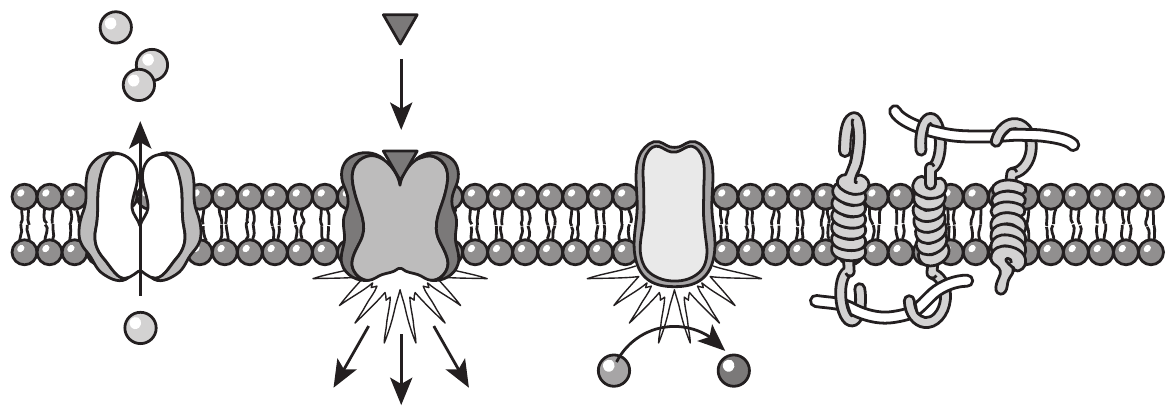
Transmembrane proteins span the width of cell membranes. Four types of transmembrane proteins are shown in a section of cell membrane. Although these proteins have different specific functions, they all —
- stop chemical reactions within the cell
- synthesize molecules that signal other cells
- help the cell interact with its external environment
- remove large waste particles from the cytoplasm of the cell
Show STAAR answer and explanation
help the cell interact with its external environment
Because they span the membrane, transmembrane proteins connect the inside of the cell to the outside. They help the cell interact with molecules and structures in its environment.
stop chemical reactions within the cell: Some membrane proteins help start reactions; they don't all stop them.
synthesize molecules that signal other cells: Signaling molecules are made by organelles inside the cell.
remove large waste particles from the cytoplasm of the cell: Vesicles, not transmembrane proteins, remove large waste particles.
Released STAAR Biology EOC · 2021 · Item 12 · 1 point
Which statements best compare the function of an ATP molecule to a DNA molecule?
- ATP carries and transmits the genetic information of organisms. DNA serves as a biological catalyst that speeds up the rate of chemical reactions.
- ATP provides energy for chemical reactions in the cell. DNA carries and transmits the genetic information of organisms.
- ATP serves as a biological catalyst that speeds up the rate of chemical reactions. DNA acts as a structural sugar in the cell walls of plants.
- ATP acts as a structural sugar in the cell walls of plants. DNA provides energy for chemical reactions in the cell.
Show STAAR answer and explanation
ATP provides energy for chemical reactions in the cell. DNA carries and transmits the genetic information of organisms.
ATP supplies usable energy for cellular reactions; DNA stores and transmits hereditary information.
ATP carries and transmits the genetic information of organisms. DNA serves as a biological catalyst that speeds up the rate of chemical reactions.: DNA carries genetic information, and DNA is not an enzyme catalyst.
ATP serves as a biological catalyst that speeds up the rate of chemical reactions. DNA acts as a structural sugar in the cell walls of plants.: ATP is an energy carrier, not an enzyme, and DNA is not cellulose in cell walls.
ATP acts as a structural sugar in the cell walls of plants. DNA provides energy for chemical reactions in the cell.: The functions are reversed and ATP is not a structural cell-wall sugar.
Released STAAR Biology EOC · 2021 · Item 31 · 1 point
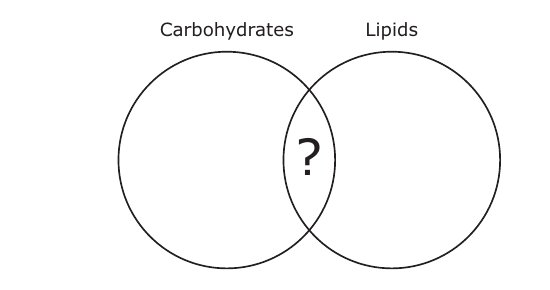
A student makes a Venn diagram to compare the functions of carbohydrates and lipids. Which cellular function of carbohydrates and lipids should be placed in the shared section of the Venn diagram?
- Hormone production
- Structural support of cell walls
- Energy storage
- Catalyst for chemical reactions
Show STAAR answer and explanation
Energy storage
Both carbohydrates and lipids can store chemical energy for cells.
Hormone production: Some lipids function as hormones, but this is not a shared function of carbohydrates and lipids.
Structural support of cell walls: Carbohydrates such as cellulose provide cell-wall support; this is not a shared lipid function.
Catalyst for chemical reactions: Enzyme catalysts are proteins, not carbohydrates or lipids.
Released STAAR Biology EOC · 2024 · Item 41 · 1 point
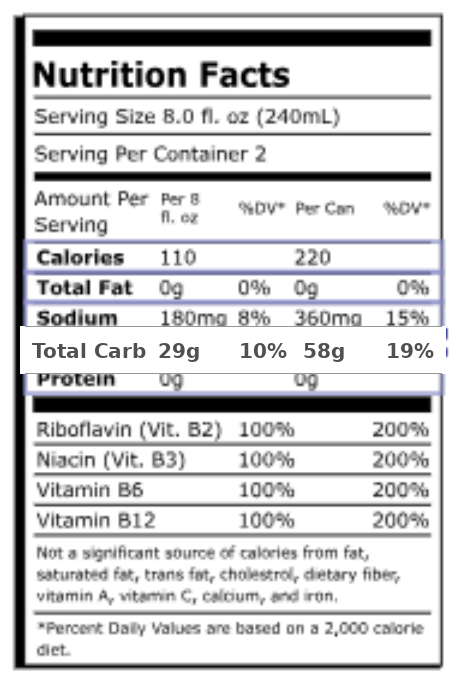
A student athlete wants to choose a drink that will provide quick energy for track practice. Which portion of the label should provide the athlete with information about the amount of quick energy in the drink? Select ONE correct answer.
Show STAAR answer and explanation
Total Carb (carbohydrates)
Total Carb identifies the carbohydrates, which provide the body with a source of quick energy.
Released STAAR Biology EOC · 2025 · Item 8 · 1 point
One way in which genetically modified mice are developed is by injecting the gene sequence for green fluorescent protein (GFP) into a mouse embryo at a very early stage of development. The injection typically contains genetic material and a biomolecule that catalyzes the reaction. Which statement BEST classifies the biomolecules responsible for the development of these genetically modified mice?
- Lipids are responsible for carrying the genetic material and carbohydrates are responsible for catalyzing the reaction.
- Carbohydrates are responsible for carrying the genetic material and nucleic acids are responsible for catalyzing the reaction.
- Proteins are responsible for carrying the genetic material and lipids are responsible for catalyzing the reaction.
- Nucleic acids are responsible for carrying genetic material and proteins are responsible for catalyzing the reaction.
Show STAAR answer and explanation
Nucleic acids are responsible for carrying genetic material and proteins are responsible for catalyzing the reaction.
Enzymes are proteins that catalyze reactions, and the primary function of DNA, a nucleic acid, is to store and carry genetic material.
Lipids are responsible for carrying the genetic material and carbohydrates are responsible for catalyzing the reaction.: Lipids do not carry genetic material, and carbohydrates provide energy but do not catalyze reactions.
Carbohydrates are responsible for carrying the genetic material and nucleic acids are responsible for catalyzing the reaction.: Carbohydrates do not carry genetic information, and nucleic acids do not catalyze these reactions.
Proteins are responsible for carrying the genetic material and lipids are responsible for catalyzing the reaction.: Nucleic acids, not proteins, carry genetic material; proteins, not lipids, catalyze reactions.
Released STAAR Biology EOC · 2025 · Item 44 · 1 point
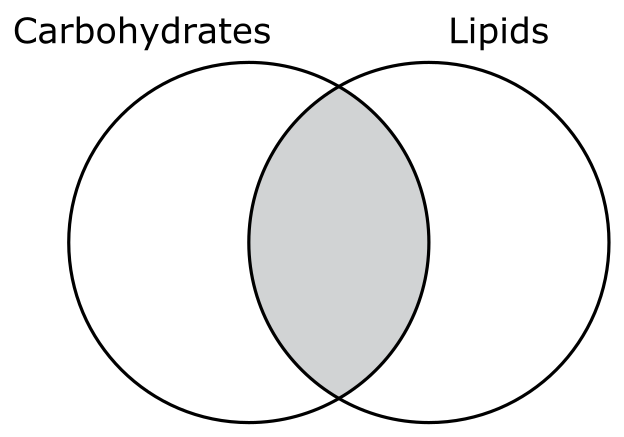
A student is completing this Venn diagram that compares carbohydrates and lipids. Which description belongs in the shaded area of the Venn diagram?
- Change shape in order to function properly
- Act as insulation to reduce heat loss
- Provide organisms with energy
- Encode genetic information
Show STAAR answer and explanation
Provide organisms with energy
The shaded area shows what both biomolecules share. Both carbohydrates and lipids provide energy for organisms.
Change shape in order to function properly: Proteins change shape to function properly.
Act as insulation to reduce heat loss: Lipids act as insulation, but carbohydrates do not.
Encode genetic information: Nucleic acids encode genetic information.
Learning objectives
By the end of the lesson, students can:
- Identify the monomers and major functions of all four biomolecule groups.
- Relate a biomolecule's structure to its function in a cell.
- Explain how changing a protein's amino-acid sequence can alter folding and function.
Instructional sequence
- 1
Engage
5 minDisplay a pasta dinner and a salmon dinner. Ask which molecules provide quick energy, long-term storage, and materials for growth.
- 2
Direct instruction
10 minBuild a four-column chart: monomer, elements or bonding pattern, structure, and function. Emphasize monosaccharides, fatty acids and glycerol, amino acids, and nucleotides.
- 3
Guided practice
12 minSort examples such as starch, enzymes, DNA, and cell membranes. Require a structure-based reason rather than a memorized label.
- 4
Application
13 minTrace a single amino-acid substitution through primary structure, folding, active-site shape, and protein function.
- 5
Closure
5 minStudents complete the exit ticket and correct their comparison chart with a different color.
Misconceptions to address
Teacher move: Contrast starch with protein: carbohydrates supply short-term energy; proteins primarily build structures and perform cellular work.
Teacher move: Show that a substitution changes the sequence, not the entire backbone; altered interactions can still change folding.