

Cell Complexity
Compare prokaryotic and eukaryotic cells, including evidence for endosymbiotic theory.
Students compare cell organization across prokaryotes and eukaryotes and evaluate molecular evidence that mitochondria and chloroplasts descended from free-living bacteria.
Lesson plan and worked examples by TEKSForge · not a TEA-issued lesson. Videos by independent educators.
Learn the concept
Shared cell machinery
Prokaryotic and eukaryotic cells both contain DNA, cytoplasm, ribosomes, and a plasma membrane. Prokaryotes lack a membrane-bound nucleus; their DNA occupies a nucleoid region. Eukaryotes have a nucleus and membrane-bound organelles that compartmentalize cellular functions.
Endosymbiosis
Endosymbiotic theory proposes that ancestral host cells incorporated bacteria that eventually became mitochondria and chloroplasts. These organelles retain their own DNA and reproduce by a division process resembling binary fission.
Use several lines of evidence
Circular DNA, bacterial-like ribosomes, division, and double membranes together support bacterial ancestry. One shared feature alone is weaker evidence. Do not infer that all organelles originated this way or that a bacterium has no genetic material.
Visualize the concept
Original TEKSForge instructional diagrams, designed for this TEKS skill and clearly distinguished from released STAAR artwork.

Study released STAAR visuals
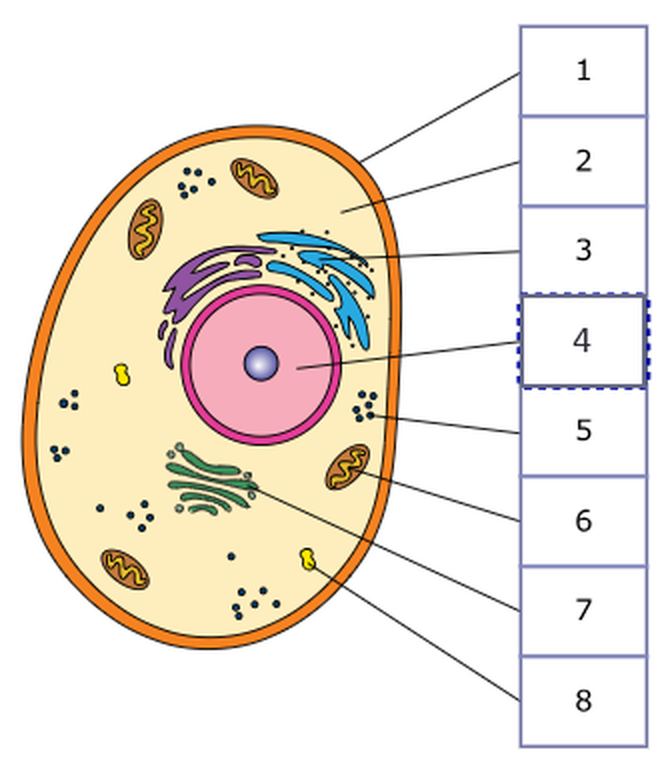
Use the original graphs, tables, and diagrams from released STAAR questions to practice reading labels, values, and relationships before answering the items below.
Released STAAR Biology EOC · 2019 · Item 6 · 1 point
Released STAAR Biology EOC · 2022 · Item 21 · 1 point
Released STAAR Biology EOC · 2021 · Item 14 · 1 point
Released STAAR Biology EOC · 2026 · Item 8 · 1 point
Released STAAR Biology EOC · 2024 · Item 7 · 1 point
Released STAAR Biology EOC · 2026 · Item 26 · 1 point
Worked example
An organelle has circular DNA, bacterial-like ribosomes, and two membranes. What origin is supported?
- Circular DNA and ribosomes resemble bacterial features.
- The membranes are consistent with an engulfment event.
- Together, these observations support descent from an incorporated bacterial ancestor.
Endosymbiotic origin of a mitochondrion or chloroplast.
Watch the lesson
Texas public-school, Texas educator-created, and TEKS-aligned lessons, hosted by their creators. Each card names its source.
Biology: Comparing Cells and Viruses
UT IPSI · Kid2Kid / Texas Education AgencyCompare structures shared by prokaryotic and eukaryotic cells and their distinguishing features.
Watch on YouTubeBiology: Scientific Explanations of Complexity of the Cell
UT IPSI · Kid2Kid / Texas Education AgencyConnect endosymbiotic theory to the origin of membrane-bound organelles.
Watch on YouTubeTry it yourself
TEKSForge practice · unscored
1. Would finding ribosomes alone identify a cell as eukaryotic?
Show answer and reasoning
No
Both cell types require ribosomes for protein synthesis. A membrane-bound nucleus is the more useful distinguishing feature.
2. Why does mitochondrial division support endosymbiosis?
Show answer and reasoning
It resembles bacterial binary fission.
An organelle retaining bacterial-style division is consistent with a bacterial ancestor that became part of a host cell.
Released STAAR practice
Texas Education Agency · released EOC items · explanations adapted from TEA rationales. Original graphs, tables, and diagrams are shown where the released item includes one.
Released STAAR Biology EOC · 2019 · Item 6 · 1 point
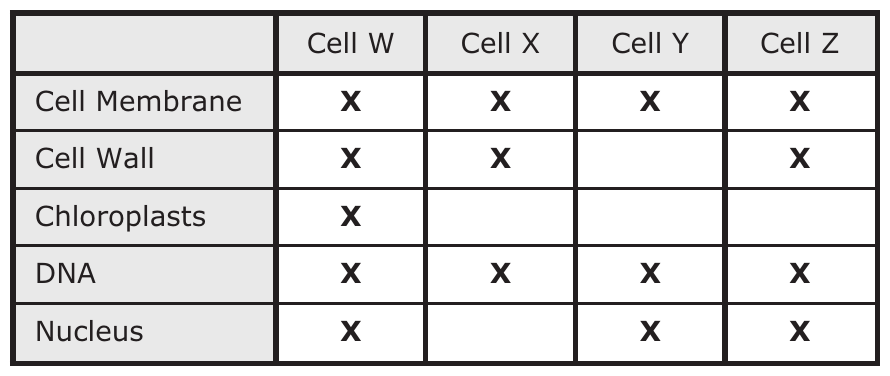
Students use a microscope to look for structures present in four different cells. The students placed an X for each structure that was viewed for each cell on the table shown. Which cell that was viewed is most likely a prokaryote?
- Cell W
- Cell X
- Cell Y
- Cell Z
Show STAAR answer and explanation
Cell X
A prokaryote is a single-celled organism with no nucleus. Cell X is the only cell where no nucleus was seen.
Cell W: A nucleus was seen in Cell W, so it is not a prokaryote.
Cell Y: A nucleus was seen in Cell Y, so it is not a prokaryote.
Cell Z: A nucleus was seen in Cell Z, so it is not a prokaryote.
Released STAAR Biology EOC · 2022 · Item 21 · 1 point
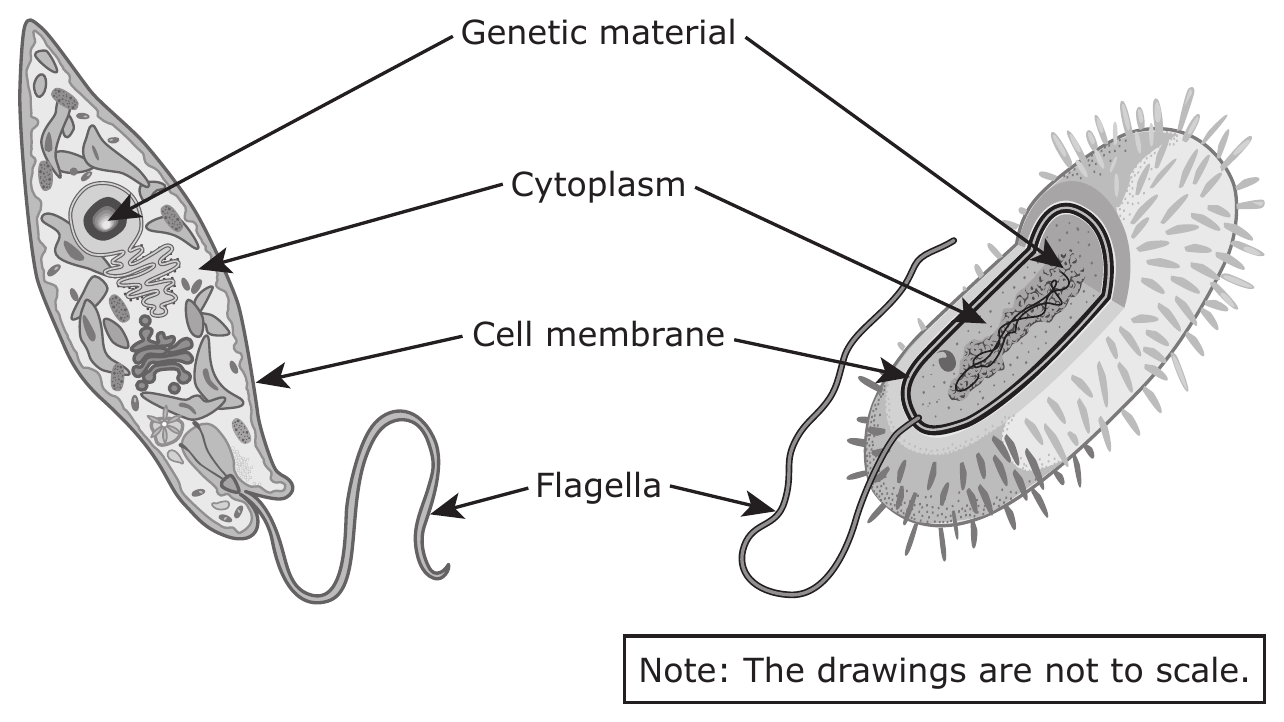
A prokaryotic cell and a eukaryotic cell are shown. Which characteristic best distinguishes these cells as either prokaryotic or eukaryotic?
- The organization of the genetic material
- The location of the cytoplasm
- The role of the cell membrane
- The function of the flagella
Show STAAR answer and explanation
The organization of the genetic material
In eukaryotic cells the genetic material is enclosed in a nucleus; in prokaryotic cells it is not. That organization is what distinguishes them.
The location of the cytoplasm: Cytoplasm fills both kinds of cells, so it doesn't distinguish them.
The role of the cell membrane: In both kinds of cells, the membrane controls what enters and leaves.
The function of the flagella: Flagella help both kinds of cells move.
Released STAAR Biology EOC · 2021 · Item 14 · 1 point
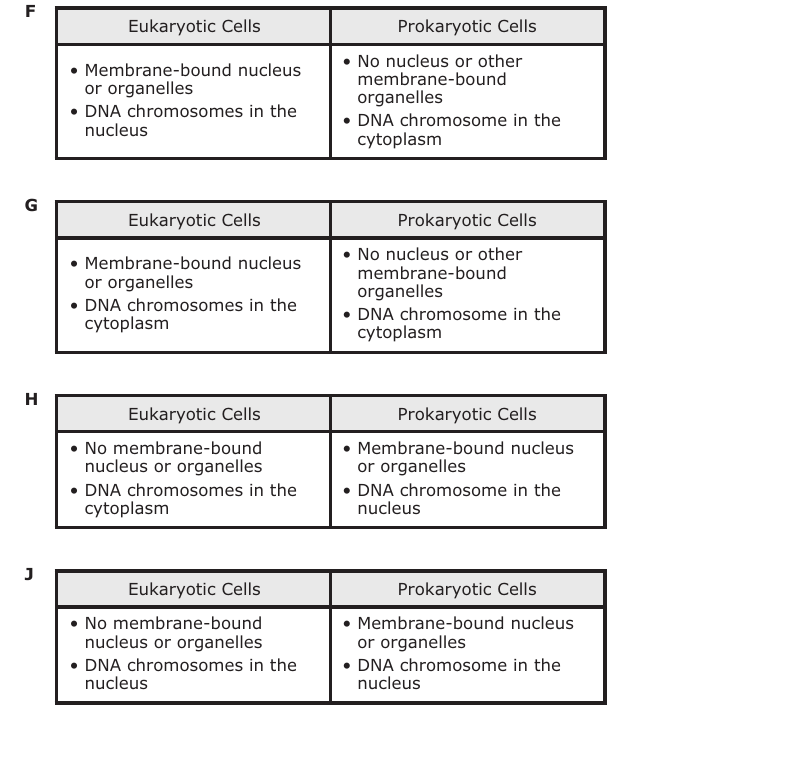
Students created note cards comparing characteristics of eukaryotic and prokaryotic cells. Which set of note cards most accurately compares these cells?
- Note cards F
- Note cards G
- Note cards H
- Note cards J
Show STAAR answer and explanation
Note cards F
Eukaryotic cells have a membrane-bound nucleus and organelles, with chromosomes in the nucleus. Prokaryotic cells lack those membrane-bound structures and have their chromosome in the cytoplasm.
Note cards G: This incorrectly places eukaryotic DNA chromosomes in the cytoplasm rather than the nucleus.
Note cards H: This reverses which cells have membrane-bound nuclei and organelles.
Note cards J: This incorrectly places prokaryotic DNA inside a membrane-bound nucleus.
Released STAAR Biology EOC · 2025 · Item 3 · 1 point
Which conclusion is shared by BOTH theories to explain cell complexity?
| Endosymbiotic Theory | Autogenous Theory |
|---|---|
| • Claims some organelles evolved from symbiotic relationships with prokaryotic ancestors • Mainly applies to mitochondria and chloroplasts • Proposed by Margulis in 1967 | • Sees eukaryotes evolving directly from a prokaryote ancestor • Claims eukaryotic cells were created by infoldings of the plasma membrane • Mainly applies to the endoplasmic reticulum, Golgi body, and single membrane-bound organelles • Presented in 1967 by Klein and Cronquist |
- Membrane-bound organelles like the Golgi body are less complex than mitochondria.
- Cells became less complex by joining together with other cells.
- Mitochondria developed before chloroplasts in complex eukaryotic cells.
- Complex eukaryotic cells developed from simpler prokaryotic cells.
Show STAAR answer and explanation
Complex eukaryotic cells developed from simpler prokaryotic cells.
Both theories propose that complex eukaryotic cells developed from simpler prokaryotic cells.
Membrane-bound organelles like the Golgi body are less complex than mitochondria.: Neither theory addresses the relative complexity of organelles.
Cells became less complex by joining together with other cells.: Only the endosymbiotic theory suggests that cells joined together, and cells would have become more complex—not less complex.
Mitochondria developed before chloroplasts in complex eukaryotic cells.: Neither theory discusses this timeline.
Released STAAR Biology EOC · 2025 · Item 9 · 2 points
Two students list characteristics of an organism: • has cytoplasm • has DNA in a nucleus • has ribosomes • has a cell wall Based on the list of characteristics, Student A claims that the organism is prokaryotic, while Student B claims that the organism is eukaryotic. Identify which student is correct AND why that student is correct.
Show STAAR answer and explanation
Student B is correct because eukaryotic organisms have DNA stored within a nucleus, while prokaryotic organisms do not.
The full two-point response identifies Student B and explains that DNA stored within a nucleus is evidence of a eukaryotic organism. One point is awarded for a partially correct response.
Released STAAR Biology EOC · 2026 · Item 8 · 1 point
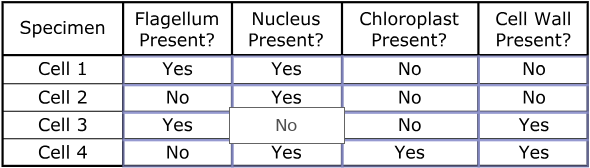
A student views four cells under a light microscope and records some observations in the table shown. Which observation in the table can be used to identify one of the cells as a prokaryote?
Show STAAR answer and explanation
The ‘No’ under ‘Nucleus Present?’ for Cell 3
Prokaryotic cells do not have a nucleus. Cell 3 is the only specimen with ‘No’ recorded for ‘Nucleus Present?’
Released STAAR Biology EOC · 2024 · Item 7 · 1 point
Dogs have 39 pairs of chromosomes in their somatic cells. In which part of the cell are these chromosomes replicated during the cell cycle? Select ONE correct answer.
Show STAAR answer and explanation
Option 4, the nucleus
Option 4 is the nucleus, where chromosomes are replicated during the cell cycle.
Released STAAR Biology EOC · 2023 · Item 11 · 2 points
Scientists observe the traits of cells on four microscope slides and record their observations in a table. Based on the scientists’ observations, identify the cell type for each microscope slide in the table. Move the correct answer to each box. Each answer may be used more than once.
| Slide 1 | Slide 2 | Slide 3 | Slide 4 |
|---|---|---|---|
| • Are single-celled • Have no nucleus • Have flagella | • Reproduce through mitosis • Have linear DNA • Have endoplasmic reticulum | • Have a membrane-bound nucleus • Have membrane-bound organelles • Are multicellular | • Have mitochondria • Are larger than 10 micrometers • Have complex structure |
Show STAAR answer and explanation
Slide 1: Prokaryotic cells; Slides 2, 3, and 4: Eukaryotic cells
Slide 1 has no nucleus, so it is prokaryotic. Linear DNA, a membrane-bound nucleus and organelles, mitochondria, mitosis, and complex structure identify the other slides as eukaryotic.
Released STAAR Biology EOC · 2026 · Item 26 · 1 point
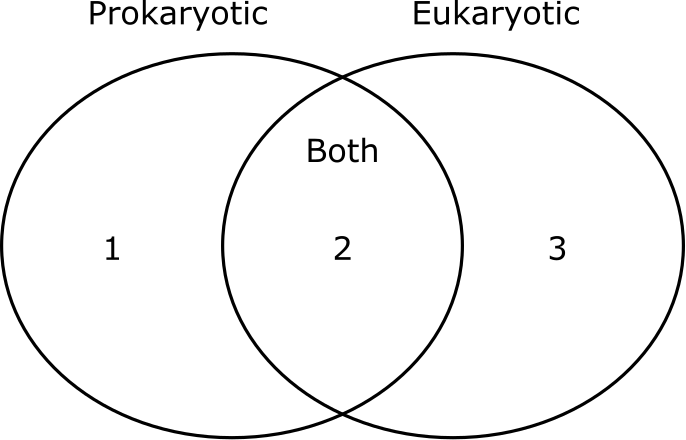
The Venn diagram compares prokaryotic and eukaryotic cells. Which table correctly completes the Venn diagram?
- 1: Linear chromosome · 2: Nucleic acids · 3: Plasmid
- 1: Linear chromosome · 2: Plasmid · 3: Nucleic acids
- 1: Plasmid · 2: Linear chromosome · 3: Nucleic acids
- 1: Plasmid · 2: Nucleic acids · 3: Linear chromosome
Show STAAR answer and explanation
1: Plasmid · 2: Nucleic acids · 3: Linear chromosome
Prokaryotes have plasmids, eukaryotes have linear chromosomes, and both have nucleic acids.
1: Linear chromosome · 2: Nucleic acids · 3: Plasmid: Linear chromosomes are found in eukaryotes, while plasmids are found in prokaryotes.
1: Linear chromosome · 2: Plasmid · 3: Nucleic acids: Eukaryotes have linear chromosomes, prokaryotes have plasmids, and both have nucleic acids.
1: Plasmid · 2: Linear chromosome · 3: Nucleic acids: Both prokaryotes and eukaryotes have nucleic acids, but only eukaryotes have linear chromosomes.
Learning objectives
By the end of the lesson, students can:
- Compare prokaryotic and eukaryotic cells while identifying structures shared by all cells.
- Explain how membrane-bound organelles support compartmentalized functions.
- Use at least two pieces of evidence to support endosymbiotic theory.
Instructional sequence
- 1
Engage
5 minAsk why a bacterium and a human cell are both considered cells despite their different organization.
- 2
Direct instruction
10 minCompare nucleoid versus nucleus and membrane-bound organelles. Anchor shared features: membrane, cytoplasm, ribosomes, and genetic material.
- 3
Evidence sort
12 minGroups sort circular DNA, bacterial-sized ribosomes, double membranes, and binary fission under mitochondria, chloroplasts, or both.
- 4
Claim and reasoning
12 minStudents write a claim about endosymbiosis, select two evidence cards, and explain why each supports a bacterial ancestor.
- 5
Closure
6 minRevise the opening Venn diagram and complete the exit ticket.
Misconceptions to address
Teacher move: Distinguish lacking a nucleus from lacking genetic material; all cells need ribosomes to make proteins.
Teacher move: Describe a shared ancient bacterial ancestor, not descent from a present-day species.