

Cell Cycle Disruptions
Explain how disruptions of the cell cycle, such as checkpoint failures, lead to diseases like cancer.
Students trace how checkpoints regulate division and explain how checkpoint failure can allow damaged cells to proliferate, forming tumors and potentially spreading.
Lesson plan and worked examples by TEKSForge · not a TEA-issued lesson. Videos by independent educators.
Learn the concept
Regulated division
The cell cycle includes growth, DNA replication, preparation for division, and mitosis with cytokinesis. Checkpoints coordinate progression: damaged DNA or incomplete replication can delay division; the spindle checkpoint helps ensure chromosomes are properly attached before separation.
When regulation fails
Regulatory proteins can pause the cycle and coordinate repair or programmed cell death. Mutations that disable tumor-suppressor function or activate growth-promoting signals can allow inappropriate division. Cancer typically involves multiple changes, not merely a cell dividing quickly.
Explain a causal chain
Name the disrupted control, describe the immediate consequence, and then connect repeated divisions to a tumor. A checkpoint coordinates the response; it does not itself chemically repair DNA.
Visualize the concept
Original TEKSForge instructional diagrams, designed for this TEKS skill and clearly distinguished from released STAAR artwork.

Study released STAAR visuals
Use the original graphs, tables, and diagrams from released STAAR questions to practice reading labels, values, and relationships before answering the items below.
Released STAAR Biology EOC · 2022 · Item 37 · 1 point
Worked example
A mutation disables p53-mediated responses to DNA damage. Explain how this can contribute to cancer.
- Normally, p53 helps coordinate cell-cycle arrest, repair responses, or apoptosis after damage.
- Without that response, a damaged cell may proceed through replication and division.
- Continued division can transmit damage and contribute to accumulation of a tumor.
Loss of protective regulation can permit damaged cells to proliferate.
Watch the lesson
Texas public-school, Texas educator-created, and TEKS-aligned lessons, hosted by their creators. Each card names its source.
The Cell Cycle (and cancer) [Updated]
Amoeba Sisters · former Texas public school educatorTrace cell-cycle checkpoints, regulation, and the uncontrolled division associated with cancer.
Watch on YouTubeTry it yourself
TEKSForge practice · unscored
1. What should happen when DNA replication is incomplete before mitosis?
Show answer and reasoning
Cell-cycle progression should pause.
A checkpoint delay provides time to resolve replication problems rather than distributing incomplete genetic information.
2. Does a checkpoint failure cause a body cell to switch to meiosis?
Show answer and reasoning
No
The relevant disruption is lost control of somatic cell division, not a switch to gamete production.
Released STAAR practice
Texas Education Agency · released EOC items · explanations adapted from TEA rationales. Original graphs, tables, and diagrams are shown where the released item includes one.
Released STAAR Biology EOC · 2019 · Item 27 · 1 point
When cells lose their ability to regulate the cell cycle, they can divide at an accelerated rate and form a mass of cells. This mass of cells is referred to as —
- a tumor
- an embryo
- a gland
- an organ
Show STAAR answer and explanation
a tumor
Unregulated cell division can produce a mass of abnormal cells called a tumor.
an embryo: An embryo is an early developing organism, not a mass caused by unregulated cell division.
a gland: A gland is an organized structure that secretes substances.
an organ: An organ contains coordinated tissues performing specific functions, not simply an unregulated cell mass.
Released STAAR Biology EOC · 2022 · Item 37 · 1 point
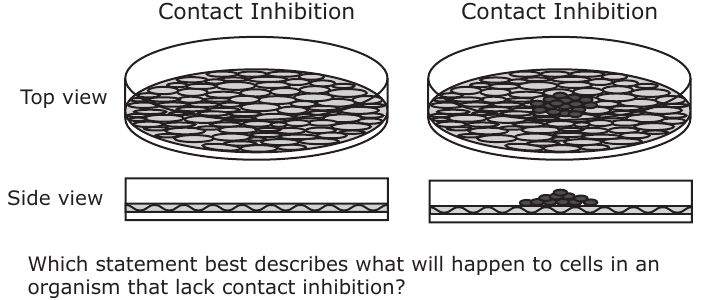
Normal cells have a contact inhibition feedback mechanism that prevents the cells from replicating when other cells are touched. A diagram of cells with contact inhibition and cells without contact inhibition is shown. Which statement best describes what will happen to cells in an organism that lack contact inhibition?
- The cells will continue to grow, causing a tumor in the body.
- The cells will replicate normally, replacing body cells that die.
- The cells will replicate until the food supply for each cell is used, causing each cell to die.
- The cells will stop replicating once one layer is produced, as other body cells will crowd them out.
Show STAAR answer and explanation
The cells will continue to grow, causing a tumor in the body.
Without contact inhibition, cells do not stop dividing when they touch neighboring cells, so continued growth can form a tumor.
The cells will replicate normally, replacing body cells that die.: Loss of this feedback mechanism removes normal control over replication.
The cells will replicate until the food supply for each cell is used, causing each cell to die.: The diagram shows continued growth rather than a necessary stopping point caused by food depletion.
The cells will stop replicating once one layer is produced, as other body cells will crowd them out.: Stopping after one layer describes normal contact inhibition, which these cells lack.
Released STAAR Biology EOC · 2021 · Item 2 · 1 point
During the cell cycle, proteins called cyclins bind to enzymes that send signals for the cell to progress through stages of cell replication. At the end of this cycle, the cyclins degrade to prevent further signaling for the cell to divide. Uncontrolled production of cyclins will most likely result in —
- the formation of tumors
- the immediate death of the cell
- the transfer of cyclins to other cells
- the formation of haploid cells
Show STAAR answer and explanation
the formation of tumors
Uncontrolled cyclin production keeps division signals active, which can cause uncontrolled cell proliferation and tumor formation.
the immediate death of the cell: The signaling described promotes continued division rather than immediate cell death.
the transfer of cyclins to other cells: The issue is overproduction within the cell, not cyclin transfer.
the formation of haploid cells: Uncontrolled mitotic division does not produce haploid gametes.
Released STAAR Biology EOC · 2026 · Item 22 · 1 point
The model shows some of the events that take place when a cell reaches the checkpoint in the cell cycle. How should the model be completed to show the MOST LIKELY outcome for this cell?
Show STAAR answer and explanation
Apoptosis takes place.
When DNA repair fails at the checkpoint, the most likely outcome is apoptosis, or programmed cell death.
Released STAAR Biology EOC · 2026 · Item 11 · 1 point
Which statement describes how cells MOST LIKELY become cancerous?
- ATP is no longer needed for cell division since division is now self-regulated.
- Unregulated cell division occurs because of mutations in the DNA.
- DNA replication is omitted because of changes in the genetic code.
- Damage to DNA molecules results in improved responses to cell cycle checkpoints.
Show STAAR answer and explanation
Unregulated cell division occurs because of mutations in the DNA.
Cancer is the result of an unregulated increase in cell division caused by DNA mutations.
ATP is no longer needed for cell division since division is now self-regulated.: ATP is needed for cell division in all cells.
DNA replication is omitted because of changes in the genetic code.: Cancer cells still go through the S phase to replicate DNA for cell division.
Damage to DNA molecules results in improved responses to cell cycle checkpoints.: In cancer cells, the checkpoints that regulate cell division are ignored or overridden.
Released STAAR Biology EOC · 2025 · Item 13 · 2 points
The intestine is lined with many fingerlike structures called villi, which allow increased absorption of digested materials. The cells within a villus change position and migrate as they mature. Each cell then dies and is sloughed off. For each of three locations within villi, the table shows the number of cells that are undergoing a cellular change called apoptosis, or programmed cell death. Based on the information in the table, how does apoptosis LIKELY affect cells? Move the correct answer to each box. Not all answers will be used. Not all answers can be moved to all boxes.
| Location within Villi | Number of Cells Undergoing Apoptosis (per 200 Villi Samples) |
|---|---|
| Base | 0 |
| Middle | 60 |
| Top | 80 |
Show STAAR answer and explanation
Apoptosis is a normal cellular process that destroys cells. A cell may enter apoptosis at the end of its lifespan. Without apoptosis, the cell may become cancerous.
Apoptosis is a normal process that destroys cells. The table shows more apoptosis toward the top of the villi, where cells reach the end of their lifespan. Without apoptosis, a cell may become cancerous. All three boxes earn two points; a partially correct response earns one point.
Learning objectives
By the end of the lesson, students can:
- Describe the roles of major cell-cycle checkpoints.
- Explain how regulatory proteins such as p53 respond to damaged DNA.
- Connect checkpoint failure to uncontrolled division and cancer.
Instructional sequence
- 1
Engage
5 minCompare a traffic-light system with a cell deciding whether it is ready to divide.
- 2
Direct instruction
10 minPlace G1, S, G2, and M checkpoints in context. Focus on cell size, DNA damage, replication completeness, and chromosome attachment.
- 3
Guided model
12 minTrace normal p53 action: detect damage → pause cycle → allow repair or trigger apoptosis → prevent damaged copies.
- 4
Disruption analysis
12 minGroups analyze disabled p53, ignored crowding signals, and failed spindle checkpoints, identifying the immediate and downstream effects.
- 5
Closure
6 minStudents write a three-link causal chain and complete the exit ticket.
Misconceptions to address
Teacher move: The central problem is lost regulation; damaged or crowded cells continue dividing when they should stop.
Teacher move: A checkpoint pauses progression and coordinates responses; repair proteins perform the repair.