

DNA Structure
Identify components of DNA and explain how the nucleotide sequence specifies some traits of an organism.
Students build a nucleotide-level model of DNA, apply complementary base pairing, and explain how nucleotide order stores information that can influence traits.
Lesson plan and worked examples by TEKSForge · not a TEA-issued lesson. Videos by independent educators.
Learn the concept
DNA building blocks
A DNA nucleotide consists of deoxyribose sugar, a phosphate group, and one nitrogenous base. Covalent bonds connect the sugar-phosphate backbone. Hydrogen bonds connect complementary bases across the two antiparallel strands: A pairs with T and C pairs with G.
Sequence stores information
Genes are DNA sequences whose information contributes to functional products. For protein-coding genes, sequence information is transcribed into RNA and translated into an amino-acid sequence. Proteins help produce traits, often together with other genes and environmental influences.
Pairing and percentages
In double-stranded DNA, the percentage of A equals T and C equals G. All four percentages total 100%. These equalities apply to the double-stranded sample as a whole, not necessarily to each individual strand.
Visualize the concept
Original TEKSForge instructional diagrams, designed for this TEKS skill and clearly distinguished from released STAAR artwork.

Study released STAAR visuals
Use the original graphs, tables, and diagrams from released STAAR questions to practice reading labels, values, and relationships before answering the items below.
Released STAAR Biology EOC · 2022 · Item 28 · 1 point
Released STAAR Biology EOC · 2021 · Item 11 · 1 point
Released STAAR Biology EOC · 2026 · Item 5 · 2 points
Released STAAR Biology EOC · 2024 · Item 32 · 2 points
Released STAAR Biology EOC · 2025 · Item 2 · 1 point
Worked example
A double-stranded DNA sample contains 28% adenine. Find the cytosine percentage.
- Thymine is also 28%, so A and T account for 56%.
- The remaining 44% is split equally between C and G.
- Divide 44% by 2.
22% cytosine.
Watch the lesson
Texas public-school, Texas educator-created, and TEKS-aligned lessons, hosted by their creators. Each card names its source.
Biology: Components of DNA
UT IPSI · Kid2Kid / Texas Education AgencyIdentify nucleotide parts and apply complementary base pairing to DNA structure.
Watch on YouTubeTry it yourself
TEKSForge practice · unscored
1. What bases complement the DNA sequence ACGT?
Show answer and reasoning
TGCA
Use A–T and C–G pairing at every position. Uracil belongs in RNA, not DNA.
2. Does changing a DNA sequence always change a visible trait?
Show answer and reasoning
No
A change may not alter a functional product, or its effect may be modified by other genes and environmental conditions.
Released STAAR practice
Texas Education Agency · released EOC items · explanations adapted from TEA rationales. Original graphs, tables, and diagrams are shown where the released item includes one.
Released STAAR Biology EOC · 2022 · Item 20 · 1 point
What components make up the backbone of a DNA molecule?
- Purines and deoxyribose
- Pyrimidines and purines
- Deoxyribose and phosphate groups
- Phosphate groups and pyrimidines
Show STAAR answer and explanation
Deoxyribose and phosphate groups
The backbone of each DNA strand alternates deoxyribose sugars and phosphate groups.
Purines and deoxyribose: Purines are nitrogenous bases that connect the two backbones; they aren't part of the backbone.
Pyrimidines and purines: Purines and pyrimidines are bases that form the 'rungs' between the backbones.
Phosphate groups and pyrimidines: Pyrimidines are bases that connect the backbones; they aren't part of the backbone.
Released STAAR Biology EOC · 2022 · Item 23 · 1 point
Which statement best describes a similarity among trees, cats, and amoebas?
- They are prokaryotic organisms.
- They are classified as members of the same kingdom.
- They have genomes that consist of the same number of genes.
- They contain DNA composed of the same four types of nucleotides.
Show STAAR answer and explanation
They contain DNA composed of the same four types of nucleotides.
All living organisms use DNA made of the same four nucleotides (A, T, G, C).
They are prokaryotic organisms.: Trees, cats, and amoebas are all eukaryotes.
They are classified as members of the same kingdom.: Trees, cats, and amoebas are in different kingdoms.
They have genomes that consist of the same number of genes.: The number of genes varies among species.
Released STAAR Biology EOC · 2019 · Item 3 · 1 point
Eight components present in nucleic acids are listed. 1. Phosphate 2. Ribose sugar 3. Deoxyribose sugar 4. Uracil 5. Thymine 6. Adenine 7. Guanine 8. Cytosine Which components bond with adenine in a section of double-stranded DNA?
- 1, 3, 5, and 6 only
- 3 and 5 only
- 2 and 4 only
- 3, 4, 7, and 8 only
Show STAAR answer and explanation
3 and 5 only
Adenine bonds to the deoxyribose sugar on its own strand and to thymine, its complementary base, on the other strand.
1, 3, 5, and 6 only: Adenine doesn't pair with another adenine, and phosphate bonds to the sugar, not to the base.
2 and 4 only: Ribose and uracil are found in RNA, not double-stranded DNA.
3, 4, 7, and 8 only: Guanine and cytosine don't pair with adenine, and uracil is found in RNA.
Released STAAR Biology EOC · 2019 · Item 37 · 1 point
Which of these components are found in the cells of all living organisms?
- Estrogen and testosterone
- Hemoglobin and lymphocytes
- Cytosine and guanine
- Cellulose and chlorophyll
Show STAAR answer and explanation
Cytosine and guanine
Cytosine and guanine are nitrogenous bases in DNA, the genetic code shared by all living organisms.
Estrogen and testosterone: These hormones are found only in vertebrate animals.
Hemoglobin and lymphocytes: These blood components are found only in animals.
Cellulose and chlorophyll: These are found mainly in plants, not animals.
Released STAAR Biology EOC · 2019 · Item 43 · 1 point
A segment of a DNA strand is shown. 3′ AGGTCAGGT 5′ Which of these is the correct complementary DNA strand for the segment shown?
- 5′ AGGTCAGGT 3′
- 5′ ACCUGAGGU 3′
- 5′ TGGACTGGA 3′
- 5′ TCCAGTCCA 3′
Show STAAR answer and explanation
5′ TCCAGTCCA 3′
Pair each base: A–T and G–C. AGGTCAGGT pairs with TCCAGTCCA, running 5′ to 3′.
5′ AGGTCAGGT 3′: This is the same sequence, not the complement. A pairs with T and G pairs with C.
5′ ACCUGAGGU 3′: DNA has no uracil (U), and the pairings don't follow the base-pairing rules.
5′ TGGACTGGA 3′: The pairings don't follow the rules: G must pair with C, not G.
Released STAAR Biology EOC · 2022 · Item 28 · 1 point
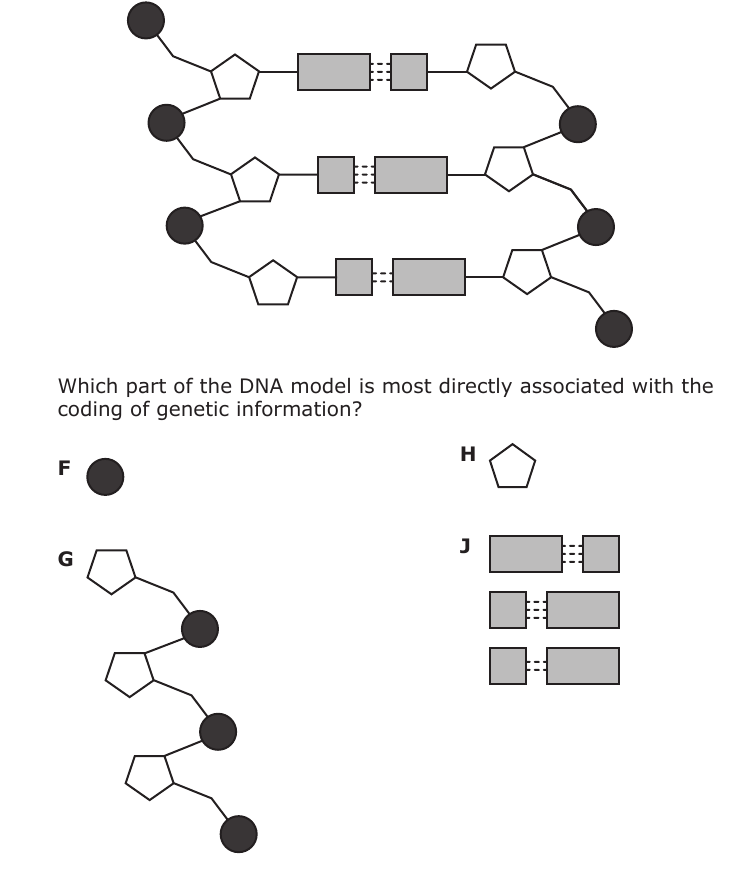
A model of DNA is shown. Which part of the DNA model is most directly associated with the coding of genetic information?
- Part F
- Part G
- Part H
- Part J
Show STAAR answer and explanation
Part J
Part J marks the nitrogenous base pairs. The sequence of these bases encodes genetic information.
Part F: Phosphate groups help form the backbone but do not encode the genetic sequence.
Part G: A complete structural unit is not the specific information-coding component; the base sequence is.
Part H: Deoxyribose sugar forms part of the backbone, not the genetic code.
Released STAAR Biology EOC · 2021 · Item 6 · 1 point
Which property is shared by the cells of all living things?
- The cells contain DNA composed of adenine, thymine, guanine, and cytosine.
- The cells are surrounded by a phospholipid bilayer and a cell wall made of cellulose.
- The cells have chromosomes that are located inside a membrane-bound nucleus.
- The cells rely on mitochondria to carry out aerobic cellular respiration.
Show STAAR answer and explanation
The cells contain DNA composed of adenine, thymine, guanine, and cytosine.
All living cells use DNA containing the four bases adenine, thymine, guanine, and cytosine.
The cells are surrounded by a phospholipid bilayer and a cell wall made of cellulose.: Not all cells have a cellulose cell wall.
The cells have chromosomes that are located inside a membrane-bound nucleus.: Prokaryotic cells do not have membrane-bound nuclei.
The cells rely on mitochondria to carry out aerobic cellular respiration.: Prokaryotes lack mitochondria, and not all cells use aerobic respiration.
Released STAAR Biology EOC · 2021 · Item 11 · 1 point
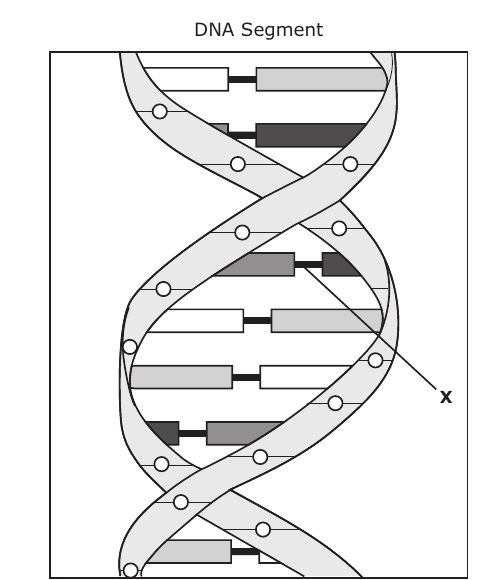
A segment of DNA is shown in the diagram. Which of these identifies the part of the DNA segment labeled X?
- Nucleotide
- Phosphate group
- Hydrogen bond
- Deoxyribose
Show STAAR answer and explanation
Hydrogen bond
X points to the weak attractions between complementary base pairs holding the two DNA strands together: hydrogen bonds.
Nucleotide: A nucleotide contains sugar, phosphate, and a base; X marks an attraction between bases.
Phosphate group: Phosphate groups are part of each strand's backbone, not the link labeled X.
Deoxyribose: Deoxyribose is a sugar in the backbone, not the hydrogen bond between strands.
Released STAAR Biology EOC · 2021 · Item 34 · 1 point
In Texas Longhorn cattle, coat coloration is an inherited trait. What is the genetic basis of coat-color variation in Texas Longhorn cattle?
- Differences in the nucleotide sequences of genes
- Differences in the numbers of chromosomes in cells
- Differences in the diets of individual cattle
- Differences in the environmental conditions of different geographic areas
Show STAAR answer and explanation
Differences in the nucleotide sequences of genes
Inherited variation results from differences in the nucleotide sequences of alleles that affect coat color.
Differences in the numbers of chromosomes in cells: Normal inherited coat-color variation does not require different chromosome numbers.
Differences in the diets of individual cattle: Diet is environmental and is not the genetic basis of inherited variation.
Differences in the environmental conditions of different geographic areas: Environment can affect expression, but inherited variation originates in gene sequences.
Released STAAR Biology EOC · 2026 · Item 5 · 2 points
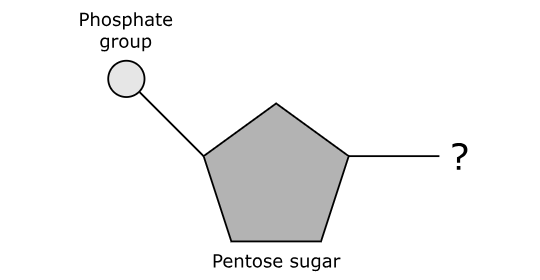
A DNA nucleotide has three components. This model of a nucleotide is missing one of these components. Identify the missing nucleotide component, AND explain the significance of this component in determining the traits of an organism.
Show STAAR answer and explanation
The missing component is a nitrogenous base. The sequence of nitrogenous bases in DNA determines an organism's traits.
The full response identifies a nitrogenous base and explains that the sequence of adenine, cytosine, guanine, and thymine determines traits. One point is awarded for a partially correct response.
Released STAAR Biology EOC · 2024 · Item 1 · 1 point
Humans have thousands of genes that combine in different ways to help create unique individuals. Where is the genetic code primarily located?
- Ribose sugars in RNA
- Phosphates in DNA
- Nucleotides in DNA
- Exons in RNA
Show STAAR answer and explanation
Nucleotides in DNA
Genes are located primarily in DNA nucleotides. Each nucleotide contains phosphate, a deoxyribose sugar, and a nitrogenous base. The sequence of nucleotides determines the gene.
Ribose sugars in RNA: The genetic code is not stored in RNA's ribose sugars. The sequence of DNA nucleotides stores inherited information.
Phosphates in DNA: Phosphates form part of the DNA backbone; their sequence does not encode the gene.
Exons in RNA: RNA exons code for proteins, but the genetic code is primarily located in DNA nucleotides.
Released STAAR Biology EOC · 2024 · Item 32 · 2 points
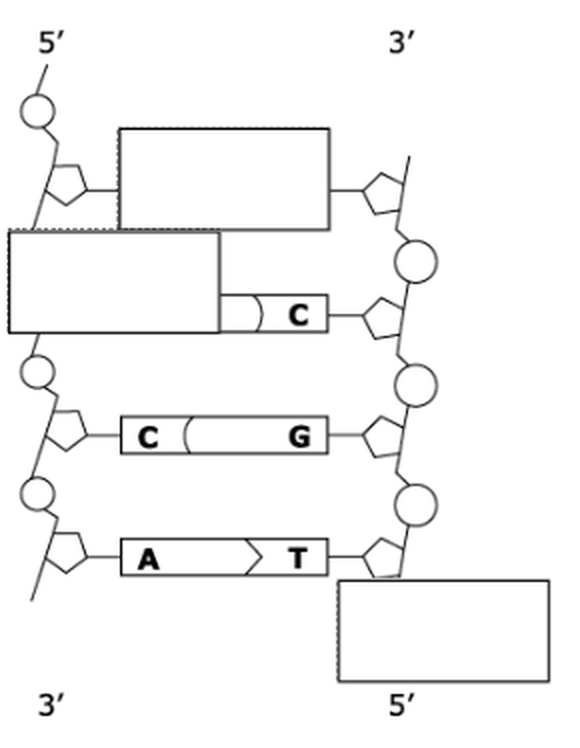
Identify the components of DNA. Move the correct answer to each box. Not all answers will be used.
Show STAAR answer and explanation
From top to bottom: Base pair, Nucleotide, Phosphate
From top to bottom, T–A is a base pair, the circle–pentagon–G group is a nucleotide, and the lone circle represents phosphate. Two correct responses earn one point; all three earn two points.
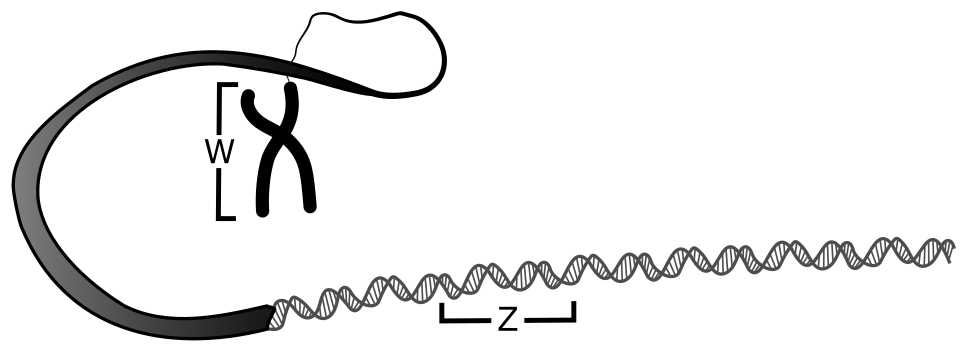
Released STAAR Biology EOC · 2025 · Item 2 · 1 point
The diagram shows important structures found in a cell. Two structures, W and Z, are labeled. Which statement BEST describes Structure W and Structure Z?
- Structure W is a gene and Structure Z is a chromosome.
- Structure W is a chromosome and Structure Z is a gene.
- Structure W is an amino acid and Structure Z is a nucleic acid.
- Structure W is a nucleic acid and Structure Z is an amino acid.
Show STAAR answer and explanation
Structure W is a chromosome and Structure Z is a gene.
Structure W is made of multiple genes, so it is a chromosome. Structure Z is made of many base pairs, so it is a gene.
Structure W is a gene and Structure Z is a chromosome.: Structure W is made of multiple genes, so it is a chromosome, and Structure Z is a stretch of base pairs, so it is a gene.
Structure W is an amino acid and Structure Z is a nucleic acid.: The diagram does not show any amino acids. Structures W and Z are both nucleic acids.
Structure W is a nucleic acid and Structure Z is an amino acid.: The diagram does not show any amino acids. Structures W and Z are both nucleic acids.
Released STAAR Biology EOC · 2025 · Item 22 · 1 point
A DNA sequence is shown. 5’ A T C G C T A G 3’ Which strand represents the complementary DNA sequence?
- 5’ T A C G G A T C 3’
- 5’ A T C G C T A G 3’
- 3’ T A G C G A T C 5’
- 3’ G A T C G C T A 5’
Show STAAR answer and explanation
3’ T A G C G A T C 5’
The complementary DNA strand runs from 3’ to 5’ and pairs A with T and C with G, giving 3’ T A G C G A T C 5’.
5’ T A C G G A T C 3’: The complementary strand would run from 3’ to 5’.
5’ A T C G C T A G 3’: This repeats the original strand; the complementary strand runs from 3’ to 5’ with paired bases.
3’ G A T C G C T A 5’: This strand runs 3’ to 5’, but its base pairs are incorrect.
Learning objectives
By the end of the lesson, students can:
- Identify the sugar, phosphate, and nitrogenous base in a nucleotide.
- Apply A–T and C–G pairing and antiparallel strand organization.
- Explain how a nucleotide sequence can specify a protein and influence a trait.
Instructional sequence
- 1
Engage
5 minShow a six-base sequence and ask what information is needed to reconstruct its missing partner strand.
- 2
Direct instruction
10 minAssemble a nucleotide, connect sugar-phosphate backbones, and distinguish hydrogen-bonded base pairs from covalent backbone bonds.
- 3
Guided practice
12 minBuild complementary strands and solve base-percentage problems using A=T and C=G.
- 4
Information connection
12 minTrace sequence → codons → amino-acid sequence → protein → trait without implying that one gene determines every trait.
- 5
Closure
6 minComplete the exit ticket and label U as RNA-only on the class model.
Misconceptions to address
Teacher move: Uracil replaces thymine in RNA; DNA uses A–T.
Teacher move: Sequence information guides protein production; proteins and environmental interactions contribute to traits.