

Evolution & Natural Selection
Analyze molecular and geographical evidence of common ancestry, and explain how natural selection acts on inherited variation in populations.
Students explain natural selection as a population-level change across generations, using variation, inheritance, differential survival, and reproduction rather than individual need or choice.
Lesson plan and worked examples by TEKSForge · not a TEA-issued lesson. Videos by independent educators.
Learn the concept
Selection acts on variation
Populations contain inherited variation. Environmental conditions can cause individuals with some traits to survive and reproduce more successfully than others. Offspring inherit those traits, changing their frequency across generations.
Populations evolve
An individual may acclimate during its lifetime, but natural selection changes a population's inherited trait frequencies over generations. Mutations and recombination generate variation; the environment does not deliberately create the needed mutation.
Build a complete explanation
Identify the original variation, selective pressure, difference in reproductive success, and resulting frequency change. Survival without reproduction is insufficient to explain a shift in the next generation.
Visualize the concept
Original TEKSForge instructional diagrams, designed for this TEKS skill and clearly distinguished from released STAAR artwork.

Study released STAAR visuals
Use the original graphs, tables, and diagrams from released STAAR questions to practice reading labels, values, and relationships before answering the items below.
Released STAAR Biology EOC · 2025 · Item 32 · 1 point
Worked example
A bacterial population becomes mostly antibiotic-resistant after repeated treatments. Explain the change.
- Resistant variants were present or arose without purposeful direction.
- Antibiotics killed susceptible bacteria more effectively than resistant ones.
- Surviving resistant bacteria reproduced and passed on resistance, increasing its frequency.
Differential survival and reproduction shifted the population toward resistance.
Watch the lesson
Texas public-school, Texas educator-created, and TEKS-aligned lessons, hosted by their creators. Each card names its source.
Biology: Natural Selection – Introduction
UT IPSI · Kid2Kid / Texas Education AgencyUse variation, selection pressure, and reproduction in an explanation.
Watch on YouTubeBiology: Natural Selection and Diversity
UT IPSI · Kid2Kid / Texas Education AgencyConnect natural selection to adaptation and diversity using evidence from finch populations.
Watch on YouTubeTry it yourself
TEKSForge practice · unscored
1. Did each bacterium learn to resist the antibiotic?
Show answer and reasoning
No
Selection changes the representation of heritable variants; it is not intentional learning by every individual.
2. Why must a favored trait be heritable for natural selection to change future generations?
Show answer and reasoning
Offspring must inherit the variation associated with reproductive success.
If the advantage is not transmitted, the favored trait need not become more common among descendants.
Released STAAR practice
Texas Education Agency · released EOC items · explanations adapted from TEA rationales. Original graphs, tables, and diagrams are shown where the released item includes one.
Released STAAR Biology EOC · 2022 · Item 11 · 1 point
Blue flying fish live in the upper layers of the ocean. Blue flying fish have enlarged pectoral fins that enable them to glide for 400 meters above the ocean surface and appear to fly. Which statement best describes how natural selection led to enlarged pectoral fins in blue flying fish?
- Fish were able to glide out of the ocean and into other bodies of water to mate with other species.
- Fish were able to live both on land and in the water as a result of their larger pectoral fins.
- Fish with enlarged pectoral fins were able to glide out of the ocean to escape predators, increasing their fitness.
- Fish changed their DNA to express enlarged pectoral fins, changing the allele frequency of the population.
Show STAAR answer and explanation
Fish with enlarged pectoral fins were able to glide out of the ocean to escape predators, increasing their fitness.
Fish with larger fins escaped predators more often, so they survived and reproduced more, passing on the trait.
Fish were able to glide out of the ocean and into other bodies of water to mate with other species.: Flying fish don't glide to other bodies of water to mate with other species.
Fish were able to live both on land and in the water as a result of their larger pectoral fins.: These fish don't live on land.
Fish changed their DNA to express enlarged pectoral fins, changing the allele frequency of the population.: Organisms can't change their own DNA on purpose. Selection acts on variation that already exists.
Released STAAR Biology EOC · 2019 · Item 33 · 1 point
Male guppies found in areas without predators are more colorful than the ones found in locations with large predator populations. A population of adult guppies from an area with many predators is moved to a nearby area with few predators. Which of these is most likely to happen over a few generations?
- The mortality rate of the guppies will increase.
- Offspring will stop competing for resources.
- There will be an increase in mutations in the offspring.
- There will be an increase in the number of colorful guppies.
Show STAAR answer and explanation
There will be an increase in the number of colorful guppies.
Predators had been selecting against bright colors. With fewer predators, colorful guppies survive and reproduce more, so their number increases.
The mortality rate of the guppies will increase.: With fewer predators, the death rate is more likely to decrease.
Offspring will stop competing for resources.: Moving to a new area doesn't stop competition for resources.
There will be an increase in mutations in the offspring.: Fewer predators don't cause more mutations.
Released STAAR Biology EOC · 2019 · Item 42 · 1 point
White-tailed deer are seasonal breeders. Females begin their reproductive cycle in the fall, and rising testosterone levels cause males to start their breeding season around the same time. Offspring are born the following spring and summer. What is the most likely explanation for white-tailed deer having a seasonal breeding cycle instead of a monthly breeding cycle like many domesticated animals?
- Male and female deer come into contact with each other only in the fall.
- Large predators are not found in deer habitats during the spring and summer months.
- Giving birth only in the spring and summer ensures that offspring are born when food is most available.
- Deer give birth in the spring and summer in order to avoid being pregnant during the hot summer months.
Show STAAR answer and explanation
Giving birth only in the spring and summer ensures that offspring are born when food is most available.
Deer are herbivores. Fawns born in spring and summer, when plants are plentiful, are more likely to survive, so this timing was favored by natural selection.
Male and female deer come into contact with each other only in the fall.: Male and female deer come into contact all year.
Large predators are not found in deer habitats during the spring and summer months.: Predators are in deer habitats all year.
Deer give birth in the spring and summer in order to avoid being pregnant during the hot summer months.: Some deer are still pregnant during the summer.
Released STAAR Biology EOC · 2019 · Item 1 · 1 point
A new predator of rabbits has been introduced within an ecosystem. This new predator runs faster than the native predators of rabbits. Which statement describes what will most likely occur in the rabbit population due to the introduction of the predator?
- The rabbits will mutate their genes and express genes that increase their speed.
- Slower rabbits will develop stronger legs and pass this trait to their offspring.
- Rabbits will mate and produce offspring with a different species that has faster runners.
- Faster rabbits will survive and reproduce increasing the average speed of the rabbit population.
Show STAAR answer and explanation
Faster rabbits will survive and reproduce increasing the average speed of the rabbit population.
Faster rabbits are more likely to escape predation, survive, and pass heritable traits to offspring, increasing average speed over generations.
The rabbits will mutate their genes and express genes that increase their speed.: Individuals do not choose to mutate in response to a predator; selection acts on existing variation.
Slower rabbits will develop stronger legs and pass this trait to their offspring.: Acquired muscle development is not the mechanism of natural selection described here.
Rabbits will mate and produce offspring with a different species that has faster runners.: The predator does not cause interspecies mating; it changes which rabbits survive and reproduce.
Released STAAR Biology EOC · 2019 · Item 16 · 1 point
The aye-aye lemur is a mammal that feeds mostly on insect larvae that live inside trees. The aye-aye lemur has a specialized middle finger that is long and thin. The aye-aye lemur moves along a tree branch and taps the branch with its specialized finger. When the aye-aye lemur hears a difference in the echo, it will tear open the bark with its teeth until the insect tunnel is exposed. The aye-aye lemur then uses its specialized finger to reach the insect larvae and remove it. Which selective pressure most likely resulted in the development of the aye-aye lemur’s special adaptation?
- Limited availability of water
- Competing for mates
- Large numbers of natural predators
- Food sources that are hard to find
Show STAAR answer and explanation
Food sources that are hard to find
The specialized finger helps the lemur locate and extract hidden insect larvae, so difficult-to-find food is the selective pressure described.
Limited availability of water: The passage describes obtaining insects, not conserving or locating water.
Competing for mates: The adaptation is used for feeding rather than attracting or competing for mates.
Large numbers of natural predators: The finger helps extract food, not escape predators.
Released STAAR Biology EOC · 2022 · Item 13 · 1 point
Green anoles are lizards that can change their skin color rapidly in response to various stimuli. This adaptation is the result of —
- selective breeding of lizards by humans
- beneficial traits passed from parents to offspring
- geographic isolation that prevented genetic mutation
- environmental pollutants that changed their genotype
Show STAAR answer and explanation
beneficial traits passed from parents to offspring
Natural selection increases heritable beneficial traits across generations, producing adaptations such as this color-change response.
selective breeding of lizards by humans: The question describes a natural adaptation, not humans selecting breeding pairs.
geographic isolation that prevented genetic mutation: Isolation does not prevent mutation, and heritable variation is needed for selection.
environmental pollutants that changed their genotype: An adaptation in a population is not produced by pollutants intentionally changing every individual's genotype.
Released STAAR Biology EOC · 2022 · Item 49 · 1 point
Most animals avoid eating monarch butterflies due to their bad taste. Viceroy butterflies look very similar to the monarchs. Which of these best explains how the viceroy butterfly benefits from looking like the monarch butterfly?
- Viceroy butterflies are able to reproduce with the monarch butterflies.
- Viceroy butterflies are able to deter predators in the same way as the monarch butterflies.
- Viceroy butterflies are able to follow the migratory patterns of the monarch butterflies.
- Viceroy butterflies are able to find additional sources of food used by the monarch butterflies.
Show STAAR answer and explanation
Viceroy butterflies are able to deter predators in the same way as the monarch butterflies.
The resemblance causes predators to avoid viceroys as they avoid bad-tasting monarchs, increasing survival.
Viceroy butterflies are able to reproduce with the monarch butterflies.: Looking similar does not make the two species reproductively compatible.
Viceroy butterflies are able to follow the migratory patterns of the monarch butterflies.: The advantage described is predator avoidance, not migration.
Viceroy butterflies are able to find additional sources of food used by the monarch butterflies.: Similar appearance does not provide access to the monarch's food sources.
Released STAAR Biology EOC · 2021 · Item 4 · 1 point
Farmers spray pesticides on their plants to protect the plants from being eaten by insects. Some individual insects have a genetic mutation that makes them resistant to the toxins in the pesticides. Which statement best describes how only a few resistant individuals resulted in the pesticide becoming ineffective?
- The resistant insects change the toxin on the plants, making it safe for others.
- The resistant insects grow larger and eat less of the plants.
- The resistant insects eat the contaminated surface and leave the rest for others.
- The resistant insects are able to survive to reproduce and create a population that is also resistant.
Show STAAR answer and explanation
The resistant insects are able to survive to reproduce and create a population that is also resistant.
Resistant insects survive pesticide exposure and pass the heritable resistance to offspring, increasing its frequency in the population.
The resistant insects change the toxin on the plants, making it safe for others.: The insects do not chemically change the pesticide on the plants.
The resistant insects grow larger and eat less of the plants.: The pesticide fails because resistance spreads, not because insects eat less.
The resistant insects eat the contaminated surface and leave the rest for others.: Avoiding the toxin is not the heritable mechanism described.
Released STAAR Biology EOC · 2021 · Item 15 · 1 point
The Mexican long-nosed bat roosts in Big Bend National Park in West Texas. The bat feeds on nectar and pollen and hovers while it feeds. Additionally, its tongue can extend up to eight centimeters. The features of Mexican long-nosed bats are evidence of natural selection because the features are adaptations that —
- lead to an increase in predation by other species of animals
- show that most DNA mutations are necessary and advantageous but do not increase survival or reproductive success
- help individuals outcompete other individuals for food resources to increase survival and reproductive success
- are the result of intentional breeding
Show STAAR answer and explanation
help individuals outcompete other individuals for food resources to increase survival and reproductive success
Hovering and a long tongue improve access to nectar and pollen, increasing feeding success and potential survival and reproduction.
lead to an increase in predation by other species of animals: These feeding adaptations do not exist to increase predation on the bats.
show that most DNA mutations are necessary and advantageous but do not increase survival or reproductive success: Natural selection favors heritable adaptations precisely because they can increase reproductive success.
are the result of intentional breeding: The passage describes natural selection in a wild population, not intentional breeding.
Released STAAR Biology EOC · 2021 · Item 40 · 1 point
The giant octopus lays 20,000 to 100,000 fertilized eggs. After hatching, most octopuses become prey to larger marine organisms, and less than 5% will reach adulthood to reproduce. One benefit of the giant octopus laying many eggs is to —
- increase the average body size for surviving individuals to avoid predation
- decrease competition between different octopus species to maintain resources in the population
- increase the chance that more individuals will survive to maintain the population
- decrease the likelihood of offspring being consumed by predators
Show STAAR answer and explanation
increase the chance that more individuals will survive to maintain the population
With very high juvenile mortality, producing many eggs increases the chance that at least some offspring survive to reproduce.
increase the average body size for surviving individuals to avoid predation: The number of eggs does not directly determine each survivor's body size.
decrease competition between different octopus species to maintain resources in the population: Producing more offspring does not necessarily reduce interspecific competition.
decrease the likelihood of offspring being consumed by predators: The passage states most are preyed upon; the benefit is that enough survive despite that mortality.
Released STAAR Biology EOC · 2025 · Item 28 · 2 points
Cytochrome c is a protein that helps release energy from food and is produced by nearly all organisms. The table shows a short sequence of the amino acids in cytochrome c for several species. Identify the organism that is MOST CLOSELY related to tuna AND explain your reasoning using evidence from the table.
| Organism | 9 | 10 | 11 | 12 | 13 |
|---|---|---|---|---|---|
| Tuna | Glycine | Aspartic acid | Valine | Alanine | Lysine |
| Chicken | Glycine | Aspartic acid | Isoleucine | Glutamic acid | Lysine |
| Neurospora | Glycine | Aspartic acid | Serine | Lysine | Lysine |
| Gray whale | Glycine | Aspartic acid | Valine | Glutamic acid | Lysine |
| Silkworm moth | Glycine | Asparagine | Alanine | Glutamic acid | Asparagine |
Show STAAR answer and explanation
The tuna is most closely related to the gray whale because the only difference in the amino acid sequence provided is at amino acid 12.
The gray whale shares every listed amino acid with tuna except the amino acid at position 12. The full response names the gray whale and supports that conclusion with this evidence.
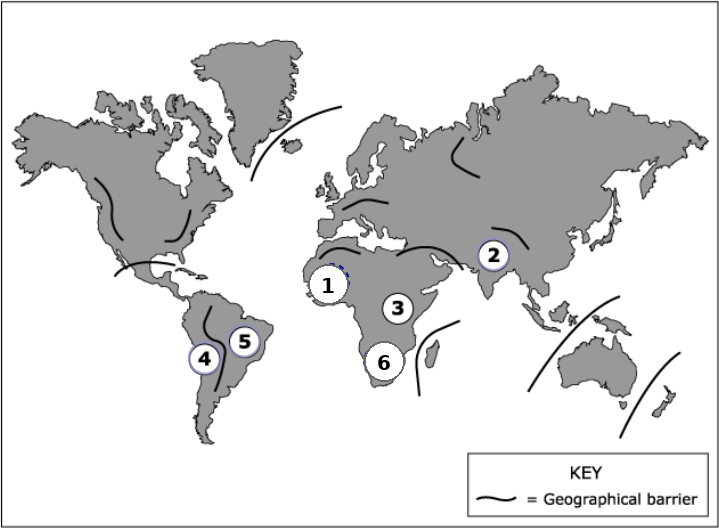
Released STAAR Biology EOC · 2025 · Item 32 · 1 point
The geographical distribution of flightless birds is shown on the map. Which locations MOST LIKELY share a most recent common ancestor with the birds found at Location 3?
Show STAAR answer and explanation
Locations 1 and 6
Locations 1 and 6 are most likely to share a most recent common ancestor with Location 3 because they are in the same nearby geographical region without a separating barrier.
Released STAAR Biology EOC · 2026 · Item 1 · 1 point
Based on the amino acid sequences shown, which species is MOST closely related to the unknown species?
| Species | 1 | 2 | 3 | 4 | 5 | 6 |
|---|---|---|---|---|---|---|
| Unknown | Tyr | Val | Pro | Leu | Phe | Ser |
| R | Trp | Leu | Val | Trp | His | Ile |
| S | Ile | Asn | Arg | Leu | Asn | Ser |
| T | Tyr | Val | His | Leu | Asn | Ile |
| U | Ile | Leu | Arg | Cys | Thr | Ser |
- Species R
- Species S
- Species T
- Species U
Show STAAR answer and explanation
Species T
Species T has three amino acids in the same positions as the unknown species, more than any other species shown.
Species R: Species R has no amino acids in the same positions as the unknown species.
Species S: Species S has only two amino acids in the same positions as the unknown species.
Species U: Species U has only one amino acid in the same position as the unknown species.
Learning objectives
By the end of the lesson, students can:
- Identify heritable variation and selective pressure in a population scenario.
- Explain differential survival and reproduction across generations.
- Distinguish individual acclimation or intentional change from population evolution.
Instructional sequence
- 1
Engage
5 minPresent a population becoming mostly resistant after repeated antibiotic use and ask whether each bacterium learned to resist.
- 2
Direct instruction
10 minBuild the logic chain: inherited variation → limited resources or selective pressure → differential reproductive success → changed trait frequency.
- 3
Simulation
15 minRun several generations of a trait-frequency simulation. Record counts before selection and after reproduction, not just survival.
- 4
Explanation writing
13 minStudents explain antibiotic resistance or another scenario using all four required ideas and precise population language.
- 5
Closure
7 minRevise statements containing “needed,” “chose,” or “became used to.”
Misconceptions to address
Teacher move: Variation arises without intention; the environment selects among variants already present or newly arising randomly.
Teacher move: Individuals survive and reproduce; the population's inherited trait frequencies change across generations.