

Congruence Transformations
Identify and describe congruence transformations on the coordinate plane.
Students identify rigid transformations from coordinate pairs and describe compositions of reflections and translations with a single rule, checking that the rule maps every corresponding vertex.
Lesson plan and worked examples by TEKSForge · not a TEA-issued lesson. Videos by independent educators.
Archived course: TEKS code and readiness label from TEA's 2013 Geometry key. Geometry is not one of Texas's current required STAAR EOC assessments, and this lesson does not change the Biology and Algebra I Study Plans.
Learn the concept
Basic rigid-motion rules
Reflection across the x-axis maps to . Reflection across the y-axis maps it to . A translation a units horizontally and b units vertically maps it to . These motions preserve distances and angle measures.
Combine operations in order
To reflect across the y-axis and then move down 4, first obtain and then . Write intermediate coordinates when the operations affect the same coordinate, because changing their order can change the result.
Test a rule against the correspondence
Match each original vertex with its labeled image. Substitute coordinates into the proposed rule and check all pairs. Equal displacement vectors suggest a translation; an axis reflection changes the appropriate signs. A composition of rigid motions still produces a congruent figure.
Study released STAAR visuals
Use the original graphs, tables, and diagrams from released STAAR questions to practice reading labels, values, and relationships before answering the items below.
Archived released STAAR Geometry EOC · 2013 · Item 40 · 1 point
Worked example
Triangle ABC has A(−4, 2), B(−1, 5), and C(−2, 1). Its image has A′(4, −1), B′(1, 2), and C′(2, −2). Find a rule and describe the motion.
- Each x-coordinate changes sign: −4 → 4, −1 → 1, and −2 → 2.
- Each y-coordinate decreases by 3: 2 → −1, 5 → 2, and 1 → −2.
- Combine these changes as .
- This is a reflection across the y-axis followed by a translation 3 units down.
; reflect across the y-axis, then translate down 3 units.
Watch the lesson
Texas public-school, Texas educator-created, and TEKS-aligned lessons, hosted by their creators. Each card names its source.
Geometry - Describing Reflections and Translations Using Coordinate Notation
Five Minute Math · Aaron Daffern, Dallas ISDIdentify reflection and translation rules from coordinate changes.
Watch on YouTubeTry it yourself
TEKSForge practice · unscored
1. Reflect P(2, −5) across the x-axis, then translate 4 units left. Give the rule and P′.
Show answer and reasoning
; .
The reflection negates y, and the translation subtracts 4 from x.
2. A(1, 2) maps to A′(4, 0), and B(3, 5) maps to B′(6, 3). Is the rule (x + 3, y − 2) consistent with both pairs?
Show answer and reasoning
Yes
Both points move 3 units right and 2 units down. The same displacement supports the translation rule for these pairs; any remaining vertices should also be checked.
Released STAAR practice
Texas Education Agency · archived 2013 released EOC items · scored with TEA's answer key; step-by-step explanations written by TEKSForge because this release has no rationales. Original graphs, tables, and diagrams are shown where the released item includes one.
Archived released STAAR Geometry EOC · 2013 · Item 40 · 1 point
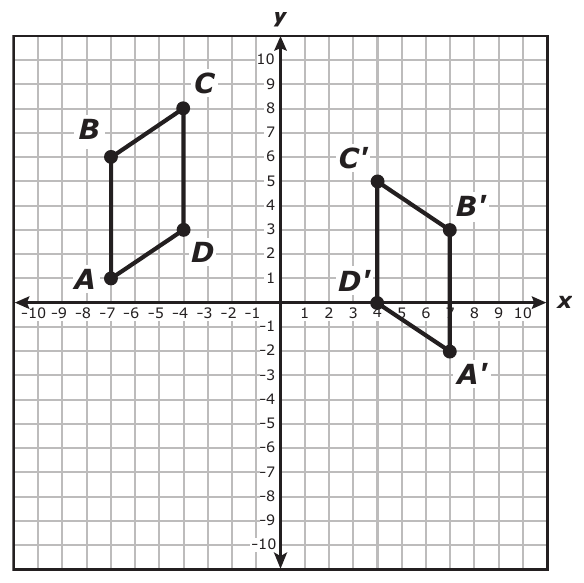
Parallelogram was transformed to form parallelogram . Which rule describes the transformation that was used to form parallelogram ?
Show STAAR answer and explanation
The image is reflected across the y-axis and translated down 3 units: for example A(−8, 1) maps to A′(8, −2). Thus the rule is .
: This reflects over the x-axis, leaving x unchanged and not producing the image to the right.
: This reflects over the y-axis but omits the 3-unit downward translation.
: This reflects over the x-axis and shifts right 6; it does not map A to A′.
Learning objectives
By the end of the lesson, students can:
- Write coordinate rules for reflections across the axes and translations.
- Describe a reflection followed by a translation using one coordinate rule.
- Verify congruence transformations with multiple corresponding points.
Instructional sequence
- 1
Engage
5 minShow two congruent asymmetric polygons on a grid. Ask whether the same horizontal and vertical shift maps every vertex.
- 2
Direct instruction
12 minReview reflection rules and translation notation. Contrast negating a coordinate with adding a constant.
- 3
Composition model
10 minReflect a polygon across the y-axis, then translate it vertically. Record intermediate points and combine the operations into one rule.
- 4
Rule testing
15 minStudents compare candidate rules against every corresponding vertex and describe the successful rule in words.
- 5
Closure
8 minComplete the exit ticket and name the measurements preserved by the transformation.
Misconceptions to address
Teacher move: The y-coordinate stays fixed. The horizontal distance to the y-axis changes sides, so x changes sign.
Teacher move: Several transformations can map one point to the same image. Test other corresponding vertices, especially points with different coordinates.