

Triangle Congruence
Justify and apply triangle congruence relationships.
Students decide whether triangle information establishes congruence, apply SSS, SAS, ASA, AAS, and HL correctly, and use congruent right triangles to explain altitude and angle-bisector properties in isosceles triangles.
Lesson plan and worked examples by TEKSForge · not a TEA-issued lesson. Videos by independent educators.
Archived course: TEKS code and readiness label from TEA's 2013 Geometry key. Geometry is not one of Texas's current required STAAR EOC assessments, and this lesson does not change the Biology and Algebra I Study Plans.
Learn the concept
Enough information, in the correct arrangement
SSS uses three corresponding sides. SAS uses two sides and their included angle. ASA uses two angles and the included side; AAS uses two angles and a nonincluded side. AAA establishes similarity only. General SSA does not establish congruence.
Right triangles and split triangles
HL applies only when both triangles are right triangles and their hypotenuses and one pair of legs are congruent. An altitude creates right triangles. If its foot is also a midpoint, the shared altitude and equal base pieces give SAS. If it bisects the vertex angle, the two right angles, equal vertex angles, and shared altitude give ASA.
Use corresponding parts after congruence
Once triangles are congruent, corresponding sides and angles are congruent. Write the vertex correspondence before transferring a measure. If two angles of a triangle are known, use the 180° angle sum to find the third before matching it to the other triangle.
Study released STAAR visuals
Use the original graphs, tables, and diagrams from released STAAR questions to practice reading labels, values, and relationships before answering the items below.
Archived released STAAR Geometry EOC · 2013 · Item 31 · 1 point
Archived released STAAR Geometry EOC · 2013 · Item 43 · 1 point
Worked example
In triangle ABC, AD is perpendicular to BC and bisects ∠BAC. The angles at B and C correspond across AD. If ∠B = 56°, prove AB = AC and find ∠BAC.
- Triangles ABD and ACD each have a right angle at D.
- AD bisects ∠BAC, so ∠BAD = ∠DAC. Segment AD is shared.
- The two angles and included side establish △ABD ≅ △ACD by ASA.
- Corresponding sides give AB = AC, and corresponding base angles give ∠C = 56°.
- The triangle angle sum gives ∠BAC = 180° − 56° − 56° = 68°.
AB = AC by corresponding parts of congruent triangles; ∠BAC = 68°
Watch the lesson
Texas public-school, Texas educator-created, and TEKS-aligned lessons, hosted by their creators. Each card names its source.
Congruent triangles and SSS | Congruence | Geometry | Khan Academy
Khan Academy · Geometry (TX TEKS) courseBuild the meaning of triangle congruence, corresponding parts, and the SSS criterion before comparing other sufficient conditions.
Watch on YouTubeTry it yourself
TEKSForge practice · unscored
1. Two triangles have corresponding sides 7 and 10 and a corresponding 35° angle opposite the side of length 7. Does this information alone prove congruence?
Show answer and reasoning
No
The angle is not included between the known sides, so the information is SSA. In this case two different triangles are possible; a valid criterion needs additional information.
2. Right triangles JKL and PQR have right angles at K and Q, hypotenuses JL = PR, and legs JK = PQ. If ∠J = 37°, find ∠R.
Show answer and reasoning
53°
The triangles are congruent by HL, with J ↔ P, K ↔ Q, and L ↔ R. Angle L is 180° − 90° − 37° = 53°, so angle R is 53°.
3. Altitude VT in triangle UVW is drawn to UW. Which guarantees VU = VW: UT = TW, or VT = 6 alone?
Show answer and reasoning
UT = TW guarantees it; VT = 6 alone does not.
Equal base pieces, the shared altitude, and right included angles prove the halves congruent by SAS. Knowing only the altitude's length supplies no equality between the two halves.
Released STAAR practice
Texas Education Agency · archived 2013 released EOC items · scored with TEA's answer key; step-by-step explanations written by TEKSForge because this release has no rationales. Original graphs, tables, and diagrams are shown where the released item includes one.
Archived released STAAR Geometry EOC · 2013 · Item 3 · 1 point
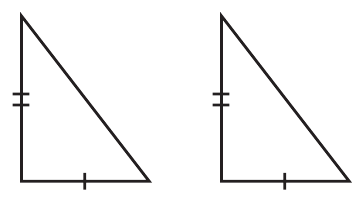
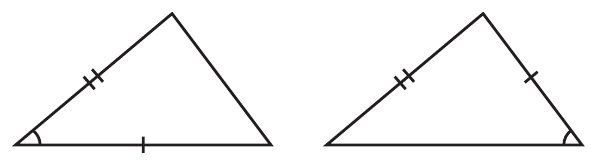
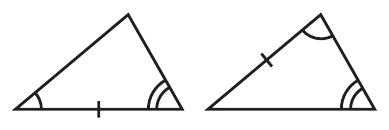
Which pair of triangles has enough given information to prove that the triangles are congruent?
- Pair A
- Pair B
- Pair C
- None of these
Show STAAR answer and explanation
None of these
None of the pairs supplies a valid congruence condition. Pair A marks only two side pairs, without a right-angle mark. Pair B places the marked angle between the marked sides in only one triangle. Pair C marks equal sides in noncorresponding positions relative to its equal angles.
Pair A: Pair A shows two pairs of congruent sides but no marked included angle or right angle; appearance alone cannot establish SAS or HL.
Pair B: Pair B marks two side pairs, but the angle is included in one triangle and non-included in the other; this is not SAS.
Pair C: Pair C shows two angle pairs, but the marked side is between those angles only in the first triangle. The sides are not corresponding, so ASA or AAS does not establish congruence.
Archived released STAAR Geometry EOC · 2013 · Item 31 · 1 point
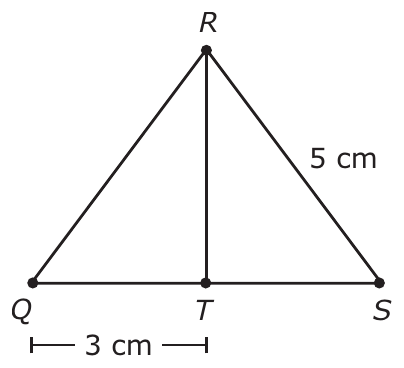
In , is an altitude. Which additional condition would not be sufficient to prove that ?
- is the midpoint of .
- bisects .
- cm
- cm
Show STAAR answer and explanation
cm
QT = 3 and RS = 5 are given. If TS = 2, then and , so QR is not 5. This condition does not prove equality.
is the midpoint of .: A midpoint gives QT = TS; the right triangles share RT and are congruent by SAS.
bisects .: An angle bisector gives equal angles at R; the right triangles share RT and are congruent by ASA.
cm: With RT = 4 and RS = 5, TS = 3 by the Pythagorean theorem. Then QT = TS and the right triangles are congruent.
Archived released STAAR Geometry EOC · 2013 · Item 43 · 1 point
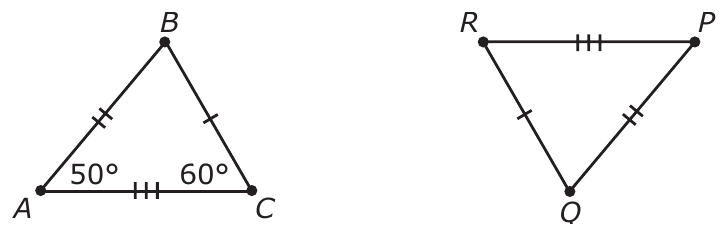
and are shown in the diagram. Based on the information provided in the diagram, what is in degrees?
Show STAAR answer and explanation
50
The side marks pair AB with PQ, BC with QR, and AC with PR, so the triangles are congruent by SSS. Vertex A, where the double- and triple-marked sides meet, corresponds to P. Therefore .
70: 70° is angle B, which corresponds to Q, not P.
Learning objectives
By the end of the lesson, students can:
- Select a valid triangle congruence criterion and reject unsupported SSA or AAA arguments.
- Use an altitude with midpoint or angle-bisector information to prove an isosceles relationship.
- Match corresponding vertices to find missing angle measures or side lengths.
Instructional sequence
- 1
Engage
5 minGive pairs of students three side lengths or two sides and a nonincluded angle. Ask which information fixes a unique triangle.
- 2
Direct instruction
13 minOrganize SSS, SAS, ASA, AAS, and HL. Mark the included angle or side and explain the special right-triangle conditions for HL.
- 3
Evidence sort
12 minClassify triangle pairs by a valid criterion or not enough information. Include shared sides, right-angle marks, SSA, and AAA.
- 4
Altitude applications
17 minSplit a triangle with an altitude. Prove the halves congruent when the foot is a midpoint or the altitude bisects the vertex angle, then use corresponding parts.
- 5
Closure
8 minComplete the exit ticket with a named congruence criterion and a corresponding-parts conclusion.
Misconceptions to address
Teacher move: For SAS, the angle must be between the two known sides. General SSA can describe different triangles. HL is a special right-triangle case with a known hypotenuse and leg.
Teacher move: An altitude guarantees perpendicularity only. A midpoint or angle-bisector condition is additional information that can establish congruent halves.
Teacher move: Match vertices using the congruence statement and side marks. Rotated or reflected drawings may place corresponding angles in different visual positions.