

Dilations and Scale Factors
Describe how dilations change lengths while preserving angle measures.
Students investigate dilations, showing that every length is multiplied by the scale factor while angle measures, parallel sides, and the figure's shape are preserved.
Lesson plan and worked examples by TEKSForge · not a TEA-issued lesson. Videos by independent educators.
Archived course: TEKS code and readiness label from TEA's 2013 Geometry key. Geometry is not one of Texas's current required STAAR EOC assessments, and this lesson does not change the Biology and Algebra I Study Plans.
Learn the concept
Lengths multiply by k
A dilation with scale factor k multiplies every distance by k. If , the figure enlarges; if , it shrinks. Perimeter also multiplies by k.
Shape is preserved
Corresponding angles keep the same measure, and parallel sides remain parallel. Because the shape is unchanged, the image is similar to the original figure. An isosceles trapezoid stays an isosceles trapezoid.
Dilations on coordinates
A dilation centered at the origin maps to . Multiply both coordinates by the same scale factor.
Study released STAAR visuals
Use the original graphs, tables, and diagrams from released STAAR questions to practice reading labels, values, and relationships before answering the items below.
Archived released STAAR Geometry EOC · 2013 · Item 2 · 1 point
Worked example
A right triangle has sides 3, 4, and 5. It is dilated by a scale factor of 2.5. Describe the image.
- Multiply each side by 2.5: 7.5, 10, and 12.5.
- The right angle remains 90°, and the other angles are unchanged.
- The perimeter changes from 12 to 12(2.5) = 30.
A similar right triangle with sides 7.5, 10, and 12.5 and the same angles
Watch the lesson
Texas public-school, Texas educator-created, and TEKS-aligned lessons, hosted by their creators. Each card names its source.
8th Grade Math Applying Dilations
Five Minute Math · Aaron Daffern, Dallas ISDApply scale factors to dilate figures and compare corresponding side lengths and angles.
Watch on YouTubeTry it yourself
TEKSForge practice · unscored
1. A 6-by-10 rectangle is dilated by a scale factor of . Give the new dimensions and angles.
Show answer and reasoning
3 by 5, with four right angles
Each length is halved, while every 90° angle stays 90°.
2. Dilate the point (4, −6) by a scale factor of 1.5 centered at the origin.
Show answer and reasoning
(6, −9)
Multiply both coordinates by 1.5.
Released STAAR practice
Texas Education Agency · archived 2013 released EOC items · scored with TEA's answer key; step-by-step explanations written by TEKSForge because this release has no rationales. Original graphs, tables, and diagrams are shown where the released item includes one.
Archived released STAAR Geometry EOC · 2013 · Item 2 · 1 point
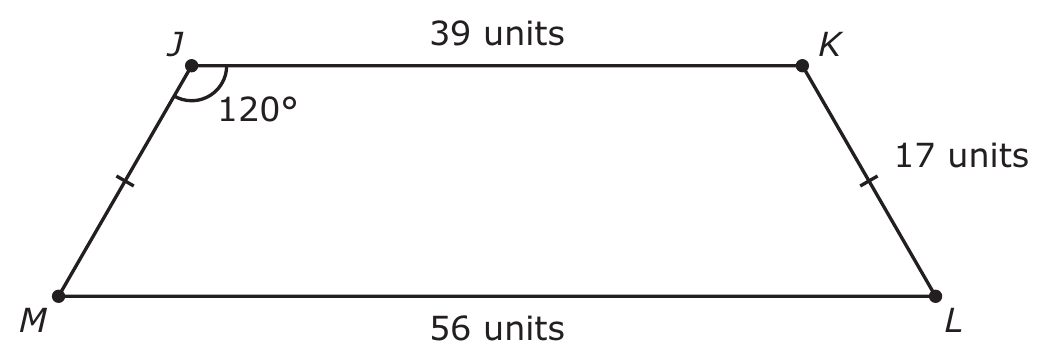
Isosceles trapezoid is shown. If its dimensions are multiplied by a scale factor of to create trapezoid , which statement is true?
- Trapezoid contains two base angles measuring 30° each.
- The longer base of trapezoid is units.
- The bases of trapezoid have lengths of 22 units and 39 units.
- Trapezoid contains two base angles measuring each.
Show STAAR answer and explanation
The longer base of trapezoid is units.
A dilation multiplies every side length by f. The longer base is 56 units, so its image measures units. Angle measures remain unchanged.
Trapezoid contains two base angles measuring 30° each.: The original base angles are 120° and 60°, and dilation does not change angle measures.
The bases of trapezoid have lengths of 22 units and 39 units.: The original bases are 39 and 56 units; their images must be and for the stated scale factor.
Trapezoid contains two base angles measuring each.: Scale factors multiply lengths, not angle measures, so the 120° angle remains 120°.
Learning objectives
By the end of the lesson, students can:
- Multiply side lengths and perimeters by a dilation's scale factor.
- Explain why dilations preserve angle measures and parallel lines.
- Dilate coordinate points from the origin.
Instructional sequence
- 1
Engage
5 minShow a photo and its enlargement. Ask what changed and what stayed the same.
- 2
Investigation
12 minDilate a trapezoid by 2 from the origin, then measure corresponding sides and angles.
- 3
Direct instruction
10 minSummarize: lengths multiply by k, angles stay the same, and the image is similar to the preimage.
- 4
Guided practice
12 minEvaluate statements about dilated figures and correct the false ones.
- 5
Closure
6 minStudents complete the exit ticket with a reason for each answer.
Misconceptions to address
Teacher move: Measure corresponding angles before and after a dilation. Only lengths change; the shape and angle measures stay the same.
Teacher move: Dilation multiplies. Adding the same amount to unequal sides changes the shape and does not create a similar figure.