

Triangle Similarity and Trigonometry
Use trigonometric ratios and similar-triangle proportions to determine unknown side lengths.
Students use triangle similarity and side-splitter proportions to find lengths, then use sine, cosine, and tangent to express or calculate right-triangle sides from either complementary acute angle.
Lesson plan and worked examples by TEKSForge · not a TEA-issued lesson. Videos by independent educators.
Archived course: TEKS code and readiness label from TEA's 2013 Geometry key. Geometry is not one of Texas's current required STAAR EOC assessments, and this lesson does not change the Biology and Algebra I Study Plans.
Learn the concept
Label from the angle
For a chosen acute angle, the hypotenuse is opposite the right angle, the opposite side faces the chosen angle, and the adjacent side touches the chosen angle without being the hypotenuse.
Choose the ratio
, , and . Pick the ratio that includes the side you know and the side you need.
Why the ratios are constant
Right triangles with the same acute angle are similar by AA. Their corresponding sides are proportional, so each trigonometric ratio has one value for that angle, regardless of the triangle's size.
A parallel segment splits sides proportionally
In triangle ABC, let D lie on AB and E lie on AC, with . Corresponding angles show by AA. Thus , and the side-splitter relationship is . Compare part to whole on both sides, or corresponding parts on both sides; do not mix the two.
Express a side from complementary angles
The acute angles of a right triangle sum to 90°. Changing the reference angle swaps opposite and adjacent, so . If a leg of length 17 is adjacent to 25° and the opposite leg is x, then . If the hypotenuse is c, that same opposite leg is . An exact trig expression is a valid answer without a decimal.
Study released STAAR visuals
Use the original graphs, tables, and diagrams from released STAAR questions to practice reading labels, values, and relationships before answering the items below.
Archived released STAAR Geometry EOC · 2013 · Item 7 · 1 point
Archived released STAAR Geometry EOC · 2013 · Item 23 · 1 point
Archived released STAAR Geometry EOC · 2013 · Item 52 · 1 point
Worked example
A right triangle has a 35° angle and a hypotenuse of 12. Find the side adjacent to the 35° angle.
- The known side is the hypotenuse, and the unknown side is adjacent.
- Use cosine: .
- Multiply: .
About 9.83 units
Watch the lesson
Texas public-school, Texas educator-created, and TEKS-aligned lessons, hosted by their creators. Each card names its source.
Geometry: Trigonometry
UT IPSI · Kid2Kid / Texas Education AgencyUse sine, cosine, and tangent to find unknown sides in right triangles.
Watch on YouTubeTry it yourself
TEKSForge practice · unscored
1. A right triangle has a 50° angle with an adjacent side of 8. Find the opposite side.
Show answer and reasoning
About 9.53 units
Use tangent: .
2. A right triangle has legs of 6 and 8. Find the hypotenuse.
Show answer and reasoning
10 units
This is a multiple of the 3-4-5 Pythagorean triple, so the hypotenuse is 10.
3. In triangle ABC, D lies on AB and E lies on AC, with . If AD = 4, DB = 6, and AE = 10, find EC.
Show answer and reasoning
15 units
Use corresponding split segments: , so .
4. A right triangle has a 25° angle and an adjacent leg of 17 cm. Express the opposite leg using tangent of each acute angle, then approximate its length.
Show answer and reasoning
cm
, while . Solve each equation for x.
Released STAAR practice
Texas Education Agency · archived 2013 released EOC items · scored with TEA's answer key; step-by-step explanations written by TEKSForge because this release has no rationales. Original graphs, tables, and diagrams are shown where the released item includes one.
Archived released STAAR Geometry EOC · 2013 · Item 7 · 1 point
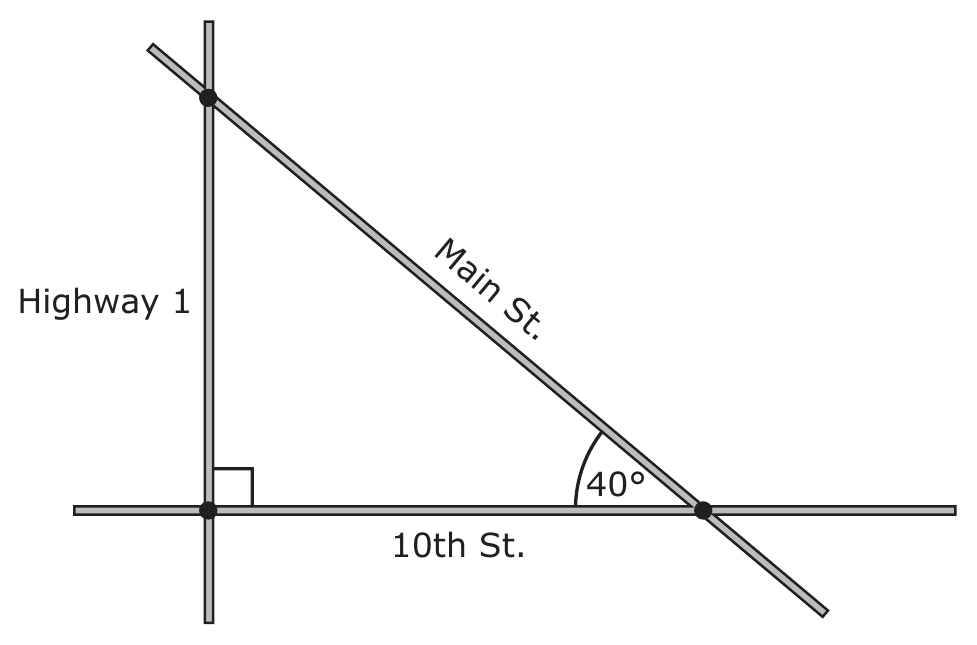
On the map, Main Street, 10th Street, and Highway 1 intersect to form a right triangle. The distance between 10th Street and Main Street along Highway 1 is 5.6 miles. Which measure is closest to the length of Main Street from Highway 1 to 10th Street?
- 8.7 mi
- 3.6 mi
- 4.7 mi
- 7.3 mi
Show STAAR answer and explanation
8.7 mi
Highway 1 is opposite the 40° angle and Main Street is the hypotenuse. Therefore miles.
3.6 mi: This is approximately , but dividing by sine is required to find the hypotenuse.
4.7 mi: This is approximately and would not be the hypotenuse; the answer must exceed 5.6 miles.
7.3 mi: This uses cosine instead of sine. The 5.6-mile Highway 1 side is opposite the 40° angle.
Archived released STAAR Geometry EOC · 2013 · Item 23 · 1 point
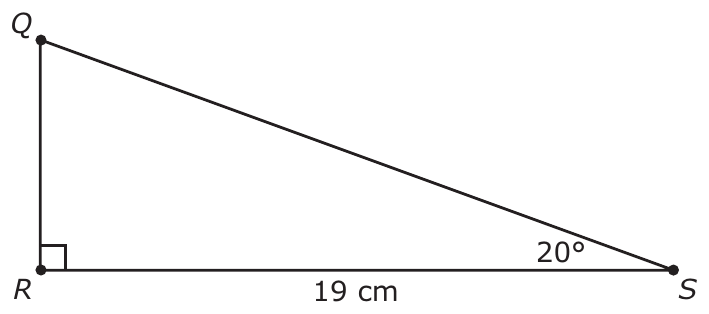
Which expression can be used to find the length of in centimeters?
Show STAAR answer and explanation
Relative to the 20° angle, QR is opposite and RS = 19 is adjacent. Therefore , so .
: Cosine compares adjacent leg to hypotenuse; QR is opposite the 20° angle.
: Relative to 70°, the 19-cm side is opposite, not the hypotenuse required by this sine multiplication.
: At 70°, tangent is , so QR would be , not the product.
Archived released STAAR Geometry EOC · 2013 · Item 52 · 1 point
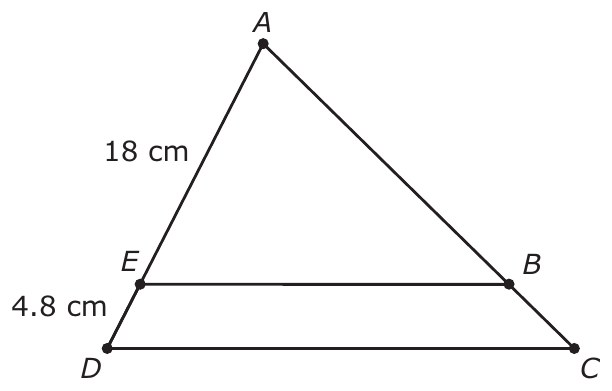
In shown, . If cm, what is the length of ?
- 22.5 cm
- 14.4 cm
- 36.1 cm
- 23.7 cm
Show STAAR answer and explanation
22.5 cm
Parallel EB and DC make triangles AEB and ADC similar. Since , . Thus cm.
14.4 cm: This does not apply the matching-side ratio .
36.1 cm: This reverses the similarity ratio and gives AB longer than the entire side AC.
23.7 cm: This subtracts 4.8 directly from AC instead of scaling corresponding sides.
Learning objectives
By the end of the lesson, students can:
- Label opposite, adjacent, and hypotenuse relative to a given acute angle.
- Choose sine, cosine, or tangent to express a side using either complementary acute angle.
- Solve for unknown sides and connect trigonometric ratios to similar right triangles.
- Use a segment parallel to a triangle's side to write proportional side lengths.
Instructional sequence
- 1
Engage
5 minShow two similar right triangles with the same acute angle. Ask what stays the same about their side ratios.
- 2
Direct instruction
10 minDefine sine, cosine, and tangent relative to an acute angle and label sides on several orientations.
- 3
Guided practice
15 minSolve multiplication and division cases, deciding whether the unknown side is in the numerator or denominator.
- 4
Map application
12 minSolve a street-map right triangle and interpret the answer in miles.
- 5
Parallel segments and complementary angles
5 minSet up a side-splitter proportion and compare equivalent side expressions using complementary acute angles.
- 6
Closure
8 minStudents complete the exit ticket and check their calculator mode.
Misconceptions to address
Teacher move: Opposite and adjacent depend on the chosen angle. Point to the angle before labeling the sides.
Teacher move: Write the ratio first. If the unknown is in the denominator, solving requires division.
Teacher move: Match corresponding segments consistently. Label whole sides as sums before writing a proportion.