

Constructions and Conjectures
Use compass-and-straightedge constructions to explore attributes of figures and make conjectures.
Students construct a perpendicular bisector with a compass and straightedge, explain what the equal-radius arcs guarantee, and use the construction to make justified conjectures about triangles and angles.
Lesson plan and worked examples by TEKSForge · not a TEA-issued lesson. Videos by independent educators.
Archived course: TEKS code and readiness label from TEA's 2013 Geometry key. Geometry is not one of Texas's current required STAAR EOC assessments, and this lesson does not change the Biology and Algebra I Study Plans.
Learn the concept
Build with equal radii
Open the compass to more than half the segment's length. Without changing the opening, draw arcs from each endpoint that intersect on both sides of the segment. The line through those intersections is the perpendicular bisector.
Read the construction's evidence
An arc intersection is the same distance from both endpoints because those distances are radii drawn with the same compass opening. Joining that point to the endpoints forms an isosceles triangle with congruent base angles.
Separate facts from appearance
The constructed line crosses the segment at its midpoint and forms right angles. Equal sides and right angles follow from the construction, not from how symmetric the drawing looks. Adjacent right angles total 180°, not 90°.
Study released STAAR visuals
Use the original graphs, tables, and diagrams from released STAAR questions to practice reading labels, values, and relationships before answering the items below.
Archived released STAAR Geometry EOC · 2013 · Item 39 · 1 point
Worked example
Equal-radius arcs centered at L and N intersect at R and S. Line RS crosses LN at T. If LN = 14 cm and ∠RLN = 38°, find LT, ∠RTN, and ∠LNR.
- RS is the perpendicular bisector of LN, so T is the midpoint.
- LT = 14 ÷ 2 = 7 cm.
- RS is perpendicular to LN, so ∠RTN = 90°.
- RL = RN because both were drawn with the same radius. Triangle LRN is isosceles, so its base angles at L and N are equal.
LT = 7 cm; ∠RTN = 90°; ∠LNR = 38°
Watch the lesson
Texas public-school, Texas educator-created, and TEKS-aligned lessons, hosted by their creators. Each card names its source.
Constructing square inscribed in circle | Geometric constructions | Geometry | Khan Academy
Khan Academy · Geometry (TX TEKS) courseWatch the equal-radius construction of a perpendicular bisector, then connect its guarantees to an inscribed square.
Watch on YouTubeTry it yourself
TEKSForge practice · unscored
1. Why must the compass opening be greater than half the distance between the endpoints?
Show answer and reasoning
So the arcs intersect at two distinct points.
A smaller radius produces no intersection. A radius equal to half the segment length produces only one intersection, which is not enough to determine the bisector line.
2. P lies on the constructed perpendicular bisector of AB. If PA = 11 cm, what is PB? Must triangle APB be equilateral?
Show answer and reasoning
PB = 11 cm; the triangle need not be equilateral.
Equidistance guarantees PA = PB. It does not guarantee that AB is also 11 cm.
Released STAAR practice
Texas Education Agency · archived 2013 released EOC items · scored with TEA's answer key; step-by-step explanations written by TEKSForge because this release has no rationales. Original graphs, tables, and diagrams are shown where the released item includes one.
Archived released STAAR Geometry EOC · 2013 · Item 39 · 1 point
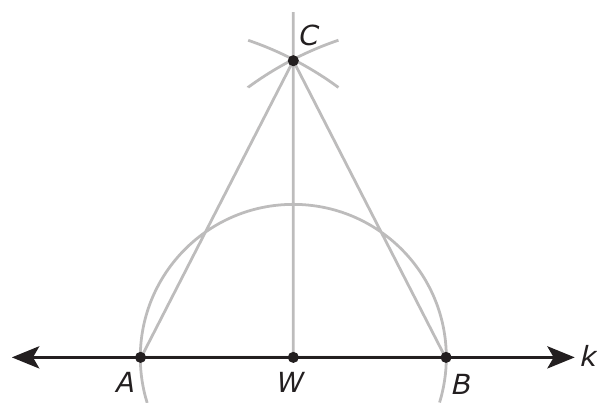
The diagram shows the arcs and segments used to construct , given line . Based on this construction, which statement is not true?
- is complementary to .
- is a right triangle.
- is isosceles.
Show STAAR answer and explanation
is complementary to .
The equal-radius arcs construct the perpendicular bisector CW of AB. Both AWC and CWB measure 90°, so their sum is 180°; they are supplementary, not complementary.
is a right triangle.: CW is perpendicular to WB, so CWB is indeed a right triangle.
is isosceles.: C lies on the perpendicular bisector of AB, giving CA = CB; the triangle is isosceles.
: Equal sides CA and CB imply equal base angles CAB and CBA.
Learning objectives
By the end of the lesson, students can:
- Construct a segment's perpendicular bisector using equal-radius arcs.
- Identify equal distances and right angles guaranteed by the construction.
- Distinguish conclusions supported by construction marks from conclusions based only on appearance.
Instructional sequence
- 1
Engage
5 minAsk students to locate a point equally far from two marked locations without measuring the two distances separately.
- 2
Construction
12 minDraw a segment, set the compass wider than half its length, and draw matching arcs from both endpoints above and below the segment. Connect the arc intersections.
- 3
Direct instruction
10 minExplain why the arc intersections are equidistant from the endpoints. Identify the midpoint, perpendicular line, and isosceles triangles created by the construction.
- 4
Conjecture check
15 minStudents sort claims as guaranteed, possible, or impossible. Include right angles, equal base angles, and the incorrect claim that two adjacent right angles are complementary.
- 5
Closure
8 minPartners inspect each other's visible construction arcs and complete the exit ticket with a reason.
Misconceptions to address
Teacher move: The arcs must use the same radius from both endpoints. Unequal radii do not guarantee equal distances to the endpoints.
Teacher move: Each angle is 90°. Together they total 180°, so they are supplementary, not complementary.