

Angle, Line, and Circle Conjectures
Make and test conjectures about angles, lines, polygons, and circles.
Students make and test conjectures about parallel and perpendicular lines, central angles and chords, and parallel cross sections of pyramids, separating guaranteed relationships from visual guesses.
Lesson plan and worked examples by TEKSForge · not a TEA-issued lesson. Videos by independent educators.
Archived course: TEKS code and readiness label from TEA's 2013 Geometry key. Geometry is not one of Texas's current required STAAR EOC assessments, and this lesson does not change the Biology and Algebra I Study Plans.
Learn the concept
Parallel lines carry angle relationships
When a transversal crosses parallel lines, corresponding angles are congruent. If one intersection contains a right angle, the matching angle at the other intersection is also right. This can establish that a triangle contains a right angle.
Central angles determine chords
Two radii and their included central angle form a triangle. In the same circle, congruent central angles make these triangles congruent by SAS, so the opposite chords are congruent. The intercepted arcs also have equal measures.
Parallel sections preserve shape
A plane parallel to a pyramid's base forms a similar cross section. Corresponding base and cross-section angles are congruent, and distances from the vertex along corresponding edges are proportional. Angles involving other edges need separate justification.
Study released STAAR visuals
Use the original graphs, tables, and diagrams from released STAAR questions to practice reading labels, values, and relationships before answering the items below.
Archived released STAAR Geometry EOC · 2013 · Item 5 · 1 point
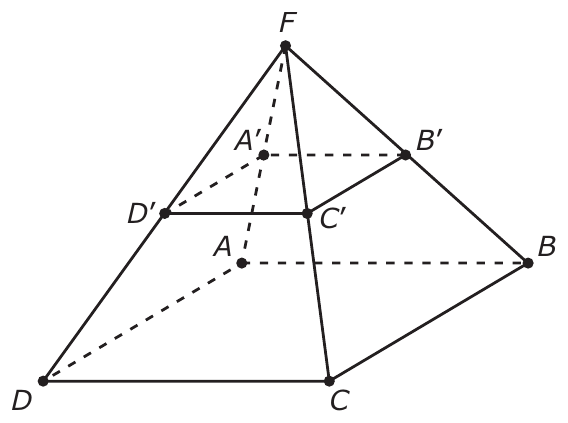
Archived released STAAR Geometry EOC · 2013 · Item 24 · 1 point
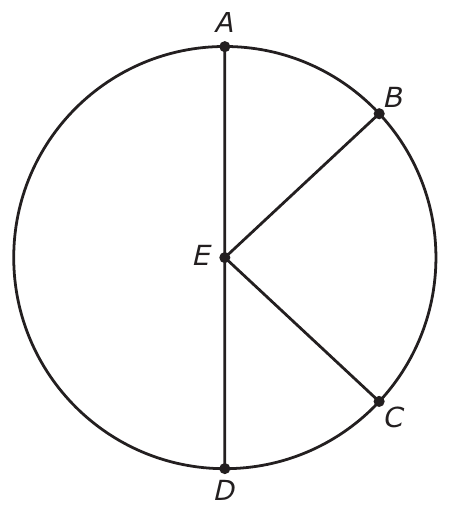
Archived released STAAR Geometry EOC · 2013 · Item 36 · 1 point
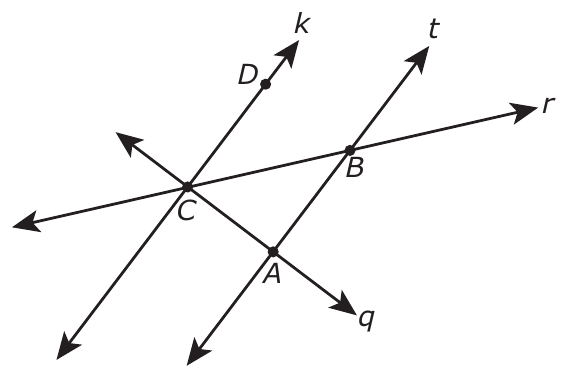
Worked example
In circle O, ∠AOB = ∠COD = 64° and AB = 9 cm. Separately, lines p and q are parallel and line t is perpendicular to p. Find CD and the angle where t meets q.
- OA, OB, OC, and OD are radii of the same circle.
- The two radius pairs and equal included central angles establish SAS congruence.
- Corresponding chords AB and CD are equal, so CD = 9 cm.
- Because p and q are parallel, t forms a right angle with q just as it does with p.
CD = 9 cm; t meets q at 90°
Watch the lesson
Texas public-school, Texas educator-created, and TEKS-aligned lessons, hosted by their creators. Each card names its source.
Geometry: Conjectures about Circles
UT IPSI · Kid2Kid / Texas Education AgencyDevelop and test conjectures using central angles, radii, and chords.
Watch on YouTube8th Grade Math Parallel Lines Cut by a Transversal
Five Minute Math · Aaron Daffern, Dallas ISDReview the angle relationships used to transfer a right angle across parallel lines.
Watch on YouTubeTry it yourself
TEKSForge practice · unscored
1. A cross section parallel to a rectangular pyramid's 12-by-8 base has a corresponding longer side of 9. Find its shorter side.
Show answer and reasoning
6 units
The cross section is similar to the base. The scale factor is 9/12 = 3/4, so the shorter side is 8(3/4) = 6.
2. Two central angles measure 50°, one in a circle of radius 3 and one in a circle of radius 8. Must their chords be congruent?
Show answer and reasoning
No
The circles are not congruent. Equal central angles guarantee equal chord lengths only within the same circle or congruent circles.
Released STAAR practice
Texas Education Agency · archived 2013 released EOC items · scored with TEA's answer key; step-by-step explanations written by TEKSForge because this release has no rationales. Original graphs, tables, and diagrams are shown where the released item includes one.
Archived released STAAR Geometry EOC · 2013 · Item 5 · 1 point
The rectangular pyramid shown was intersected by a plane parallel to base to form quadrilateral . Based on this information, which statement cannot be proved true?
Show STAAR answer and explanation
A parallel cross section is a dilation of the rectangular base with center F. It preserves base angles and gives equal ratios along the lateral edges, but it does not establish equality of angles in different lateral faces.
: Parallel sections of a pyramid are similar to the base, so this can be proved.
: The same dilation factor applies along AF and BF, so these ratios are equal.
: These are corresponding angles of similar rectangles, so this can be proved.
Archived released STAAR Geometry EOC · 2013 · Item 24 · 1 point
In circle shown, . Based on this information, which statement must be true?
Show STAAR answer and explanation
Congruent central angles intercept congruent arcs and congruent chords in the same circle, so chords AB and CD are congruent.
: No 90° measure for BEC is given; equal outer central angles do not force perpendicular radii.
: This would require DEC = 45°, which is not given.
: The three central angles AEB, BEC, and CED sum to 180°; the outer two need not sum to the middle one.
Archived released STAAR Geometry EOC · 2013 · Item 36 · 1 point
In the figure, and . Based on this information, which statement can be proved true?
- is an acute triangle.
- is a right triangle.
Show STAAR answer and explanation
is a right triangle.
A line perpendicular to one of two parallel lines is perpendicular to the other. Since k is perpendicular to q and parallel to t, t is perpendicular to q. Thus angle CAB is 90°.
: The information proves a right angle, not equal legs or equal acute angles.
is an acute triangle.: The angle at A is 90°, so the triangle is not acute.
: These angles partition the right angle DCA; neither is specified as 45°, so equality is not forced.
Learning objectives
By the end of the lesson, students can:
- Transfer perpendicular relationships between parallel lines.
- Connect congruent central angles to congruent chords in the same circle.
- Use parallel cross sections to identify similar figures and corresponding angles.
Instructional sequence
- 1
Engage
5 minDisplay a misleading sketch of parallel lines crossed by a perpendicular. Ask whether the drawing or the markings should control the conclusion.
- 2
Line investigation
12 minUse tracing and angle relationships to show that a line perpendicular to one of two parallel lines is perpendicular to the other.
- 3
Circle investigation
10 minDraw equal central angles in one circle and compare their chords. Justify the equal chords using two radii and the included angle.
- 4
Cross-section reasoning
15 minCompare a pyramid's base with a parallel cross section. Match corresponding sides and angles, and reject unsupported claims involving unrelated slant edges.
- 5
Closure
8 minStudents write one guaranteed conclusion and one tempting but unsupported conclusion before completing the exit ticket.
Misconceptions to address
Teacher move: The circles must be the same circle or congruent circles. Equal angles in different-sized circles can cut off different chord lengths.
Teacher move: It is similar to the base, but generally smaller. Corresponding angles agree while side lengths share a scale factor.
Teacher move: A right angle depends on perpendicular sides, not the triangle's orientation on the page.