

Choosing Representations
Select a pictorial, verbal, or symbolic representation to solve geometry problems.
Students choose and connect diagrams, verbal descriptions, and algebraic expressions to solve angle problems in isosceles trapezoids, including angles formed by extending the legs.
Lesson plan and worked examples by TEKSForge · not a TEA-issued lesson. Videos by independent educators.
Archived course: TEKS code and readiness label from TEA's 2013 Geometry key. Geometry is not one of Texas's current required STAAR EOC assessments, and this lesson does not change the Biology and Algebra I Study Plans.
Learn the concept
Choose a diagram for spatial information
A sketch shows which lines are parallel and which rays form an angle. Mark the parallel bases and congruent base angles of an isosceles trapezoid. Extend lines only as described, and preserve the labels when redrawing.
Translate the diagram into relationships
Parallel bases let you transfer angles using corresponding angles. An interior angle and an adjacent exterior angle form a linear pair totaling 180°. In the triangle formed by the extended legs, all three interior angles total 180°.
Choose symbols for a general answer
If the two base angles of the small triangle each measure b degrees, its vertex angle is . If a given exterior angle e is supplementary to b, substitute before simplifying. The expression depends on which angle is labeled.
Study released STAAR visuals
Use the original graphs, tables, and diagrams from released STAAR questions to practice reading labels, values, and relationships before answering the items below.
Archived released STAAR Geometry EOC · 2013 · Item 32 · 1 point
Worked example
An isosceles trapezoid has a longer horizontal base below a shorter base. The legs extend upward to P. The exterior angle beside the lower-right vertex, formed by extending the lower base to the right, is 126°. Find the angle at P.
- Draw the trapezoid and mark the 126° angle outside the lower-right vertex.
- The lower-right interior angle is 180° − 126° = 54°.
- The two lower base angles are equal. By parallel bases, the small triangle above the trapezoid has two base angles of 54°.
- The remaining angle at P is 180° − 54° − 54° = 72°.
72°
Watch the lesson
Texas public-school, Texas educator-created, and TEKS-aligned lessons, hosted by their creators. Each card names its source.
8th Grade Math Parallel Lines Cut by a Transversal
Five Minute Math · Aaron Daffern, Dallas ISDUse diagrams and angle relationships to translate parallel-line information into equations.
Watch on YouTubeTry it yourself
TEKSForge practice · unscored
1. In the same extended-leg layout, the lower interior base angles are 67°. Find the vertex angle above the trapezoid.
Show answer and reasoning
46°
The small triangle has two 67° base angles, so its vertex angle is 180° − 2(67°) = 46°.
2. Each base angle of a triangle is (4y + 9)°. Which is correct for the third angle: 180 − (4y + 9) or 180 − 2(4y + 9)?
Show answer and reasoning
180 − 2(4y + 9)
Both equal base angles must be subtracted from 180°. An annotated diagram makes the repeated angle visible.
Released STAAR practice
Texas Education Agency · archived 2013 released EOC items · scored with TEA's answer key; step-by-step explanations written by TEKSForge because this release has no rationales. Original graphs, tables, and diagrams are shown where the released item includes one.
Archived released STAAR Geometry EOC · 2013 · Item 32 · 1 point
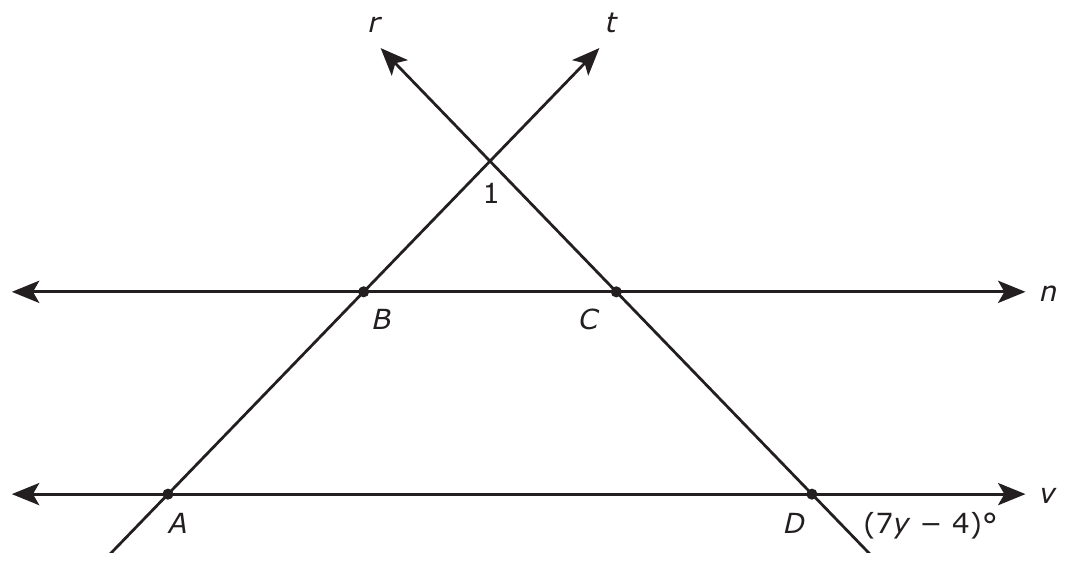
Lines , , , and intersect as shown to form isosceles trapezoid . Which expression represents the measure of in degrees?
Show STAAR answer and explanation
The labeled angle at D is vertical to the trapezoid base angle there. Both base angles at A and D are . The triangle formed by the extended legs therefore has apex angle .
: Triangle angles add to 180°; division by one base angle is not the angle-sum relationship.
: This is a base angle, not the apex angle.
: This subtracts only one base angle; both equal base angles must be subtracted.
Learning objectives
By the end of the lesson, students can:
- Annotate a diagram with parallel bases, equal base angles, and extensions.
- Translate angle relationships into equations or expressions.
- Choose a representation that makes a multistep angle relationship easier to see.
Instructional sequence
- 1
Engage
5 minGive a verbal trapezoid description without a picture. Ask students what information a sketch would make easier to track.
- 2
Represent the givens
12 minDraw an isosceles trapezoid with a horizontal longer base below a shorter base. Extend the legs upward until they meet and label the small triangle.
- 3
Direct instruction
10 minConnect equal base angles, corresponding angles, linear pairs, and the triangle angle sum to symbolic expressions.
- 4
Guided practice
15 minMove among words, annotated diagrams, and algebra. Compare an interior base angle with its exterior supplement before substituting expressions.
- 5
Closure
8 minComplete the exit ticket and explain which representation prevented an angle-labeling error.
Misconceptions to address
Teacher move: Trace the two rays that form the labeled angle. An exterior angle can be supplementary to the interior angle.
Teacher move: The triangle has two base angles. If each is b, the remaining angle is 180° − 2b.