

Transformations in Real-World Designs
Apply properties of transformations, including rotations, to real-world layouts.
Students rotate asymmetric real-world layouts about a specified center, especially 90° counterclockwise, and check the result using landmarks, distances, and orientation.
Lesson plan and worked examples by TEKSForge · not a TEA-issued lesson. Videos by independent educators.
Archived course: TEKS code and readiness label from TEA's 2013 Geometry key. Geometry is not one of Texas's current required STAAR EOC assessments, and this lesson does not change the Biology and Algebra I Study Plans.
Learn the concept
Specify the complete rotation
A rotation requires a center, an angle, and a direction. Every point turns through the same angle about the center and remains the same distance from it. A 90° counterclockwise rotation is a quarter-turn opposite the direction of a clock's hands.
Track relative positions
About the origin, a 90° counterclockwise rotation maps to . Right becomes up, up becomes left, left becomes down, and down becomes right. For another center, apply the rule to offsets from that center.
Check the whole design
A rotation preserves lengths, angle measures, and the figure's orientation around its boundary. It turns every feature together; it does not mirror the plan. Check two landmarks and the fixed center rather than relying on the outside shape alone.
Study released STAAR visuals
Use the original graphs, tables, and diagrams from released STAAR questions to practice reading labels, values, and relationships before answering the items below.
Archived released STAAR Geometry EOC · 2013 · Item 51 · 1 point
Worked example
A courtyard plan has center C(2, 3). A fountain is at F(5, 4), and a gate is at G(2, 1). Rotate both features 90° counterclockwise about C.
- Relative to C, the fountain has offset (3, 1). Rotate this to (−1, 3).
- Add the center back: F′ = (2 − 1, 3 + 3) = (1, 6).
- The gate has offset (0, −2), which rotates to (2, 0).
- Add the center back: G′ = (4, 3). The center C remains (2, 3).
F′(1, 6); G′(4, 3)
Watch the lesson
Texas public-school, Texas educator-created, and TEKS-aligned lessons, hosted by their creators. Each card names its source.
Geometry - Describing Rotations Using Coordinate Notation
Five Minute Math · Aaron Daffern, Dallas ISDConnect quarter-turn layouts to coordinate rules and a specified center.
Watch on YouTubeTry it yourself
TEKSForge practice · unscored
1. A triangular tile has vertices (1, 1), (4, 1), and (1, 2). Rotate it 90° counterclockwise about the origin.
Show answer and reasoning
(−1, 1), (−1, 4), and (−2, 1)
Apply (x, y) → (−y, x) to each vertex. Every point makes the same quarter-turn.
2. A bench directly above a rotation center appears directly to its right in a proposed quarter-turn layout. Is this a 90° counterclockwise rotation?
Show answer and reasoning
No; it indicates a 90° clockwise rotation.
A point above the center must move to the left of the center under a 90° counterclockwise rotation.
Released STAAR practice
Texas Education Agency · archived 2013 released EOC items · scored with TEA's answer key; step-by-step explanations written by TEKSForge because this release has no rationales. Original graphs, tables, and diagrams are shown where the released item includes one.
Archived released STAAR Geometry EOC · 2013 · Item 51 · 1 point
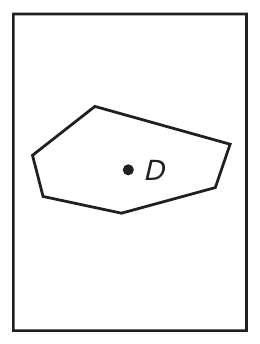
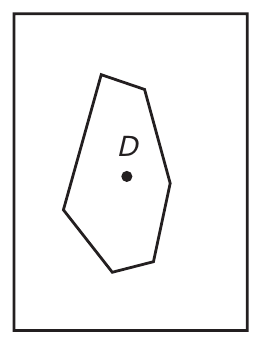
The diagram represents one layout of a hexagonal swimming pool that contains a drain at point in the center of a rectangular yard. Other layouts are also being considered. Which layout is the result of a 90° counterclockwise rotation of the original layout using as the center of rotation?
- Layout A
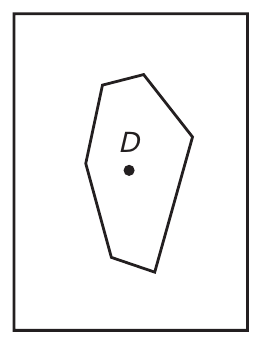
- Layout B
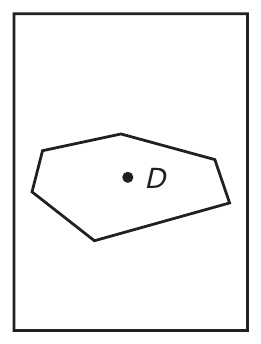
- Layout C
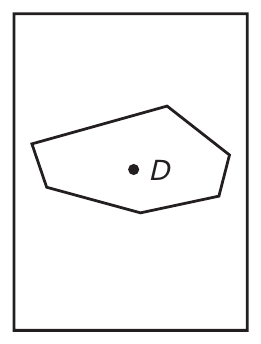
- Layout D
Show STAAR answer and explanation
Layout D
Layout D carries the pool’s left-of-drain portion below the drain and its upper-left vertex to the lower-left, as a 90° counterclockwise turn requires. The drain stays fixed; the yard outline is retained as a reference.
Layout A: Layout A places the pool’s upper-left vertex at the upper-right, matching a clockwise rather than counterclockwise quarter-turn.
Layout B: Layout B keeps the pool’s long direction horizontal and reflects its upper and lower features rather than making a quarter-turn.
Layout C: Layout C keeps the pool’s long direction horizontal and reverses its left and right features rather than making a quarter-turn.
Learning objectives
By the end of the lesson, students can:
- Identify the center, direction, and angle of a rotation.
- Rotate a layout 90° counterclockwise using tracing or coordinates relative to the center.
- Distinguish a rotated design from a reflected or translated design.
Instructional sequence
- 1
Engage
5 minDisplay a garden plan with an off-center bench. Ask where the bench moves when the entire plan turns a quarter-turn left.
- 2
Physical model
10 minPin tracing paper at the rotation center and turn the entire drawing 90° counterclockwise. Track two different landmarks.
- 3
Direct instruction
10 minConnect a quarter-turn to right becoming up and up becoming left. State the origin-centered coordinate rule.
- 4
Design comparison
14 minCompare candidate layouts by checking the center, two landmarks, and the direction of the turn. Include reflected distractors.
- 5
Closure
6 minComplete the exit ticket and explain one feature preserved by the rotation.
Misconceptions to address
Teacher move: Movement depends on a point's position relative to the center. A point to the right moves above the center in a 90° counterclockwise turn.
Teacher move: Symmetric outlines can hide a wrong transformation. Track an asymmetric feature such as a gate, bench, or drain.