

Special Right Triangles and Elevation
Apply special right triangles and trigonometric ratios, including angles of elevation and depression.
Students model angles of elevation and depression with right triangles, solve special right triangles from known legs or hypotenuses, and recognize Pythagorean triples in distance and path diagrams.
Lesson plan and worked examples by TEKSForge · not a TEA-issued lesson. Videos by independent educators.
Archived course: TEKS code and readiness label from TEA's 2013 Geometry key. Geometry is not one of Texas's current required STAAR EOC assessments, and this lesson does not change the Biology and Algebra I Study Plans.
Learn the concept
Measure from the horizontal
An angle of elevation is measured upward from a horizontal line to a line of sight. An angle of depression is measured downward from a horizontal line. The line of sight connects the observer and the object.
Depression equals elevation
The horizontal line at the observer and the ground are parallel. The line of sight crosses both, so the angle of depression from the top equals the angle of elevation from the bottom as alternate interior angles.
Special right triangles
In a 45°-45°-90° triangle, the legs are equal and the hypotenuse is . In a 30°-60°-90° triangle, the shortest leg is s, the longer leg is , and the hypotenuse is . Pythagorean triples such as 3-4-5 also give exact side lengths.
Find a leg from a 45°-45°-90° hypotenuse
The side pattern is . If the hypotenuse is h, each leg is . For a hypotenuse of centimeters, each leg is centimeters. Divide rather than multiply when working backward from the hypotenuse.
Follow a 30°-60°-90° path diagram
Match sides to their opposite angles: the short leg s faces 30°, the long leg faces 60°, and the hypotenuse faces 90°. If the long leg is known, divide by to find s. In a multi-triangle path diagram, solve one triangle first and transfer any shared length to the next triangle.
Pythagorean triples
Positive whole-number lengths a, b, c form a Pythagorean triple when , with c the hypotenuse. Common triples include 3-4-5, 5-12-13, and 8-15-17. Multiplying all three lengths by the same positive number preserves the right triangle; for example, 9-12-15 is three times 3-4-5.
Study released STAAR visuals
Use the original graphs, tables, and diagrams from released STAAR questions to practice reading labels, values, and relationships before answering the items below.
Archived released STAAR Geometry EOC · 2013 · Item 4 · 1 point
Archived released STAAR Geometry EOC · 2013 · Item 26 · 1 point
Archived released STAAR Geometry EOC · 2013 · Item 41 · 1 point
Worked example
From the top of a 60-foot tower, the angle of depression to a car is 30°. How far is the car from the base of the tower?
- The angle of elevation from the car to the tower top is also 30°.
- The tower height is opposite the 30° angle, so it is the shortest leg: s = 60.
- The ground distance is the longer leg: feet.
feet
Watch the lesson
Texas public-school, Texas educator-created, and TEKS-aligned lessons, hosted by their creators. Each card names its source.
Geometry: Trigonometry
UT IPSI · Kid2Kid / Texas Education AgencyUse right-triangle relationships to solve for unknown distances in applied problems.
Watch on YouTubeTry it yourself
TEKSForge practice · unscored
1. A kite string makes a 45° angle with the ground, and the kite is 50 feet high. How long is the string?
Show answer and reasoning
feet
The height and horizontal distance are equal legs, so the hypotenuse is .
2. The angle of depression from a cliff to a boat is 40°. What is the angle of elevation from the boat to the cliff top?
Show answer and reasoning
40°
The angles are alternate interior angles formed by parallel horizontal lines and the line of sight.
3. An isosceles right triangle has hypotenuse cm. Find each leg. A different right triangle has legs 9 cm and 12 cm; find its hypotenuse.
Show answer and reasoning
Each isosceles-triangle leg is 12.4 cm; the other hypotenuse is 15 cm.
Divide by . For the other triangle, 9-12-15 is a multiple of 3-4-5, and .
4. A straight path is the hypotenuse of a 30°-60°-90° triangle. The path is 16 meters long. Find its shorter and longer perpendicular components.
Show answer and reasoning
8 m and m
Since , the short leg is 8. The long leg is .
Released STAAR practice
Texas Education Agency · archived 2013 released EOC items · scored with TEA's answer key; step-by-step explanations written by TEKSForge because this release has no rationales. Original graphs, tables, and diagrams are shown where the released item includes one.
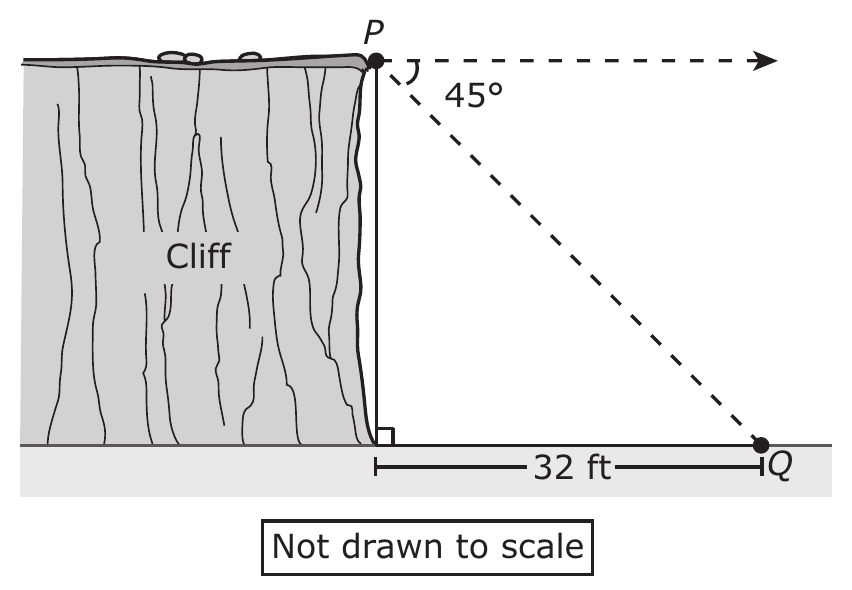
Archived released STAAR Geometry EOC · 2013 · Item 4 · 1 point
In the diagram, the angle of depression from to is 45°. Which of the following is closest to the distance between and ?
- 45.3 ft
- 22.6 ft
- 55.4 ft
- 18.5 ft
Show STAAR answer and explanation
45.3 ft
The 32-foot horizontal segment is adjacent to the 45° angle, and PQ is the hypotenuse. Thus feet.
22.6 ft: This is , but PQ is the hypotenuse and must be longer than the 32-foot leg.
55.4 ft: This does not match ; the hypotenuse is approximately 45.3 feet.
18.5 ft: This is , which does not apply to a 45° right triangle and is shorter than the given leg.
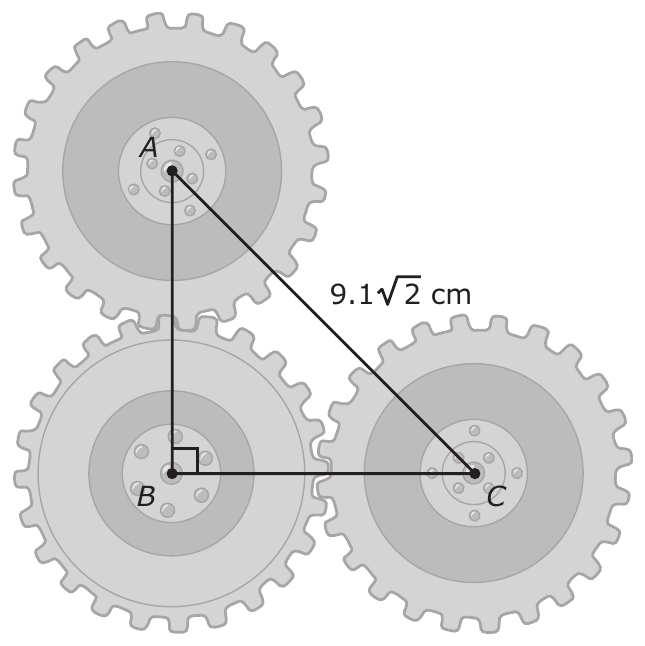
Archived released STAAR Geometry EOC · 2013 · Item 26 · 1 point
Three gears in a machine are positioned relative to each other to form an isosceles right triangle, as shown. What is the distance in centimeters between the centers of the gears located at and ?
Show STAAR answer and explanation
9.1
A 45°–45°–90° triangle has hypotenuse equal to a leg times . Thus cm.
18.2: Multiplying the hypotenuse by instead of dividing gives 18.2.
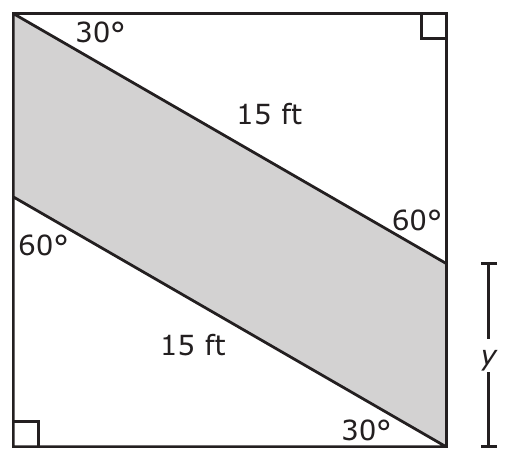
Archived released STAAR Geometry EOC · 2013 · Item 41 · 1 point
Within a square section of land, a landscaper will build a path, as represented by the shaded section in the diagram. Which measure is closest to the value of ?
- 5.5 ft
- 3.1 ft
- 4.3 ft
- 7.5 ft
Show STAAR answer and explanation
5.5 ft
Each unshaded triangle has hypotenuse 15. The square side is the long leg . The short vertical leg is . Therefore ft.
3.1 ft: This is not the difference of the long and short legs of the 15-ft special triangle.
4.3 ft: This does not use the full square side before subtracting 7.5.
7.5 ft: This is the short leg of an unshaded triangle, not the remaining vertical path segment.
Learning objectives
By the end of the lesson, students can:
- Draw and label angles of elevation and depression from a horizontal line.
- Explain why an angle of depression equals the matching angle of elevation.
- Apply 45°-45°-90° and 30°-60°-90° triangle patterns to find distances.
- Recognize Pythagorean triples and their multiples to find exact missing lengths.
Instructional sequence
- 1
Engage
5 minA person on a balcony looks down at a car. Ask students where the angle should be measured.
- 2
Direct instruction
12 minDraw horizontal lines at both locations. Use alternate interior angles to show depression equals elevation.
- 3
Pattern review
15 minUse and in both directions, then recognize Pythagorean triples and their multiples.
- 4
Guided practice
15 minSketch, label, and solve tower, drone, and kite problems, identifying the line-of-sight hypotenuse.
- 5
Closure
8 minStudents complete the exit ticket with a labeled sketch.
Misconceptions to address
Teacher move: Both elevation and depression are measured from a horizontal line of sight. Draw the horizontal before marking the angle.
Teacher move: The hypotenuse is always the longest side. It is the leg length times .