

Nets of Three-Dimensional Figures
Use nets to represent and construct three-dimensional figures.
Students connect solids to their nets by matching faces, shared edges, and fold locations, rejecting layouts that overlap or leave an opening.
Lesson plan and worked examples by TEKSForge · not a TEA-issued lesson. Videos by independent educators.
Archived course: TEKS code and readiness label from TEA's 2013 Geometry key. Geometry is not one of Texas's current required STAAR EOC assessments, and this lesson does not change the Biology and Algebra I Study Plans.
Learn the concept
A net preserves the faces
A net is a connected flat arrangement of faces that folds into a solid. Every face of a closed solid must appear exactly once. Tabs used for gluing are not additional faces.
Match edges and dimensions
A right prism has two congruent polygonal bases and one rectangular lateral face for each base side. Each rectangle has one dimension equal to the prism's height and another equal to the matching base-side length.
Check the fold, not just the count
Choose a starting face and imagine folding around each shared edge. Check that meeting edges have equal lengths, that no faces overlap, and that the bases close opposite ends of a prism. Different layouts can be valid nets of the same solid.
Study released STAAR visuals
Use the original graphs, tables, and diagrams from released STAAR questions to practice reading labels, values, and relationships before answering the items below.
Archived released STAAR Geometry EOC · 2013 · Item 38 · 1 point
Worked example
A right triangular prism has base-side lengths 6, 8, and 10 centimeters and prism height 9 centimeters. Describe the faces of a possible net.
- Use two congruent triangles with side lengths 6, 8, and 10 centimeters.
- Use lateral rectangles measuring 6 by 9, 8 by 9, and 10 by 9 centimeters.
- Join the rectangles along their 9-centimeter edges to make a strip.
- Attach one triangle along a matching edge on one side of the strip and the other triangle on the opposite side so they close the two ends.
Two congruent 6-8-10 triangles and three rectangles: 6 by 9, 8 by 9, and 10 by 9 centimeters, arranged to close without overlap.
Watch the lesson
Texas public-school, Texas educator-created, and TEKS-aligned lessons, hosted by their creators. Each card names its source.
7th Grade Math Lateral Surface Area
Five Minute Math · Aaron Daffern, Dallas ISDUse the triangular-prism net and its folding explanation to identify bases, lateral faces, and matching edges; the area calculation is an extension.
Watch on YouTubeTry it yourself
TEKSForge practice · unscored
1. What faces are needed for a closed square pyramid?
Show answer and reasoning
One square and four triangles
The square is the base. One triangular lateral face connects each base side to the apex.
2. A cube net has six squares, but two squares fold onto the same face position. Is the net valid?
Show answer and reasoning
No
Six squares give the correct face count, but overlapping faces leave another position uncovered. A valid net must close without overlap.
Released STAAR practice
Texas Education Agency · archived 2013 released EOC items · scored with TEA's answer key; step-by-step explanations written by TEKSForge because this release has no rationales. Original graphs, tables, and diagrams are shown where the released item includes one.
Archived released STAAR Geometry EOC · 2013 · Item 38 · 1 point
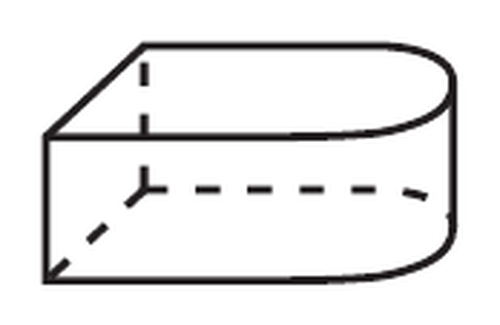
A company is designing a flotation device made of foam. The shape of the design is modeled. Which net can be folded to form the shape of the flotation device?
- Net F
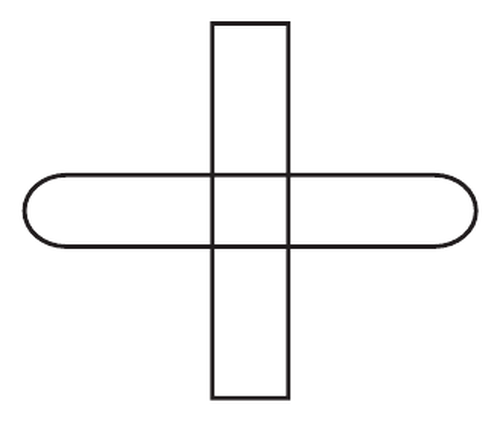
- Net G
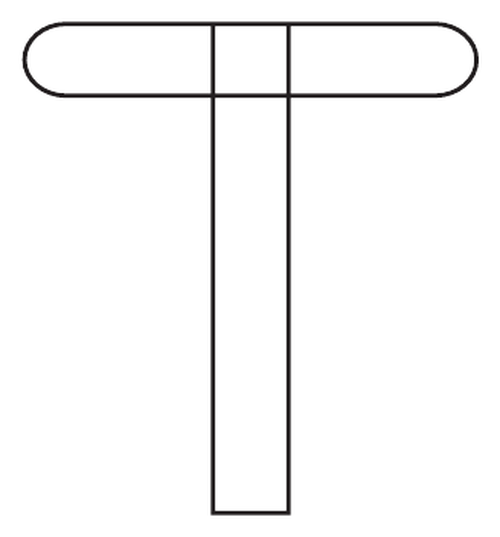
- Net H
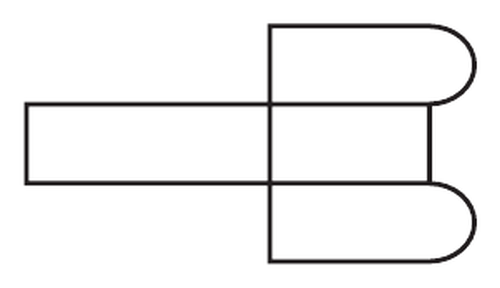
- Net J
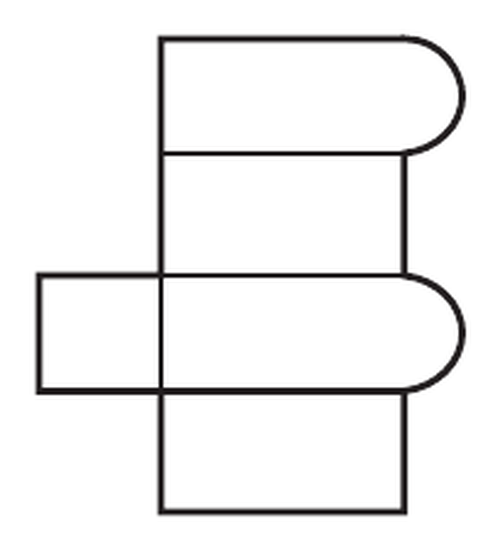
Show STAAR answer and explanation
Net G
Net G has two matching end faces, each a rectangle joined to a semicircle, and one continuous rectangular strip. The strip wraps around the straight and curved boundary of each end to form the flotation device.
Net F: Net F places the central attachment partway along the strip; folding leaves the strip ends in the wrong positions to close around the two end faces.
Net H: Net H puts both rounded ends toward the same side of a short central band and does not supply the required continuous wraparound strip.
Net J: Net J alternates a rounded end face with rectangular panels in a short cross shape, lacking the long strip needed to cover the curved boundary.
Learning objectives
By the end of the lesson, students can:
- Identify the faces needed to construct a prism or pyramid.
- Match shared edges in a net to edges of the folded solid.
- Justify whether a proposed layout folds into a specified solid.
Instructional sequence
- 1
Engage
5 minOpen a small cardboard package along selected edges. Ask which features of the original solid remain visible in the flattened layout.
- 2
Direct instruction
10 minIdentify bases and lateral faces. Match the dimensions of edges that must meet when the net folds.
- 3
Guided folding
12 minFold candidate nets, marking the starting face and tracking which faces become adjacent or opposite.
- 4
Mental folding
12 minEvaluate new layouts without cutting first. Check face inventory, matching edges, overlap, and closure before testing predictions.
- 5
Closure
6 minComplete the exit ticket and explain why counting faces alone is insufficient.
Misconceptions to address
Teacher move: The faces must fold into different positions without overlap and must close every opening. The correct inventory is necessary but not sufficient.
Teacher move: A fold line becomes a shared edge between faces. Trace it in the net and on the model.