

Orthographic and Isometric Views
Use front, side, and top views to represent and build three-dimensional figures.
Students build cube structures from front, side, and top views and test isometric drawings against all three projections while keeping the designated front fixed.
Lesson plan and worked examples by TEKSForge · not a TEA-issued lesson. Videos by independent educators.
Archived course: TEKS code and readiness label from TEA's 2013 Geometry key. Geometry is not one of Texas's current required STAAR EOC assessments, and this lesson does not change the Biology and Algebra I Study Plans.
Learn the concept
Three views record different dimensions
The front view shows width and height. A side view shows depth and height. The top view shows width and depth, marking the footprint of occupied locations. These views are straight-on projections rather than perspective pictures.
Translate stacks into views
For stacks rising from a common base with no gaps, a front column reaches the greatest stack height at that left-to-right position. A side column reaches the greatest stack height at that front-to-back position. The top view marks each location containing a stack, regardless of its height.
Use an isometric drawing to check
An isometric drawing represents width, depth, and height together on three families of parallel grid lines. Keep the front direction fixed, include supporting cubes hidden behind visible faces, and compare the drawing with every supplied view. The views do not always determine a unique structure.
Study released STAAR visuals
Use the original graphs, tables, and diagrams from released STAAR questions to practice reading labels, values, and relationships before answering the items below.
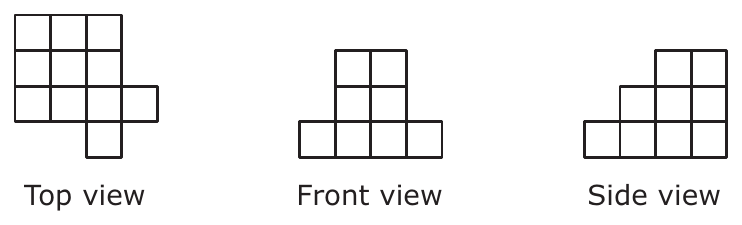
Archived released STAAR Geometry EOC · 2013 · Item 34 · 1 point
Worked example
A structure has two width positions and two depth rows. From left to right, the front-row stack heights are 2 and 1; the back-row heights are 1 and 3. Describe its three views and total number of cubes.
- Every footprint cell is occupied, so the top view is a 2-by-2 square of cells.
- For the front view, take the greater height in each width position: max(2, 1) = 2 and max(1, 3) = 3.
- For the right-side view, the front depth row reaches height 2 and the back depth row reaches height 3.
- Add the stack heights: 2 + 1 + 1 + 3 = 7.
Top: full 2-by-2 footprint; front: heights 2 and 3; right side: front-to-back heights 2 and 3; 7 cubes.
Watch the lesson
Texas public-school, Texas educator-created, and TEKS-aligned lessons, hosted by their creators. Each card names its source.
3rd Grade Math Describing 3D Shapes
Five Minute Math · Aaron Daffern, Dallas ISDReview solid-shape vocabulary before the teacher-led cube-view investigation; this foundational video does not teach orthographic reconstruction.
Watch on YouTubeTry it yourself
TEKSForge practice · unscored
1. A top view has three occupied cells. Must the structure contain exactly three cubes?
Show answer and reasoning
No
Each occupied cell contains at least one cube, but the top view does not show how high the stacks rise.
2. Two stacks lie one directly behind the other. The front stack is 1 cube high and the back stack is 4 cubes high. What is the front view?
Show answer and reasoning
One column 4 cubes high
Depth collapses in a front projection. Both stacks occupy the same width position, and the taller stack determines the column's height.
Released STAAR practice
Texas Education Agency · archived 2013 released EOC items · scored with TEA's answer key; step-by-step explanations written by TEKSForge because this release has no rationales. Original graphs, tables, and diagrams are shown where the released item includes one.
Archived released STAAR Geometry EOC · 2013 · Item 34 · 1 point
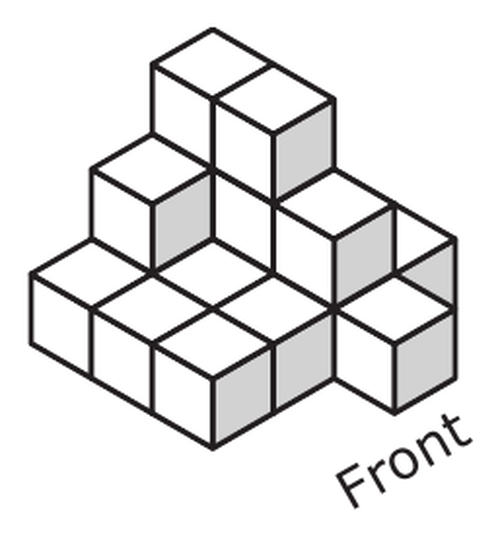
The front, side, and top views of a three-dimensional figure made of identical cubes are shown. Which diagram best represents this three-dimensional figure?
- Figure F
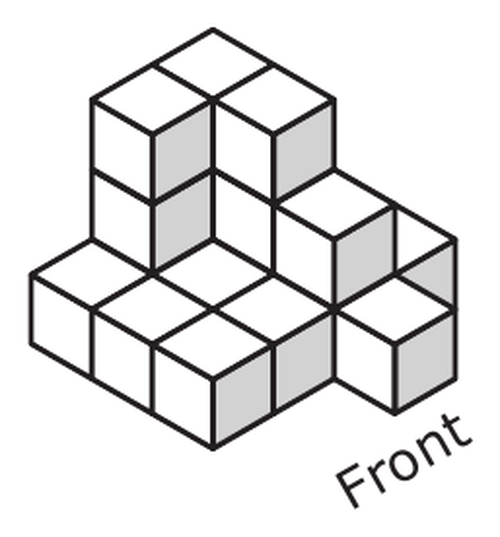
- Figure G
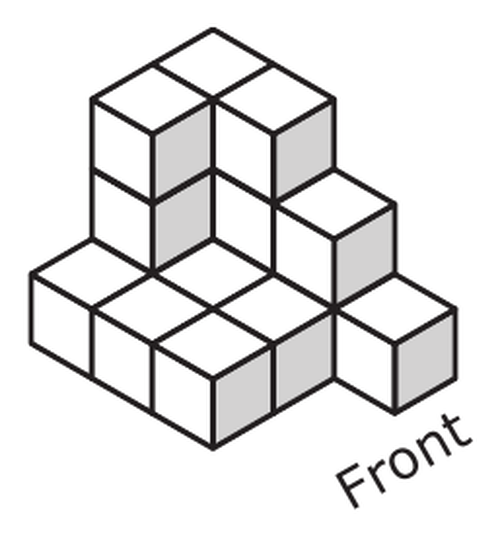
- Figure H
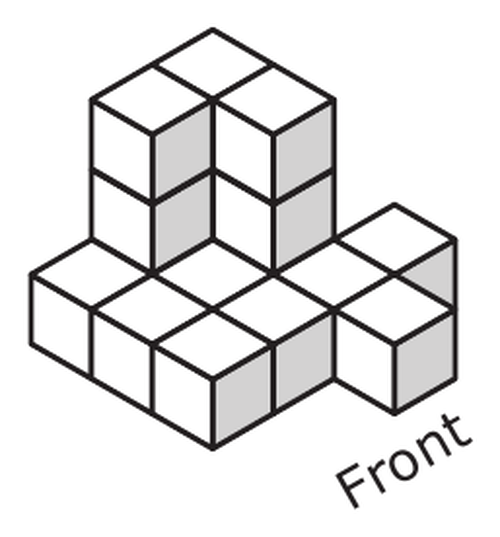
- Figure J
Show STAAR answer and explanation
Figure F
Figure F has the shown footprint, a two-by-two group of three-cube-high stacks, and the intermediate two-cube-high step. Its front silhouette has heights 1, 3, 3, 1 and its side silhouette has heights 1, 2, 3, 3, matching all three views.
Figure G: Figure G has an L-shaped group of tallest stacks, leaving a missing corner in the top plateau that does not match the shown top view.
Figure H: Figure H has the two-by-two tall group but omits the intermediate two-cube-high step needed in the side view.
Figure J: Figure J has only a single row of two tallest stacks rather than the two-by-two tall group in the top view.
Learning objectives
By the end of the lesson, students can:
- Describe the information shown by front, side, and top views.
- Build and sketch a cube structure consistent with given views.
- Reject an isometric drawing that fails even one required view.
Instructional sequence
- 1
Engage
5 minShow a cube structure from the front only. Ask whether students can determine every cube's location from that single view.
- 2
Direct instruction
10 minLabel width, depth, and height. Show which two dimensions appear in each orthographic view and establish a fixed front.
- 3
Guided building
12 minBuild structures from a footprint and height clues. Compare front column heights and side row heights.
- 4
View matching
12 minSketch structures on isometric paper and eliminate candidate drawings by checking the top, front, and right-side views in turn.
- 5
Closure
6 minComplete the exit ticket and explain why one matching view does not guarantee a matching solid.
Misconceptions to address
Teacher move: Cubes can hide behind other cubes. The front view records width and height but collapses depth.
Teacher move: A top-view square marks an occupied footprint location. Several cubes may be stacked there.
Teacher move: Use the indicated front consistently. Rotating a candidate changes which direction is called the front and may invalidate the other views.