

Slopes of Parallel and Perpendicular Lines
Use slopes to identify parallel and perpendicular lines and their equations.
Students compare slopes to identify parallel and perpendicular lines, write parallel lines with a specified y-intercept and perpendicular lines through a point, and classify quadrilateral sides using slope evidence.
Lesson plan and worked examples by TEKSForge · not a TEA-issued lesson. Videos by independent educators.
Archived course: TEKS code and readiness label from TEA's 2013 Geometry key. Geometry is not one of Texas's current required STAAR EOC assessments, and this lesson does not change the Biology and Algebra I Study Plans.
Learn the concept
Compare slopes
In , the slope is m. Parallel lines have equal slopes. Perpendicular lines have slopes that are negative reciprocals, such as and , so their product is −1.
Write a perpendicular line
Find the original slope, take its negative reciprocal, and use point-slope form with the required point. A line perpendicular to has slope .
Verify right angles
In a right triangle, the legs are perpendicular. Compute the slopes of the sides that meet at a vertex; if the product is −1, the angle at that vertex is 90°. A horizontal line and a vertical line are also perpendicular.
Write a parallel line from its intercept
Distinct nonvertical parallel lines have the same slope and different y-intercepts. Find the original slope, then use the required intercept in . For example, a line parallel to with y-intercept is . Vertical lines have undefined slopes and are parallel when their x-values are different.
Classify quadrilateral sides with slopes
List the sides in vertex order and compare opposite pairs first. Equal slopes show parallel sides; two pairs of parallel opposite sides establish a parallelogram. Then compare adjacent sides: negative-reciprocal slopes show a right angle, making a parallelogram a rectangle. Slopes alone do not prove equal side lengths, so use distances before claiming a rhombus or square. One right angle alone does not prove a general quadrilateral is a rectangle.
Study released STAAR visuals
Use the original graphs, tables, and diagrams from released STAAR questions to practice reading labels, values, and relationships before answering the items below.
Archived released STAAR Geometry EOC · 2013 · Item 25 · 1 point
Worked example
Write the line perpendicular to that passes through .
- The original slope is , so the perpendicular slope is .
- Use point-slope form: .
- Simplify: .
Watch the lesson
Texas public-school, Texas educator-created, and TEKS-aligned lessons, hosted by their creators. Each card names its source.
Geometry - Determining Perpendicular Lines
Five Minute Math · Aaron Daffern, Dallas ISDIdentify and write perpendicular lines using negative-reciprocal slopes.
Watch on YouTubeGeometry - Verifying Parallel and Perpendicular Lines
Five Minute Math · Aaron Daffern, Dallas ISDUse slopes to verify whether lines and polygon sides are parallel or perpendicular.
Watch on YouTubeTry it yourself
TEKSForge practice · unscored
1. What slope is perpendicular to the line ?
Show answer and reasoning
Rewrite as . The negative reciprocal of −3 is .
2. Are and perpendicular?
Show answer and reasoning
Yes
The slopes are 2 and −0.5, and .
3. Write a line parallel to the line through (2, 7) and (6, 1) with y-intercept (0, −4).
Show answer and reasoning
The original slope is . Keep that slope and use .
4. Quadrilateral ABCD has vertices A(0, 0), B(4, 2), C(3, 4), and D(−1, 2). Use slopes to decide whether it is a rectangle.
Show answer and reasoning
Yes, it is a rectangle.
and , so both opposite-side pairs are parallel. Adjacent slopes multiply to −1, so the parallelogram has right angles and is a rectangle.
Released STAAR practice
Texas Education Agency · archived 2013 released EOC items · scored with TEA's answer key; step-by-step explanations written by TEKSForge because this release has no rationales. Original graphs, tables, and diagrams are shown where the released item includes one.
Archived released STAAR Geometry EOC · 2013 · Item 14 · 1 point
The equation of a line containing one leg of a right triangle is . Which equation could represent the line containing the other leg of this triangle?
Show STAAR answer and explanation
Perpendicular nonvertical lines have opposite reciprocal slopes. The negative reciprocal of −4 is , and the y-intercept 2 does not affect perpendicularity.
: This is the reciprocal but not the opposite sign; perpendicular slopes must multiply to −1.
: The sign changed, but 4 is not the reciprocal of −4; the slope must be .
: This line is parallel to the given line because both slopes are −4, not perpendicular.
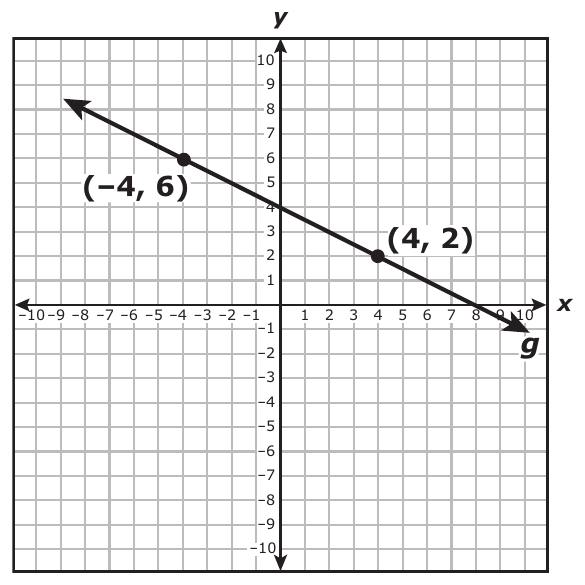
Archived released STAAR Geometry EOC · 2013 · Item 25 · 1 point
The graph of line is shown. Which equation describes a line parallel to line that has a y-intercept at ?
Show STAAR answer and explanation
The slope of g through (−4, 6) and (4, 2) is . A parallel line has the same slope; with intercept −1 its equation is .
: Slope 2 is the negative reciprocal, so this line is perpendicular rather than parallel.
: This has the wrong slope sign; g decreases from left to right.
: This uses the reciprocal slope −2 instead of −1/2.
Archived released STAAR Geometry EOC · 2013 · Item 47 · 1 point
The slopes of the sides of quadrilateral are shown in the table. Which statement describes the relationships between the sides of the quadrilateral?
| Side | Slope |
|---|---|
- is parallel to , but is not parallel to .
- is parallel to , but is not parallel to .
- is parallel to , and is parallel to .
- is not parallel to , and is not parallel to .
Show STAAR answer and explanation
is parallel to , but is not parallel to .
AB and CD both have slope 2/5, so they are parallel. AD has slope −5/2 while BC has slope −2/5; unequal slopes mean those sides are not parallel.
is parallel to , but is not parallel to .: This reverses both comparisons: AB and CD have equal slopes; AD and BC do not.
is parallel to , and is parallel to .: AD and BC have different negative slopes; sharing a sign does not make lines parallel.
is not parallel to , and is not parallel to .: AB and CD have the same slope, so that pair is parallel.
Learning objectives
By the end of the lesson, students can:
- Identify slopes from equations in different forms.
- Recognize perpendicular lines by negative-reciprocal slopes.
- Use slopes to verify right angles in triangles and other polygons.
- Write a parallel line with a given y-intercept and use side slopes to classify quadrilaterals.
Instructional sequence
- 1
Engage
5 minGraph y = 2x and y = −0.5x. Use an index card corner to test the angle where they meet.
- 2
Direct instruction
10 minDefine parallel slopes as equal and perpendicular slopes as negative reciprocals with a product of −1.
- 3
Guided practice
12 minFind slopes from equations, then choose or write equations of perpendicular lines.
- 4
Right-triangle check
12 minUse the slopes of the sides of coordinate triangles to locate right angles.
- 5
Parallel lines and quadrilaterals
10 minKeep the slope and replace the intercept to write a parallel line, then compare opposite and adjacent side slopes in coordinate quadrilaterals.
- 6
Closure
6 minComplete the exit ticket with a slope product check.
Misconceptions to address
Teacher move: Changing only the sign of −4 gives 4, but . Take the reciprocal and change the sign to get .
Teacher move: The reciprocal of is , but the slopes must also have opposite signs.