

Areas of Polygons and Composite Figures
Find areas of regular polygons, circles, and composite figures.
Students find regular-polygon areas using apothems, decompose composite polygons, and subtract circular regions from squares, including reading lengths from coordinates.
Lesson plan and worked examples by TEKSForge · not a TEA-issued lesson. Videos by independent educators.
Archived course: TEKS code and readiness label from TEA's 2013 Geometry key. Geometry is not one of Texas's current required STAAR EOC assessments, and this lesson does not change the Biology and Algebra I Study Plans.
Learn the concept
Regular polygons use the apothem
Connecting a regular polygon's center to its vertices creates triangles with a common height a, the apothem. Adding their areas gives . For a regular hexagon with side s, , so and .
Composite polygons
Divide a composite figure into nonoverlapping familiar shapes. A rectangle has area and a triangle has area , with the height perpendicular to the selected base. Find missing heights by subtracting given lengths when the diagram supports that relationship.
Subtract excluded regions
For a shaded remainder, use containing area minus excluded area. Two congruent semicircles with disjoint interiors have combined area . On a coordinate grid, find horizontal or vertical lengths by subtracting endpoint coordinates. For nested polygons, calculate both areas before subtracting.
Study released STAAR visuals
Use the original graphs, tables, and diagrams from released STAAR questions to practice reading labels, values, and relationships before answering the items below.
Archived released STAAR Geometry EOC · 2013 · Item 15 · 1 point
Archived released STAAR Geometry EOC · 2013 · Item 33 · 1 point
Archived released STAAR Geometry EOC · 2013 · Item 50 · 1 point
Worked example
A square has opposite corners at (−5, −2) and (5, 8), with sides parallel to the axes. Two semicircles lie inside it with the left and right sides as diameters. Find the area outside both semicircles but inside the square.
- The side length is 5 − (−5) = 10 units; the vertical difference is also 10.
- Each diameter is 10 units, so each radius is 5 units. The semicircles meet only at the square's center.
- The square's area is . The combined semicircle area is .
- Subtract: .
square units
Watch the lesson
Texas public-school, Texas educator-created, and TEKS-aligned lessons, hosted by their creators. Each card names its source.
7th Grade Math Area of Composite Figures (Additive Property - updated)
Five Minute Math · Aaron Daffern, Dallas ISDAdd areas of nonoverlapping pieces in composite figures.
Watch on YouTube7th Grade Math Area of Composite Figures (Sections Removed)
Five Minute Math · Aaron Daffern, Dallas ISDFind a remaining area by subtracting removed regions.
Watch on YouTubeTry it yourself
TEKSForge practice · unscored
1. A regular hexagon has apothem centimeters. Find its area.
Show answer and reasoning
square centimeters
Use , so . Then .
2. A decorative panel consists of a 14-by-6 rectangle and two exterior triangles, each attached along a 6-unit side. Each triangle extends 4 units perpendicularly from that side. Find the total area.
Show answer and reasoning
108 square units
The pieces have disjoint interiors, so add: .
3. A smaller regular hexagon of area 54 square units is entirely inside a larger regular hexagon with apothem 6 units and perimeter 30 units. Find the area between them.
Show answer and reasoning
36 square units
The larger area is . Subtract the inner area: .
Released STAAR practice
Texas Education Agency · archived 2013 released EOC items · scored with TEA's answer key; step-by-step explanations written by TEKSForge because this release has no rationales. Original graphs, tables, and diagrams are shown where the released item includes one.
Archived released STAAR Geometry EOC · 2013 · Item 15 · 1 point
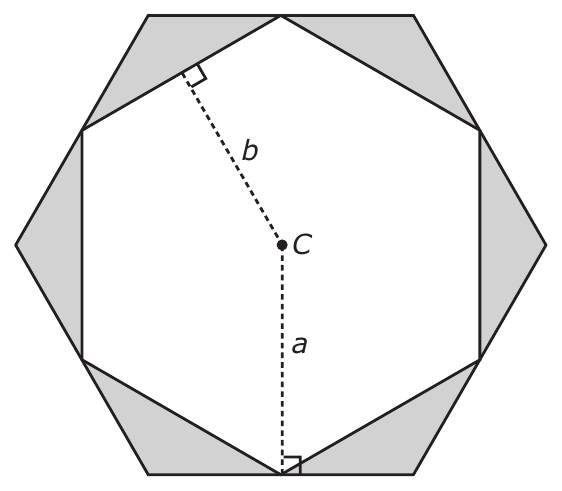
Two regular hexagons with center and apothems and are shown in the figure. Each vertex of the smaller hexagon is a midpoint on a side of the larger hexagon. If cm and cm, what is the total area of the shaded regions?
- cm²
- cm²
- cm²
- cm²
Show STAAR answer and explanation
cm²
A regular hexagon with apothem r has area . The larger area is and the smaller area is , so the shaded difference is cm².
cm²: This is the smaller hexagon area, not the shaded difference.
cm²: This is one of the six congruent shaded triangles, not all six.
cm²: This adds the two hexagon areas instead of subtracting them.
Archived released STAAR Geometry EOC · 2013 · Item 33 · 1 point
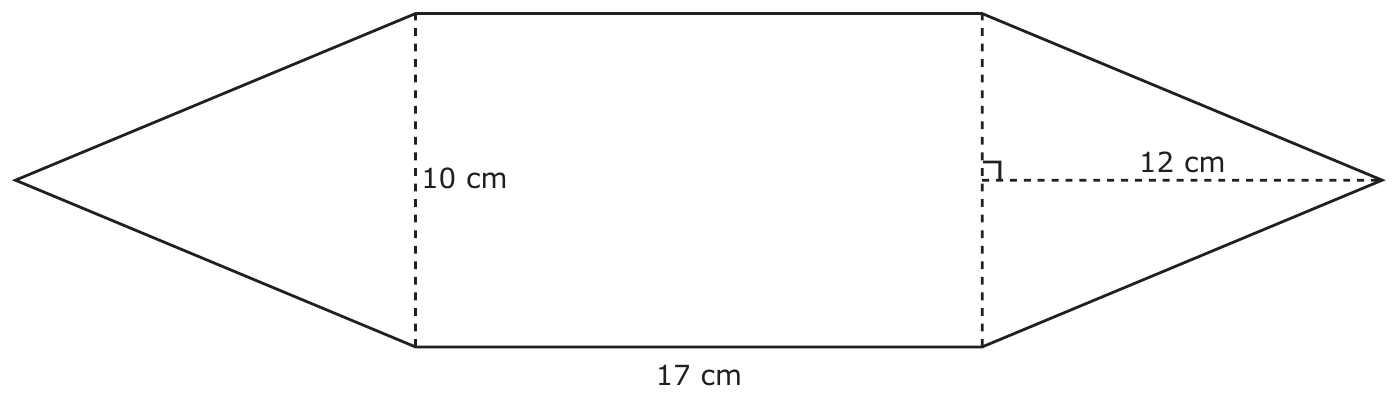
A banner is composed of two congruent triangles and a rectangle, as shown. What is the total area of the banner in square centimeters?
Show STAAR answer and explanation
290
The rectangle area is . Each triangle has base 10 and perpendicular height 12, so each area is . The total is cm².
410: This omits the one-half factor for both triangular areas.
Archived released STAAR Geometry EOC · 2013 · Item 50 · 1 point
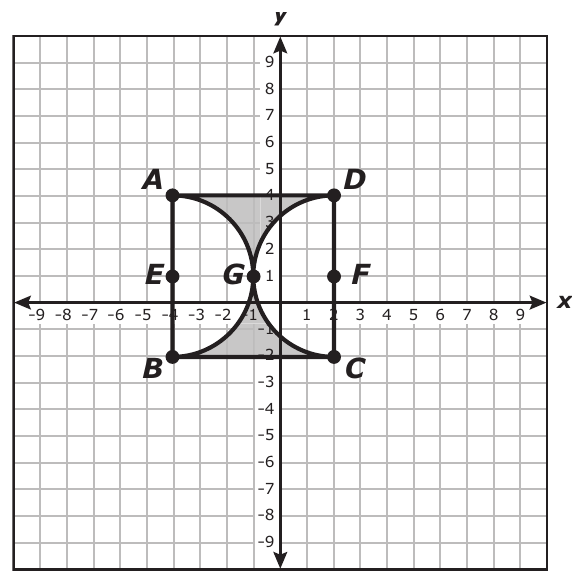
Points , , , and are the vertices of a square. Points and are the centers of two congruent semicircles that are tangent to each other at point . Which value is closest to the area of the shaded regions?
- 7.7 units²
- 4.3 units²
- 17.2 units²
- 64.3 units²
Show STAAR answer and explanation
7.7 units²
The grid shows a square of side 6. Each semicircle has radius 3, so together they have area . The shaded area is square units.
4.3 units²: This is not the square area minus the area of the two radius-3 semicircles.
17.2 units²: This is approximately , using side 8 and radius 4 rather than the grid measurements.
64.3 units²: This is approximately , adding instead of subtracting the unshaded semicircles.
Learning objectives
By the end of the lesson, students can:
- Use an apothem and perimeter to find a regular polygon's area.
- Add nonoverlapping polygon areas using perpendicular heights.
- Subtract semicircular or polygonal regions to find shaded area.
Instructional sequence
- 1
Engage
5 minPartition a regular hexagon into six congruent triangles. Ask which triangle dimension is the apothem.
- 2
Direct instruction
12 minDerive A = one-half aP. Use a 30°-60°-90° triangle to connect a regular hexagon's apothem and side length when needed.
- 3
Guided decomposition
12 minFind areas of panels formed from rectangles and triangles, distinguishing each triangle's perpendicular height from a slanted side.
- 4
Shaded regions
14 minSubtract nested regular-polygon areas and solve square-minus-semicircles problems. Read coordinate differences before identifying radii.
- 5
Closure
7 minComplete the exit ticket and identify whether addition or subtraction models the shaded region.
Misconceptions to address
Teacher move: The apothem meets a side at a right angle. The center-to-vertex segment is a radius and is longer.
Teacher move: Identify the straight diameter first, then divide by 2 before squaring the radius.
Teacher move: Decide what is shaded. Add disjoint included pieces, but subtract excluded regions from a containing shape.