

Arc Length and Sector Area
Use proportional reasoning to find arc lengths and sector areas.
Students use fractions of a full turn to find arc lengths and sector areas, emphasizing the curved distance traveled by a clock hand's tip.
Lesson plan and worked examples by TEKSForge · not a TEA-issued lesson. Videos by independent educators.
Archived course: TEKS code and readiness label from TEA's 2013 Geometry key. Geometry is not one of Texas's current required STAAR EOC assessments, and this lesson does not change the Biology and Algebra I Study Plans.
Learn the concept
Find the fraction of a turn
A central angle of degrees represents of a full turn. Each interval between neighboring hour labels is of a turn, or . A minute hand completes one revolution in 60 minutes.
Arc length is part of circumference
For radius r, arc length is . A rotating hand's tip uses the hand's length as r. The answer measures distance along the circle, not the straight chord joining the endpoints.
Sector area uses the same fraction
A sector is the region bounded by two radii and their connecting arc. Its area is . Use circumference for curved distance and circle area for an interior region.
Study released STAAR visuals
Use the original graphs, tables, and diagrams from released STAAR questions to practice reading labels, values, and relationships before answering the items below.
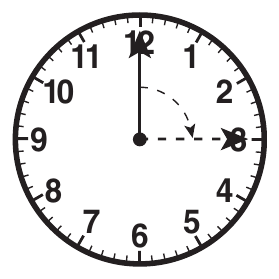
Archived released STAAR Geometry EOC · 2013 · Item 21 · 1 point
Worked example
A 9-centimeter minute hand moves clockwise from the 2 to the 6 without an extra revolution. Find the distance traveled by its tip.
- There are four clock intervals, so the motion is 4/12 = 1/3 of a revolution.
- The radius of the tip's path is 9 centimeters.
- The full circumference is .
- The arc length is centimeters.
centimeters
Watch the lesson
Texas public-school, Texas educator-created, and TEKS-aligned lessons, hosted by their creators. Each card names its source.
Arc length as fraction of circumference | Trigonometry | Khan Academy
Khan Academy · Geometry (TX TEKS) courseUse proportional reasoning to find an arc as a fraction of the full circumference.
Watch on YouTubeTry it yourself
TEKSForge practice · unscored
1. Find the length of a 135° arc in a circle with radius 8 inches.
Show answer and reasoning
inches
Use .
2. Find the area of a 120° sector of a circle with radius 6 meters.
Show answer and reasoning
square meters
The sector is one-third of the circle, so .
Released STAAR practice
Texas Education Agency · archived 2013 released EOC items · scored with TEA's answer key; step-by-step explanations written by TEKSForge because this release has no rationales. Original graphs, tables, and diagrams are shown where the released item includes one.
Archived released STAAR Geometry EOC · 2013 · Item 21 · 1 point
The hand on the circular clock in the figure measures 10 cm. Which of the following is closest to the distance that the tip of the hand travels as it moves from the 12 to the 3?
- 79 cm
- 21 cm
- 63 cm
- 16 cm
Show STAAR answer and explanation
16 cm
The tip moves one-quarter of a circle of radius 10 cm, so its distance is cm, closest to 16 cm.
79 cm: This is approximately one-quarter of the circle area, not an arc length.
21 cm: This is not the quarter-circumference; the arc is about 15.7 cm.
63 cm: This is approximately the entire circumference, not a quarter of it.
Learning objectives
By the end of the lesson, students can:
- Express a central angle or elapsed clock time as a fraction of a revolution.
- Multiply circumference by a turn fraction to find arc length.
- Distinguish arc length from sector area and calculate each.
Instructional sequence
- 1
Engage
5 minMove a clock hand and compare the tip's curved path with the straight segment between its starting and ending positions.
- 2
Direct instruction
10 minConnect angle over 360 to arc over circumference and sector area over circle area.
- 3
Clock practice
12 minCount clockwise intervals, use the hand length as radius, and calculate the tip's travel distance.
- 4
Guided comparisons
12 minSolve paired arc-length and sector-area problems for the same radius and angle, labeling linear and square units.
- 5
Closure
6 minComplete the exit ticket and check that a partial-turn distance is less than a full circumference.
Misconceptions to address
Teacher move: The hand extends from the center to the tip, so its length is the radius of the tip's circular path.
Teacher move: The hand rotates, so the tip follows the curved arc rather than the straight shortcut.
Teacher move: Arc length is part of the circumference and has linear units. Sector area is part of the interior and has square units.