

The Pythagorean Theorem
Use the Pythagorean theorem to find unknown lengths in context.
Students identify right triangles in contextual diagrams, solve for a leg or hypotenuse, and combine a calculated segment with another length to answer the actual question.
Lesson plan and worked examples by TEKSForge · not a TEA-issued lesson. Videos by independent educators.
Archived course: TEKS code and readiness label from TEA's 2013 Geometry key. Geometry is not one of Texas's current required STAAR EOC assessments, and this lesson does not change the Biology and Algebra I Study Plans.
Learn the concept
Identify the right triangle
The Pythagorean theorem applies to right triangles: . The legs a and b meet at the right angle. The hypotenuse c is opposite the right angle and is the longest side.
Solve for the correct side
For a missing hypotenuse, use . For a missing leg, use . Squaring and taking the square root are different steps; the sum of the squares is not the side length.
Return to the context
North-south and east-west travel can form perpendicular legs, with direct separation as the hypotenuse. In a rectangle, a diagonal or interior segment can create a right triangle covering only part of a side. Use segment addition and equal opposite sides to reach the requested length.
Study released STAAR visuals
Use the original graphs, tables, and diagrams from released STAAR questions to practice reading labels, values, and relationships before answering the items below.
Archived released STAAR Geometry EOC · 2013 · Item 17 · 1 point
Worked example
Rectangle ABCD is labeled in order, with AB along the top. Point E lies on DC. AE = 17 inches, AD = 8 inches, and EC = 4 inches. Find AB.
- Triangle ADE is right at D, and AE is its hypotenuse.
- Use , so .
- DE = 15 inches. Add the remaining segment: DC = DE + EC = 15 + 4 = 19 inches.
- Opposite sides of a rectangle are congruent, so AB = DC.
19 inches
Watch the lesson
Texas public-school, Texas educator-created, and TEKS-aligned lessons, hosted by their creators. Each card names its source.
8th Grade Math Applying the Pythagorean Theorem
Five Minute Math · Aaron Daffern, Dallas ISDModel contextual distances with right triangles and solve for missing lengths.
Watch on YouTubeTry it yourself
TEKSForge practice · unscored
1. A right triangle has hypotenuse 26 centimeters and one leg 10 centimeters. Find the other leg.
Show answer and reasoning
24 centimeters
The missing leg is .
2. Two delivery robots start together. One travels 14 meters west and the other 23 meters south. Find their direct separation to the nearest tenth.
Show answer and reasoning
26.9 meters
The perpendicular distances are legs, so . Adding 14 and 23 would give combined travel, not separation.
Released STAAR practice
Texas Education Agency · archived 2013 released EOC items · scored with TEA's answer key; step-by-step explanations written by TEKSForge because this release has no rationales. Original graphs, tables, and diagrams are shown where the released item includes one.
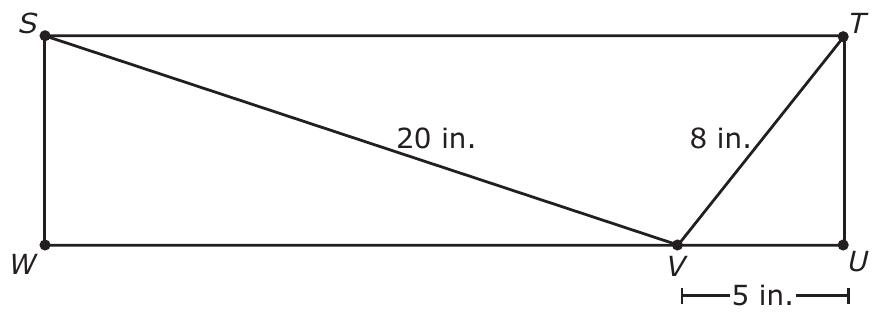
Archived released STAAR Geometry EOC · 2013 · Item 17 · 1 point
Rectangle is shown. What is ?
- 33 in.
- 24 in.
- in.
- in.
Show STAAR answer and explanation
24 in.
In right triangle TUV, . Since SW = TU, right triangle SWV gives , so WV = 19. Hence inches.
33 in.: Adding 20, 8, and 5 combines slanted segments rather than finding the rectangle length.
in.: This combines squared slanted lengths and omits the two right-triangle relationships.
in.: This equals 19 inches, which is WV; add VU = 5 to get ST.
Archived released STAAR Geometry EOC · 2013 · Item 48 · 1 point
Two motorcycles start at the same point. One motorcycle travels 15 km due north and stops. The second motorcycle travels 32 km due west and stops. Which value is closest to the distance between the motorcycles when they stop?
- 28.3 km
- 47.0 km
- 35.3 km
- 21.9 km
Show STAAR answer and explanation
35.3 km
The north and west paths are perpendicular legs of a right triangle. Their separation is km.
28.3 km: This is approximately , which incorrectly treats 32 as the hypotenuse.
47.0 km: This adds the two paths, giving distance through the starting point rather than straight-line separation.
21.9 km: This is approximately ; the Pythagorean theorem adds squared legs.
Learning objectives
By the end of the lesson, students can:
- Identify the hypotenuse from the right angle rather than diagram orientation.
- Use the Pythagorean theorem to find a missing leg or hypotenuse.
- Interpret a calculated length within a larger diagram or perpendicular-travel context.
Instructional sequence
- 1
Engage
5 minSketch two walkers leaving the same location in perpendicular directions. Compare total travel with the direct separation.
- 2
Direct instruction
12 minIdentify the hypotenuse, write the equation, and contrast adding squares to find a hypotenuse with subtracting squares to find a leg.
- 3
Guided practice
12 minSolve missing-side problems in rotated triangles and check that the hypotenuse is longest.
- 4
Context problems
14 minFind a partial rectangle side from a diagonal, then add a remaining segment. Model perpendicular journeys as legs of a right triangle.
- 5
Closure
7 minComplete the exit ticket with a labeled sketch and a final reasonableness check.
Misconceptions to address
Teacher move: The hypotenuse is opposite the right angle. A rotated diagram may make a leg look slanted.
Teacher move: Add when finding the hypotenuse. If the hypotenuse is known, subtract the known leg's square from its square.
Teacher move: Compare the segment found with the segment requested. A rectangle problem may require adding another piece or using opposite sides.