

Surface Area and Volume
Calculate surface area and volume for three-dimensional figures in context.
Students calculate surface area and volume of common solids, distinguish lateral from total surface area, and choose the correct radius, perpendicular height, or slant height for each context.
Lesson plan and worked examples by TEKSForge · not a TEA-issued lesson. Videos by independent educators.
Archived course: TEKS code and readiness label from TEA's 2013 Geometry key. Geometry is not one of Texas's current required STAAR EOC assessments, and this lesson does not change the Biology and Algebra I Study Plans.
Learn the concept
Surface area covers the outside
Surface area is the total area of all outside surfaces. It is measured in square units, such as square centimeters. Painting, wrapping, and covering problems use surface area.
Key formulas
For a sphere, . For a closed cylinder, . For a prism, add the areas of all faces, or use , where B is the base area and P is the base perimeter.
Read the context
Convert diameter to radius. Leave out surfaces that are not covered, such as an open top. If several identical objects are involved, multiply one object's surface area by the number of objects.
Volume of prisms and cylinders
Volume measures space inside in cubic units. For any prism, , where B is the area of a base and h is the perpendicular distance between bases. A rectangular prism has . For a cylinder, , so . Convert diameter to radius before substituting.
Volume of pyramids, cones, and spheres
A pyramid has , and a cone has . Each has one-third the volume of a prism or cylinder with the same base area and perpendicular height. A sphere has . A cone's capacity uses its perpendicular height, not the sloping side length.
Lateral area of a square pyramid
A regular square pyramid has four triangular lateral faces. Their combined area is , where P is the base perimeter and is the slant height measured along a face from the apex to the midpoint of a base edge. For base side s, . Lateral area excludes the base; total surface area is . The vertical height is not the triangular face's height.
Study released STAAR visuals
Use the original graphs, tables, and diagrams from released STAAR questions to practice reading labels, values, and relationships before answering the items below.
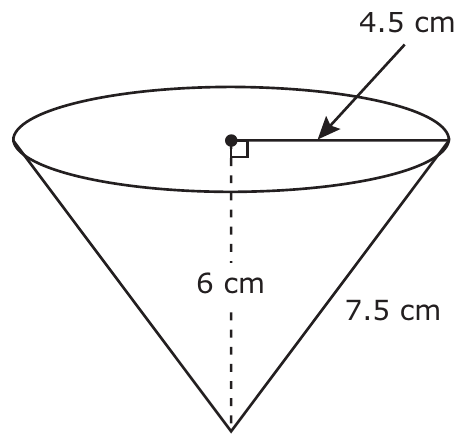
Archived released STAAR Geometry EOC · 2013 · Item 28 · 1 point
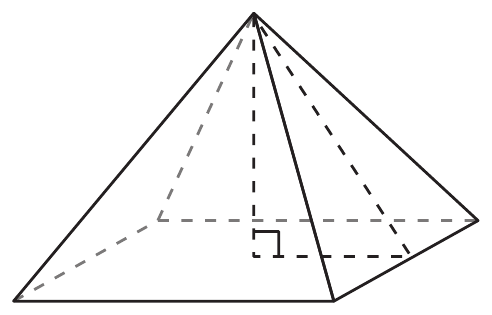
Archived released STAAR Geometry EOC · 2013 · Item 37 · 1 point
Worked example
Three closed cylinders, each with radius 2 inches and height 5 inches, are painted. What total area is painted?
- One cylinder: .
- Three cylinders: .
- Approximate: square inches.
About 263.9 square inches
Watch the lesson
Texas public-school, Texas educator-created, and TEKS-aligned lessons, hosted by their creators. Each card names its source.
Geometry: Composite Figures Volume and Surface Area
UT IPSI · Kid2Kid / Texas Education AgencyFind surface area and volume for three-dimensional and composite figures in context.
Watch on YouTubeTry it yourself
TEKSForge practice · unscored
1. Find the surface area of a sphere with a diameter of 10 centimeters.
Show answer and reasoning
square centimeters
The radius is 5, so .
2. Find the surface area of a cube with an edge length of 4 inches.
Show answer and reasoning
96 square inches
Each of the six faces has an area of 16 square inches, and 6(16) = 96.
3. A conical container has radius 3 cm and perpendicular height 10 cm. Find its exact capacity.
Show answer and reasoning
cubic centimeters
. Use cubic units because capacity is volume.
4. A regular square pyramid has base side 12 m and slant height 10 m. Find its lateral surface area.
Show answer and reasoning
240 square meters
The base perimeter is m, so square meters. Do not add the base.
Released STAAR practice
Texas Education Agency · archived 2013 released EOC items · scored with TEA's answer key; step-by-step explanations written by TEKSForge because this release has no rationales. Original graphs, tables, and diagrams are shown where the released item includes one.
Archived released STAAR Geometry EOC · 2013 · Item 6 · 1 point
Five spheres are being painted for a display at a store. If the diameter of each sphere is 7 centimeters, which value is closest to the total surface area that will be painted?
- 770 cm²
- 154 cm²
- 192 cm²
- 440 cm²
Show STAAR answer and explanation
770 cm²
Each radius is 3.5 cm. One sphere has area , so five spheres have cm².
154 cm²: cm² is the surface area of only one sphere, not all five.
192 cm²: This does not apply with radius 3.5 and then multiply by five.
440 cm²: This underestimates . Use the radius, not the diameter, in and multiply by five.
Archived released STAAR Geometry EOC · 2013 · Item 28 · 1 point
A conical paper cup is shown in the diagram. Which value is closest to the maximum volume of water this cup can hold?
- 159 cm³
- 32 cm³
- 127 cm³
- 40 cm³
Show STAAR answer and explanation
127 cm³
The radius is 4.5 cm and perpendicular height is 6 cm. Thus cm³.
159 cm³: Using slant height 7.5 instead of perpendicular height 6 gives about 159 cm³.
32 cm³: Halving the given radius incorrectly gives about 32 cm³.
40 cm³: This approximates 40.5 but omits the factor of .
Archived released STAAR Geometry EOC · 2013 · Item 37 · 1 point
The main entrance to the Louvre art museum is shaped like a pyramid. The pyramid is 71 feet tall and has a slant height of approximately 91 feet. Each side of the square base measures 115 feet. Which of the following is closest to the lateral surface area of the pyramid?
- 20,930 ft²
- 16,330 ft²
- 10,465 ft²
- 34,155 ft²
Show STAAR answer and explanation
20,930 ft²
The lateral area is ft². Lateral area excludes the square base.
16,330 ft²: This uses perpendicular height 71 rather than slant height 91.
10,465 ft²: This counts only two of the four triangular faces.
34,155 ft²: This adds the base area and gives total surface area, not lateral area.
Learning objectives
By the end of the lesson, students can:
- Apply the sphere surface-area formula .
- Find surface areas of prisms and cylinders by adding the areas of their faces.
- Decide which surfaces count in a context and scale the result for several objects.
- Find volumes of prisms, cylinders, pyramids, cones, and spheres, and lateral surface area of regular square pyramids.
Instructional sequence
- 1
Engage
5 minAsk whether painting a ball requires surface area or volume and why.
- 2
Direct instruction
10 minConnect nets to surface-area formulas and introduce the sphere formula with radius.
- 3
Guided practice
12 minFind surface areas for spheres, cylinders, and prisms, converting diameter to radius first.
- 4
Context problems
12 minSolve problems with several identical objects or open surfaces, deciding what counts.
- 5
Volume and pyramid faces
10 minCompare volume formulas, distinguish perpendicular height from slant height, and find a square pyramid's lateral surface area.
- 6
Closure
6 minComplete the exit ticket with square units.
Misconceptions to address
Teacher move: Divide the diameter by 2 first. Using the diameter makes the surface area four times too large.
Teacher move: Paint covers the outside, so it is measured in square units. Volume measures space inside in cubic units.
Teacher move: Volume uses perpendicular height. A regular pyramid's lateral-area formula uses slant height along a triangular face.