

Geometric Probability
Use area models to find probabilities.
Students find geometric probabilities from area ratios and spinner-sector angles, using relationships among unequal sectors instead of assuming every labeled outcome is equally likely.
Lesson plan and worked examples by TEKSForge · not a TEA-issued lesson. Videos by independent educators.
Archived course: TEKS code and readiness label from TEA's 2013 Geometry key. Geometry is not one of Texas's current required STAAR EOC assessments, and this lesson does not change the Biology and Algebra I Study Plans.
Learn the concept
Probability measures a share of the whole
When a point is selected uniformly from a region, . Larger regions are more likely. This model requires equal-area pieces to have equal chances of being selected.
Spinner angles replace sector areas
For an unbiased spinner with sectors sharing one center and radius, . Sector area is , so the common circle area cancels. Twice the sector area means twice the central angle.
Use the entire circle
All central angles sum to . Subtract known angles, then divide the remaining angle according to any given ratio. For an event containing several nonoverlapping sectors, add their angles or their probabilities.
Study released STAAR visuals
Use the original graphs, tables, and diagrams from released STAAR questions to practice reading labels, values, and relationships before answering the items below.
Archived released STAAR Geometry EOC · 2013 · Item 45 · 1 point
Worked example
An unbiased spinner has four sectors. Blue measures 90° and green measures 120°. Red has twice the area of yellow. Find the probability of red.
- Red and yellow together measure 360 − 90 − 120 = 150 degrees.
- Let yellow measure x degrees. Red then measures 2x degrees.
- Solve x + 2x = 150, giving x = 50 and red = 100 degrees.
- The probability of red is .
Watch the lesson
Texas public-school, Texas educator-created, and TEKS-aligned lessons, hosted by their creators. Each card names its source.
7th Grade Math Predictions Using Theoretical Probability
Five Minute Math · Aaron Daffern, Dallas ISDReview theoretical probability as a favorable share of the sample space before applying the lesson's unequal-sector area models.
Watch on YouTubeTry it yourself
TEKSForge practice · unscored
1. An unbiased spinner has sectors A, B, and C. C is a semicircle, and A has three times B's area. Find P(A).
Show answer and reasoning
A and B share the remaining in a 3:1 ratio. A measures , so .
2. A point is selected uniformly from a 12-by-8 rectangular target. A nonoverlapping collection of favorable regions has total area 30 square units. Find the probability of selecting a favorable point.
Show answer and reasoning
The target's area is , so the probability is .
Released STAAR practice
Texas Education Agency · archived 2013 released EOC items · scored with TEA's answer key; step-by-step explanations written by TEKSForge because this release has no rationales. Original graphs, tables, and diagrams are shown where the released item includes one.
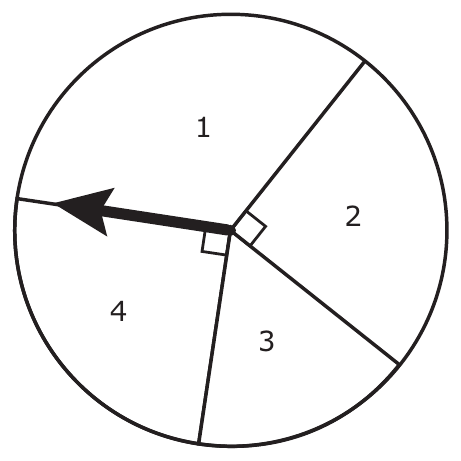
Archived released STAAR Geometry EOC · 2013 · Item 45 · 1 point
In the spinner modeled, Sector 1 has twice the area of Sector 3. If the arrow is spun once, what is the probability that the arrow will land in Sector 1?
Show STAAR answer and explanation
Sectors 2 and 4 are each right-angle sectors, leaving 180° for sectors 1 and 3. With sector 1 twice sector 3, their angles are 120° and 60°. The probability is .
: The sectors are not all equal; only sectors 2 and 4 each occupy one quarter.
: This is the probability of sector 3, half the size of sector 1.
: This treats sector 1 as two-thirds of the full circle rather than two-thirds of the remaining half.
Learning objectives
By the end of the lesson, students can:
- Express geometric probability as favorable area divided by total area.
- Use central angles and area relationships to compare spinner sectors.
- Find a missing sector probability using a whole-circle constraint.
Instructional sequence
- 1
Engage
5 minShow a spinner with four unequal sectors. Ask whether four labels guarantee a one-fourth probability for each label.
- 2
Direct instruction
10 minState the uniform-selection assumption and connect sector area fractions to central-angle fractions.
- 3
Guided practice
12 minTranslate marked right angles, semicircles, and sector-area ratios into equations whose angles sum to 360 degrees.
- 4
Area models
12 minFind probabilities for combined favorable regions and rectangular targets, checking that the numerator describes the event.
- 5
Closure
6 minComplete the exit ticket and explain why counting sectors would give the wrong result.
Misconceptions to address
Teacher move: That is true only when the sectors have equal angles and the spinner is unbiased. Unequal sectors have different probabilities.
Teacher move: Two-thirds would describe a whole consisting only of those two sectors. Include every sector when determining the total.