

Secants, Chords, and Circle Angles
Test conjectures about angles and arcs formed by lines that intersect circles.
Students choose circle-angle relationships by locating the angle's vertex, distinguishing central and inscribed angles from angles formed by intersecting chords or exterior secants.
Lesson plan and worked examples by TEKSForge · not a TEA-issued lesson. Videos by independent educators.
Archived course: TEKS code and readiness label from TEA's 2013 Geometry key. Geometry is not one of Texas's current required STAAR EOC assessments, and this lesson does not change the Biology and Algebra I Study Plans.
Learn the concept
At the center or on the circle
A central angle equals the degree measure of its intercepted arc. An inscribed angle has its vertex on the circle and equals half its intercepted arc. Therefore, central and inscribed angles intercepting the same arc have a 2:1 relationship.
Inside the circle
When two chords intersect inside a circle, an angle equals half the sum of the arcs intercepted by that angle and its vertical angle: . Use the pair opposite the chosen angle and its vertical partner.
Outside the circle
When two secants meet outside a circle, the exterior angle equals half the far arc minus the near arc: . All arcs around a circle total ; a semicircle totals . Locate the vertex before deciding which relationship applies.
Study released STAAR visuals
Use the original graphs, tables, and diagrams from released STAAR questions to practice reading labels, values, and relationships before answering the items below.
Archived released STAAR Geometry EOC · 2013 · Item 9 · 1 point
Worked example
From exterior point P, two secants pass through near points A and C and then far points B and D. The far arc BD measures 166° and the near arc AC measures 54°. Find the angle at P and the measure of an inscribed angle intercepting arc BD.
- The secants intersect outside the circle, so the angle at P uses half the difference of the far and near arcs.
- .
- An inscribed angle intercepting arc BD uses only that arc.
- Its measure is .
The exterior angle is 56°; the inscribed angle is 83°.
Watch the lesson
Texas public-school, Texas educator-created, and TEKS-aligned lessons, hosted by their creators. Each card names its source.
Geometry: Conjectures about Circles
UT IPSI · Kid2Kid / Texas Education AgencyUse circle relationships to test conjectures about angles and intercepted arcs.
Watch on YouTubeTry it yourself
TEKSForge practice · unscored
1. Two chords intersect inside a circle. An angle and its vertical angle intercept arcs measuring 92° and 48°. Find the angle.
Show answer and reasoning
70°
The vertex is inside, so use the half-sum: .
2. An inscribed angle measures 37°. Find its intercepted arc and the central angle intercepting that same arc.
Show answer and reasoning
The arc and central angle both measure 74°.
An intercepted arc is twice the inscribed angle. A central angle has the same measure as that arc.
3. A student says an exterior secant angle equals half the sum of its intercepted arcs. Correct the statement.
Show answer and reasoning
Use half the far arc minus the near arc.
Half the sum is the rule for two chords intersecting inside the circle. Exterior secants use half the positive difference.
Released STAAR practice
Texas Education Agency · archived 2013 released EOC items · scored with TEA's answer key; step-by-step explanations written by TEKSForge because this release has no rationales. Original graphs, tables, and diagrams are shown where the released item includes one.
Archived released STAAR Geometry EOC · 2013 · Item 9 · 1 point
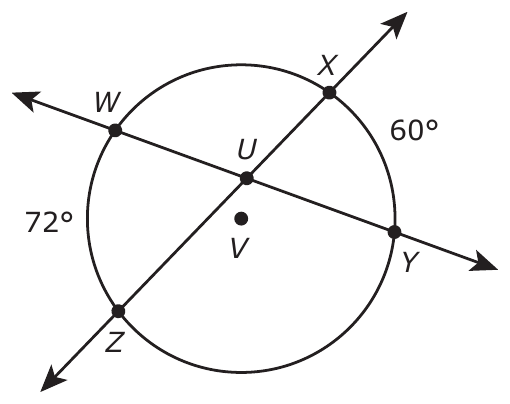
and are secants of circle , as shown. Based on this information, which of the following can be proved true?
Show STAAR answer and explanation
Two chords intersect inside the circle at U, so the angle is half the sum of the intercepted arcs of that angle and its vertical angle. Thus .
: U is not the center; the intersecting-chord angle is not generally equal to central angle ZVY.
: This assumes ZX is a diameter; no diameter is given.
: Interior chord angles use half the sum of intercepted arcs, not half their difference.
Learning objectives
By the end of the lesson, students can:
- Identify intercepted arcs for central, inscribed, interior, and exterior angles.
- Use half-sum or half-difference relationships for intersecting lines.
- Evaluate conjectures using circle-angle theorems and arc totals.
Instructional sequence
- 1
Engage
5 minDraw angles with vertices at the center, on the circle, and outside it. Ask why the same intercepted arc does not always give the same angle.
- 2
Direct instruction
12 minOrganize the four angle relationships by vertex location. Trace the intercepted arcs, including the arc of the vertical angle for interior intersections.
- 3
Guided practice
12 minSolve central, inscribed, and intersecting-chord examples. Use full-circle and semicircle totals only when their conditions are shown.
- 4
Conjecture testing
14 minAnalyze exterior secant examples and correct claims that confuse arc sums with arc differences. Justify statements with the appropriate theorem.
- 5
Closure
7 minComplete the exit ticket with a vertex classification before writing an equation.
Misconceptions to address
Teacher move: That rule applies to an inscribed angle. A central angle equals its arc; interior and exterior intersections require two arcs.
Teacher move: Locate their intersection. An intersection inside uses half the sum of the opposite intercepted arcs; an exterior intersection uses half the positive difference.
Teacher move: They must together form a semicircle with diameter endpoints. Otherwise use the actual marked relationships or the 360-degree full-circle total.