

Enzymes
Investigate how enzymes facilitate cellular reactions and how temperature and pH cause denaturation.
Students model enzyme-substrate interactions and investigate how temperature and pH change reaction rates by altering molecular motion or active-site structure.
Lesson plan and worked examples by TEKSForge · not a TEA-issued lesson. Videos by independent educators.
Learn the concept
Catalysts and activation energy
Enzymes increase reaction rate by lowering the activation energy barrier. They are not consumed by the reaction and do not supply the reaction's energy. Substrates bind to an active site whose shape and chemical properties help the reaction occur.
Temperature and pH
At low temperatures, slower molecular motion often lowers activity without permanently damaging the enzyme. Increasing temperature may increase activity up to an optimum. Excessive heat or unsuitable pH can disrupt interactions maintaining protein structure, changing the active site and reducing activity.
Read activity graphs
Locate the highest rate and its temperature or pH. Compare data on both sides of the optimum before explaining a change. Different enzymes have different optima; do not assume that a higher pH always produces a faster reaction.
Visualize the concept
Original TEKSForge instructional diagrams, designed for this TEKS skill and clearly distinguished from released STAAR artwork.

Study released STAAR visuals
Use the original graphs, tables, and diagrams from released STAAR questions to practice reading labels, values, and relationships before answering the items below.
Released STAAR Biology EOC · 2022 · Item 29 · 1 point
Released STAAR Biology EOC · 2026 · Item 7 · 1 point
Released STAAR Biology EOC · 2026 · Item 24 · 1 point
Released STAAR Biology EOC · 2025 · Item 38 · 1 point
Worked example
An enzyme's rates at 10, 30, 40, and 70 °C are 2, 8, 10, and 0 units. Interpret the pattern.
- The highest measured rate is at 40 °C, the best of these tested temperatures.
- The low rate at 10 °C is consistent with slower molecular motion.
- The loss of activity at 70 °C is consistent with denaturation, although additional evidence would be needed to prove structural damage.
Activity increases toward the measured optimum, then falls sharply at high temperature.
Watch the lesson
Texas public-school, Texas educator-created, and TEKS-aligned lessons, hosted by their creators. Each card names its source.
Biology: Enzymes
UT IPSI · Kid2Kid / Texas Education AgencyExplain active sites, enzyme function, and how environmental conditions affect activity.
Watch on YouTubeTry it yourself
TEKSForge practice · unscored
1. Why might an enzyme regain activity after warming from 5 °C to its optimum?
Show answer and reasoning
Molecular motion increases without necessarily changing the enzyme's structure.
Cold often slows collisions reversibly; this is different from heat-induced denaturation.
2. Pepsin is most active at pH 2. Why does moving it to pH 8 reduce activity?
Show answer and reasoning
Unsuitable pH alters interactions that maintain its active site.
Changing the active site's shape or chemical properties can prevent effective substrate binding. The enzyme has not become a different enzyme.
Released STAAR practice
Texas Education Agency · released EOC items · explanations adapted from TEA rationales. Original graphs, tables, and diagrams are shown where the released item includes one.
Released STAAR Biology EOC · 2019 · Item 14 · 1 point
Enzymes are proteins that have a three-dimensional shape that is specific to a particular substrate. Environmental conditions can change the shape of the protein. What is the most likely result if the shape of the enzyme changes?
- The substrate will change its shape to match the enzyme.
- The enzyme will no longer be able to catalyze the reaction with the substrate.
- The products made from the enzyme and the substrate will be changed.
- The enzyme will be able to bind to more diverse substrates than before.
Show STAAR answer and explanation
The enzyme will no longer be able to catalyze the reaction with the substrate.
The active site's shape matches the substrate. If the shape changes, the substrate can't bind, so the enzyme can't catalyze the reaction.
The substrate will change its shape to match the enzyme.: Substrates don't change shape to fit an altered enzyme.
The products made from the enzyme and the substrate will be changed.: If the substrate can't bind, no products are made at all.
The enzyme will be able to bind to more diverse substrates than before.: Substrates need a specific fit, so a changed shape doesn't let the enzyme bind more substrates.
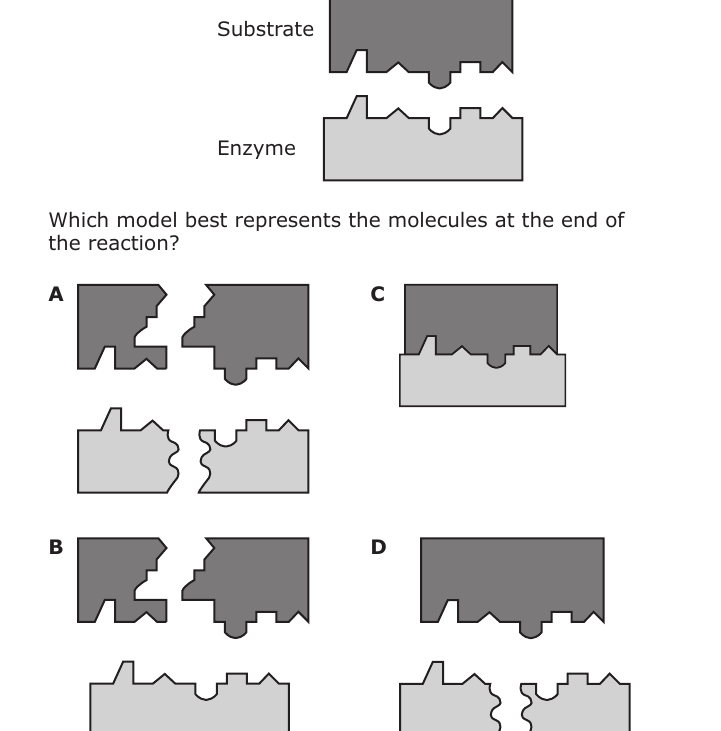
Released STAAR Biology EOC · 2022 · Item 29 · 1 point
A model of an enzyme and its corresponding substrate is shown. Which model best represents the molecules at the end of the reaction?
- Model A
- Model B
- Model C
- Model D
Show STAAR answer and explanation
Model B
The substrate is split into products while the enzyme remains unchanged and can be reused, as shown in Model B.
Model A: The products and enzyme do not have the correct final structures.
Model C: The enzyme and substrate remain joined; an enzyme is not permanently consumed in the reaction.
Model D: The substrate is not converted into the expected products and the enzyme is altered.
Released STAAR Biology EOC · 2021 · Item 19 · 1 point
For an enzyme to be able to catalyze a reaction, the active site must —
- be occupied by an inhibitor
- increase the activation energy level
- have a complementary shape to the substrate
- cause the enzyme to be destroyed in the reaction
Show STAAR answer and explanation
have a complementary shape to the substrate
The active site must fit the substrate's shape so the substrate can bind and the enzyme can lower activation energy.
be occupied by an inhibitor: An inhibitor occupying the active site can prevent substrate binding.
increase the activation energy level: Enzymes lower, not increase, activation energy.
cause the enzyme to be destroyed in the reaction: Enzymes are not destroyed by the reactions they catalyze.
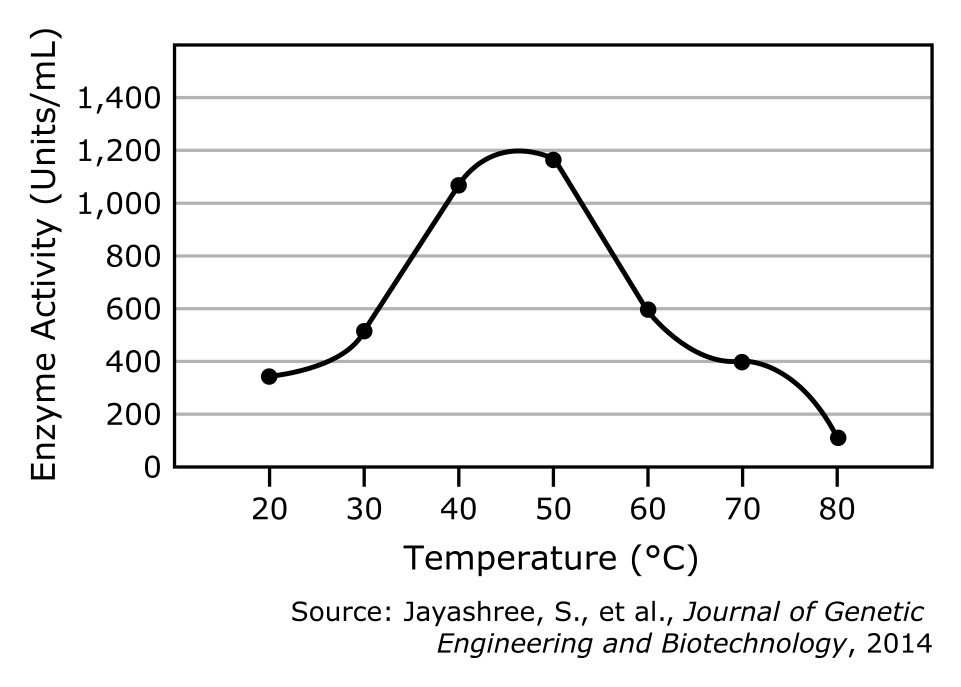
Released STAAR Biology EOC · 2026 · Item 7 · 1 point
A graph of enzyme activity is shown. Which statement is BEST supported by the data?
- The enzyme is denatured and can no longer bind to its substrate between 20 and 40 °C.
- The enzyme is able to optimally function and bind to its substrate at around 45 °C.
- The enzyme can only bind to its substrate at temperatures between 30 and 60 °C.
- The enzyme can no longer bind to its substrate at temperatures greater than 60 °C.
Show STAAR answer and explanation
The enzyme is able to optimally function and bind to its substrate at around 45 °C.
Enzyme activity on the graph is highest at about 45 °C, so the enzyme functions optimally near that temperature.
The enzyme is denatured and can no longer bind to its substrate between 20 and 40 °C.: The enzyme is still active at these temperatures.
The enzyme can only bind to its substrate at temperatures between 30 and 60 °C.: The enzyme is still active at temperatures outside this range.
The enzyme can no longer bind to its substrate at temperatures greater than 60 °C.: The enzyme is still active at 70 °C.
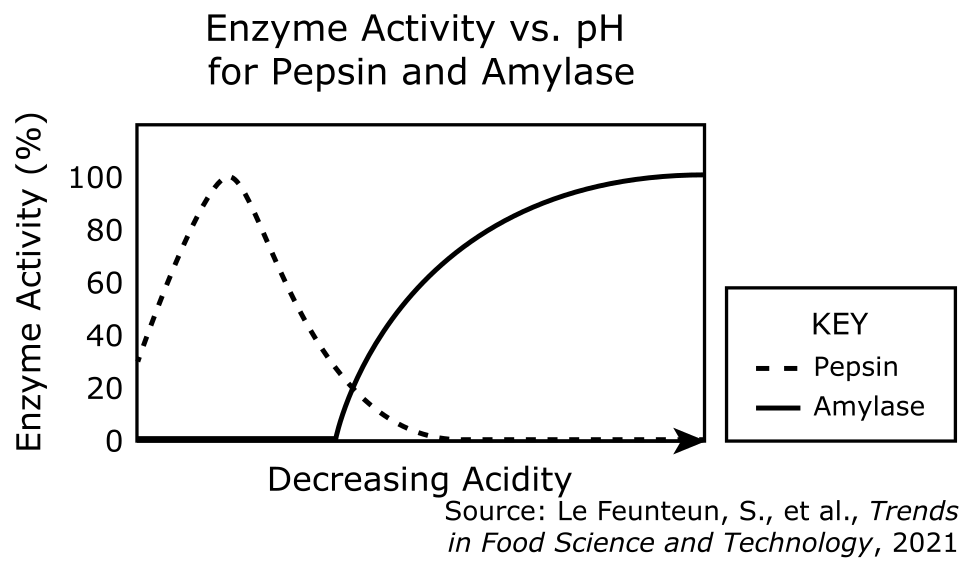
Released STAAR Biology EOC · 2026 · Item 24 · 1 point
The graph shows the reaction rates for two different enzymes at different pH levels. Each enzyme is used in the body for different reactions: • Pepsin is used in the stomach to help digest proteins. • Amylase is used in the mouth to help digest sugars. Which statement BEST describes what will happen when amylase is swallowed and enters the stomach?
- Amylase will continue to break down sugars in the stomach.
- Amylase will help the stomach break down proteins.
- Amylase will be recycled for use in other systems.
- Amylase will be unable to function in the stomach.
Show STAAR answer and explanation
Amylase will be unable to function in the stomach.
The change to the stomach's acidic pH will denature amylase, so it will no longer function.
Amylase will continue to break down sugars in the stomach.: The pH change causes amylase to stop functioning, so it no longer breaks down sugars.
Amylase will help the stomach break down proteins.: Amylase does not digest proteins, and the pH change alters it so it is no longer functional.
Amylase will be recycled for use in other systems.: The pH change alters amylase, and it will no longer function.
Released STAAR Biology EOC · 2025 · Item 29 · 1 point
Lipase is an enzyme responsible for breaking fat down in the stomach. Which statement explains the effectiveness of lipase as it moves through the digestive system from the stomach to the intestine?
- It becomes less effective because it is used up by fats in the stomach.
- It becomes more effective because it acquires energy for more reactions from fats.
- It becomes less effective because it is inhibited by the change in pH from the stomach to the intestines.
- It becomes more effective because it changes shape and is able to break down other materials in the intestines.
Show STAAR answer and explanation
It becomes less effective because it is inhibited by the change in pH from the stomach to the intestines.
An enzyme has an optimal pH range. The shift in pH from the stomach to the intestine causes this lipase to become less effective.
It becomes less effective because it is used up by fats in the stomach.: Enzymes are reused if they are not denatured.
It becomes more effective because it acquires energy for more reactions from fats.: Enzymes lower the activation energy of reactions; they do not acquire energy.
It becomes more effective because it changes shape and is able to break down other materials in the intestines.: A change in an enzyme's shape indicates denaturation, which makes it less effective.
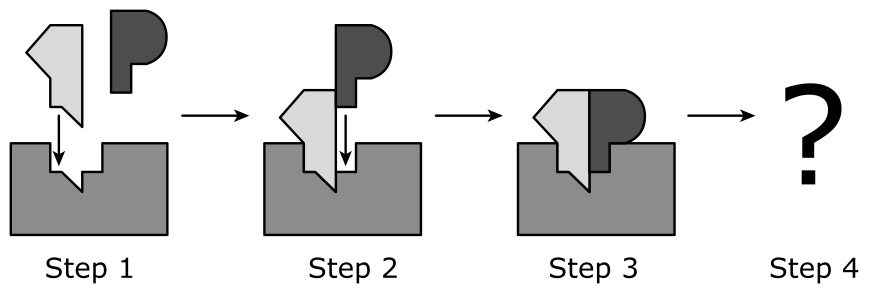
Released STAAR Biology EOC · 2025 · Item 38 · 1 point
The diagram illustrates a biological process. Which statement describes what will most likely happen during Step 4?
- The substrates will bind together to form a product, and the enzyme will be unchanged.
- The substrates will bind together to form a product, and the enzyme will be denatured.
- The enzymes and substrates will all bind together to form one product.
- The enzyme will become the product and both substrates will be released.
Show STAAR answer and explanation
The substrates will bind together to form a product, and the enzyme will be unchanged.
In enzymatic reactions, the substrates are changed into a product, while the enzyme is unchanged and can be reused.
The substrates will bind together to form a product, and the enzyme will be denatured.: Enzymes are reused in chemical reactions; they are not denatured by catalyzing them.
The enzymes and substrates will all bind together to form one product.: Enzymes detach from the substrates once the reaction is complete.
The enzyme will become the product and both substrates will be released.: The substrates, not the enzyme, become the product.
Learning objectives
By the end of the lesson, students can:
- Explain activation energy, active sites, and enzyme specificity.
- Interpret enzyme-activity graphs across temperature and pH.
- Distinguish reduced molecular motion from denaturation.
Instructional sequence
- 1
Engage
5 minPresent boiled amylase that no longer breaks down starch after cooling. Ask what changed if the enzyme was not used up.
- 2
Direct instruction
10 minModel induced fit and activation energy. Connect the active site's three-dimensional shape to substrate binding.
- 3
Graph investigation
15 minCompare low temperature, optimum temperature, high temperature, and pH shifts. Students annotate molecular motion and denaturation on each region.
- 4
Scenario practice
12 minExplain pepsin moving from pH 2 to pH 8 and a high fever affecting human enzymes using cause-and-effect chains.
- 5
Closure
8 minComplete the exit ticket and correct the phrase “used up” wherever it appears in draft explanations.
Misconceptions to address
Teacher move: Emphasize that enzymes are reusable; a reaction does not use them up, although extreme conditions can damage their shape.
Teacher move: Contrast slower molecular motion at low temperature with structural disruption at high temperature or extreme pH.