

Protein Synthesis
Describe transcription and translation and how they produce proteins from a DNA template.
Students follow genetic information from a DNA template through transcription and translation, distinguishing the location, molecules, and product of each process.
Lesson plan and worked examples by TEKSForge · not a TEA-issued lesson. Videos by independent educators.
Learn the concept
Transcription
RNA polymerase uses a DNA template to build complementary RNA. For a eukaryotic protein-coding gene, transcription occurs in the nucleus; processed mRNA can leave the nucleus. RNA uses uracil instead of thymine. A template strand and a coding strand must not be treated as interchangeable.
Translation
A ribosome reads mRNA codons in groups of three. tRNAs pair anticodons with codons and deliver amino acids. The ribosome links amino acids into a polypeptide. A start codon establishes the reading frame; a stop codon signals termination rather than adding an amino acid.
Track the molecules
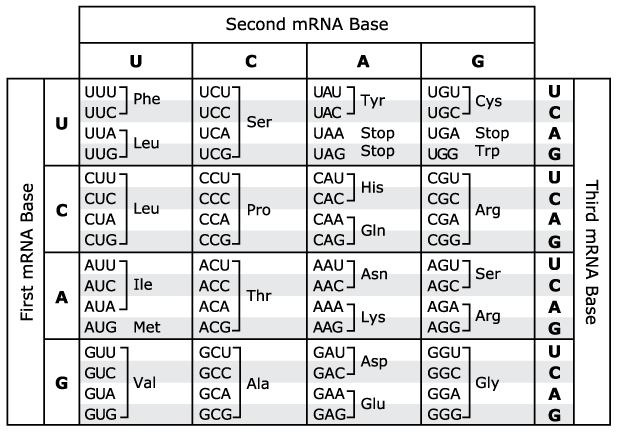
Use the codon chart with mRNA, not the DNA template or tRNA anticodon. Transcription produces RNA; translation produces a polypeptide. RNA polymerase does not transport amino acids.
Visualize the concept
Original TEKSForge instructional diagrams, designed for this TEKS skill and clearly distinguished from released STAAR artwork.

Study released STAAR visuals
Use the original graphs, tables, and diagrams from released STAAR questions to practice reading labels, values, and relationships before answering the items below.
Released STAAR Biology EOC · 2022 · Item 16 · 1 point
Released STAAR Biology EOC · 2021 · Item 27 · 1 point
Released STAAR Biology EOC · 2026 · Item 32 · 1 point
Released STAAR Biology EOC · 2025 · Item 6 · 1 point
Released STAAR Biology EOC · 2025 · Item 36 · 1 point
Worked example
Transcribe the DNA template 3′-TAC GAA ACT-5′, then translate the mRNA.
- Build complementary mRNA 5′-AUG CUU UGA-3′ using A–U, T–A, C–G, and G–C.
- Read AUG as methionine and CUU as leucine on an mRNA codon chart.
- UGA is a stop codon, so it adds no amino acid.
mRNA: AUG CUU UGA; polypeptide segment: methionine–leucine.
Watch the lesson
Texas public-school, Texas educator-created, and TEKS-aligned lessons, hosted by their creators. Each card names its source.
Biology: Transcription and Translation
UT IPSI · Kid2Kid / Texas Education AgencyFollow DNA information through mRNA to a polypeptide.
Watch on YouTubeTry it yourself
TEKSForge practice · unscored
1. Which molecule carries amino acids to the ribosome?
Show answer and reasoning
tRNA
Its anticodon pairs with an mRNA codon; RNA polymerase instead synthesizes RNA during transcription.
2. What is the mRNA complement of template DNA 3′-TAC-5′?
Show answer and reasoning
5′-AUG-3′
T pairs with A, A with U, and C with G. AUG is the start codon that codes for methionine.
Released STAAR practice
Texas Education Agency · released EOC items · explanations adapted from TEA rationales. Original graphs, tables, and diagrams are shown where the released item includes one.
Released STAAR Biology EOC · 2019 · Item 8 · 1 point
Students are modeling mRNA during the process of protein synthesis. Which answer choice correctly describes the model of the mRNA strand being transcribed?
- The mRNA strand is complementary to the DNA template strand; however, uracil instead of adenine is paired with thymine.
- The mRNA strand is complementary to the DNA template strand; however, uracil instead of thymine is paired with adenine.
- The mRNA strand is an exact copy of the DNA template strand; however, uracil instead of adenine is paired with thymine.
- The mRNA strand is an exact copy of the DNA template strand; however, uracil instead of thymine is paired with adenine.
Show STAAR answer and explanation
The mRNA strand is complementary to the DNA template strand; however, uracil instead of thymine is paired with adenine.
During transcription, mRNA is complementary to the DNA template. Wherever the DNA has adenine, the mRNA gets uracil instead of thymine.
The mRNA strand is complementary to the DNA template strand; however, uracil instead of adenine is paired with thymine.: Uracil pairs with adenine, not with thymine.
The mRNA strand is an exact copy of the DNA template strand; however, uracil instead of adenine is paired with thymine.: mRNA is complementary to the template, not an exact copy.
The mRNA strand is an exact copy of the DNA template strand; however, uracil instead of thymine is paired with adenine.: mRNA is complementary to the template, not an exact copy.
Released STAAR Biology EOC · 2022 · Item 16 · 1 point
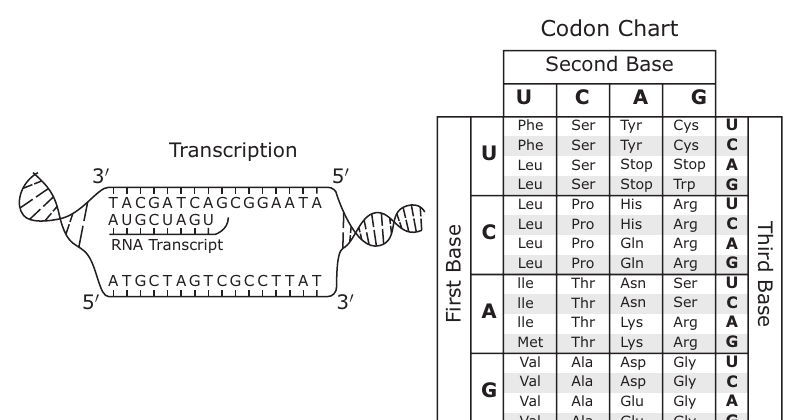
A model of transcription and a codon chart are shown. Which amino acid would be coded first from the DNA strand being transcribed?
- Cys
- Phe
- Ile
- Met
Show STAAR answer and explanation
Met
The first DNA triplet TAC is transcribed to AUG. The codon chart shows AUG codes for Met.
Cys: Cys is coded by UGU or UGC, not the first transcript codon AUG.
Phe: Phe is coded by UUU or UUC, not AUG.
Ile: Ile is coded by AUU, AUC, or AUA; the first codon is AUG.
Released STAAR Biology EOC · 2021 · Item 23 · 1 point
Environmental factors typically activate genes in a cell by causing the cell to —
- produce identical daughter cells through mitosis
- form haploid gamete cells through meiosis
- fuse with another cell to increase the size of its genome
- transcribe specific DNA segments to mRNA for translation
Show STAAR answer and explanation
transcribe specific DNA segments to mRNA for translation
Gene activation begins expression of a specific segment by transcribing it into mRNA, which can then be translated into protein.
produce identical daughter cells through mitosis: Mitosis duplicates cells; it does not specifically activate a gene.
form haploid gamete cells through meiosis: Meiosis produces gametes and is not the direct mechanism of gene activation.
fuse with another cell to increase the size of its genome: Cell fusion is not required for environmental signals to activate transcription.
Released STAAR Biology EOC · 2021 · Item 27 · 1 point
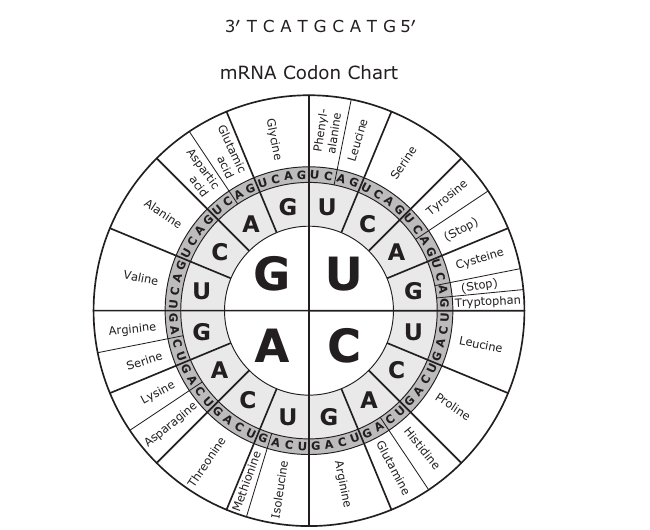
A partial DNA segment and an mRNA codon chart are shown. What amino acid sequence is encoded in the partial DNA segment?
- Serine – Threonine – Tyrosine
- Serine – Serine – Tyrosine
- Serine – Threonine – Methionine
- Serine – Alanine – Methionine
Show STAAR answer and explanation
Serine – Threonine – Tyrosine
The template 3′-TCA TGC ATG-5′ is transcribed to 5′-AGU ACG UAC-3′. Those codons specify serine, threonine, and tyrosine.
Serine – Serine – Tyrosine: The middle codon is ACG, which codes for threonine, not serine.
Serine – Threonine – Methionine: The final codon is UAC (tyrosine), not AUG (methionine).
Serine – Alanine – Methionine: The second and third codons are ACG and UAC, not an alanine codon and AUG.
Released STAAR Biology EOC · 2024 · Item 43 · 2 points
Complete the sentences to describe a start codon. Move the correct answer to each box. Not all answers will be used.
Show STAAR answer and explanation
triplet; amino acid
Almost every organism begins protein synthesis with a triplet nucleotide sequence. This start codon is translated to a common amino acid in all organisms. One correct response earns one point; both earn two points.
Released STAAR Biology EOC · 2026 · Item 32 · 1 point
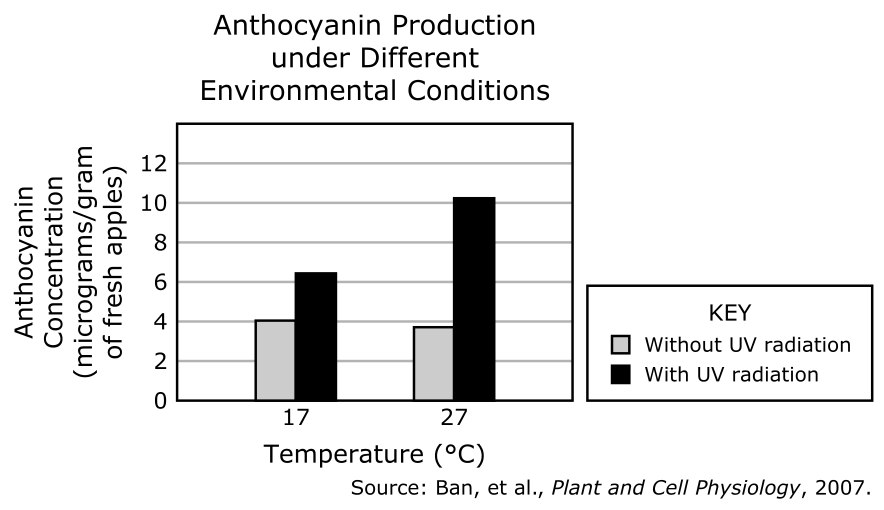
Anthocyanin is a pigment that gives some plants red or blue coloration. Scientists examined the production of anthocyanin in fresh apples stored under different environmental conditions. The graph shows the amount of anthocyanin pigment per gram of fresh apples. Based on the graph, which statement correctly describes the conditions MOST LIKELY to produce the proteins involved in the gene expression of anthocyanin?
- Messenger RNA is most active when UV radiation is absent and when temperatures are warm.
- Messenger RNA is most active when UV radiation is present and when temperatures are cool.
- Messenger RNA is most active when UV radiation is present and when temperatures are warm.
- Messenger RNA is most active when UV radiation is absent and when temperatures are cool.
Show STAAR answer and explanation
Messenger RNA is most active when UV radiation is present and when temperatures are warm.
The graph shows the most anthocyanin when UV radiation is present at the warmer temperature, so mRNA is most active then, producing messages for protein synthesis.
Messenger RNA is most active when UV radiation is absent and when temperatures are warm.: Less anthocyanin is produced without UV radiation, so gene expression is likely lower under these conditions.
Messenger RNA is most active when UV radiation is present and when temperatures are cool.: More anthocyanin is made at warmer temperatures with UV radiation, so the genes are more active when it is warm, not cool.
Messenger RNA is most active when UV radiation is absent and when temperatures are cool.: Less anthocyanin is produced without UV radiation and at cool temperatures, so gene expression is likely lower.
Released STAAR Biology EOC · 2025 · Item 6 · 1 point
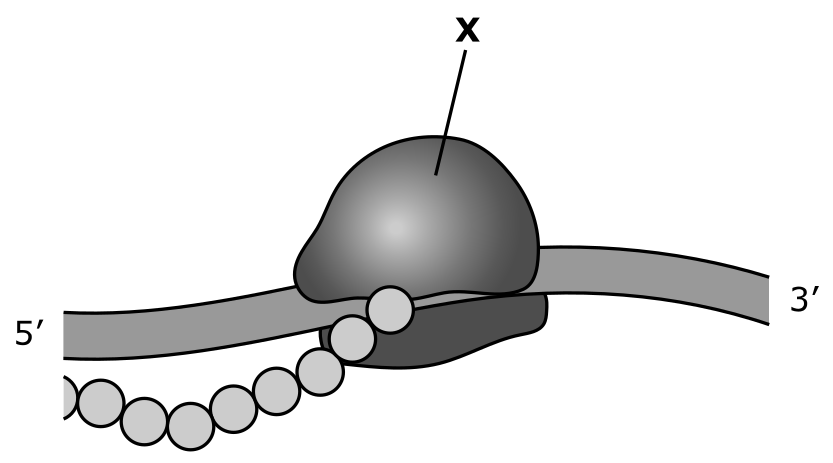
Proteins serve numerous roles in the human body. Part of the biological process for making proteins is shown in the image. Based on the image, which of these BEST describes the structure and function of the organelle identified as X?
- Endoplasmic reticulum, which carries nucleotides as a DNA strand is being transcribed
- Endoplasmic reticulum, which carries nucleotides as a DNA strand is being translated
- Ribosome, which holds the mRNA in place as amino acids are transported by tRNA
- Ribosome, which holds the tRNA in place as amino acids are transported by mRNA
Show STAAR answer and explanation
Ribosome, which holds the mRNA in place as amino acids are transported by tRNA
The ribosome holds the mRNA molecule, allowing tRNA molecules to bring the amino acids that form a polypeptide or protein during protein synthesis.
Endoplasmic reticulum, which carries nucleotides as a DNA strand is being transcribed: This is not the endoplasmic reticulum, and transcription makes RNA from DNA in the nucleus.
Endoplasmic reticulum, which carries nucleotides as a DNA strand is being translated: This is not the endoplasmic reticulum. In translation, mRNA is translated into a polypeptide as tRNA carries amino acids to the ribosome.
Ribosome, which holds the tRNA in place as amino acids are transported by mRNA: This reverses the roles: the ribosome holds the mRNA, and tRNA brings the amino acids.
Released STAAR Biology EOC · 2025 · Item 36 · 1 point
A portion of an mRNA sequence and a codon chart are shown. 5' UCU UGU CGA 3' Based on the codon chart, what sequence of amino acids is produced when this mRNA is translated?
- Thr - Asn - Glu
- Cys - Phe - Leu
- Ser - Cys - Arg
- Ser - Trp - Asp
Show STAAR answer and explanation
Ser - Cys - Arg
On the codon chart, UCU codes for serine (Ser), UGU codes for cysteine (Cys), and CGA codes for arginine (Arg).
Thr - Asn - Glu: Threonine is coded by ACU, ACC, ACA, and ACG; asparagine by AAU and AAC; and glutamic acid by GAA and GAG.
Cys - Phe - Leu: Cysteine is coded by UGU and UGC; phenylalanine by UUU and UUC; and leucine by CUU, CUC, CUA, CUG, UUA, and UUG.
Ser - Trp - Asp: Serine is coded by UCU, UCC, UCA, UCG, AGU, and AGC; tryptophan by UGG; and aspartic acid by GAU and GAC.
Learning objectives
By the end of the lesson, students can:
- Transcribe a DNA template into a complementary mRNA sequence.
- Describe how mRNA, ribosomes, tRNA, and amino acids participate in translation.
- Compare transcription and translation by template, location, machinery, and product.
Instructional sequence
- 1
Engage
5 minAsk how information stored in nuclear DNA can lead to a protein assembled at a ribosome.
- 2
Direct instruction
12 minModel RNA polymerase building mRNA from a DNA template. Emphasize complementary pairing and U replacing T.
- 3
Guided translation
14 minMove an mRNA strip through a ribosome model; use tRNA anticodons and a codon chart to attach amino acids.
- 4
Compare and apply
12 minComplete a two-process comparison chart, then trace TAC → AUG → methionine with each molecule's role named.
- 5
Closure
7 minComplete the exit ticket without using the comparison chart.
Misconceptions to address
Teacher move: Separate the stages: transcription makes mRNA from DNA; translation reads mRNA to build a polypeptide.
Teacher move: RNA polymerase builds RNA during transcription; tRNA delivers amino acids during translation.