

Mutations
Explain how substitutions, insertions, and deletions in DNA can change proteins and traits.
Students compare substitutions, insertions, and deletions at the DNA level and predict downstream effects on codons, amino acids, protein structure, and traits.
Lesson plan and worked examples by TEKSForge · not a TEA-issued lesson. Videos by independent educators.
Learn the concept
Types of sequence changes
A substitution replaces a nucleotide; an insertion adds nucleotides; a deletion removes them. In a coding region, inserting or deleting a number of bases not divisible by three changes downstream codon grouping, producing a frameshift.
Predict protein effects
A substitution can be silent (same amino acid), missense (different amino acid), or nonsense (a premature stop). A three-base insertion can add an amino acid without shifting the downstream frame. Not every sequence change produces a harmful or visible effect.
Trace cause and effect
Compare original and altered codons, identify the amino-acid change, and then consider protein folding or function. Mutations do not occur because an organism intends to adapt; their effects can be neutral, beneficial, or harmful depending on context.
Visualize the concept
Original TEKSForge instructional diagrams, designed for this TEKS skill and clearly distinguished from released STAAR artwork.

Study released STAAR visuals
Use the original graphs, tables, and diagrams from released STAAR questions to practice reading labels, values, and relationships before answering the items below.
Released STAAR Biology EOC · 2019 · Item 28 · 1 point

Released STAAR Biology EOC · 2021 · Item 3 · 1 point
Released STAAR Biology EOC · 2025 · Item 41 · 1 point

Released STAAR Biology EOC · 2023 · Item 19 · 2 points
Released STAAR Biology EOC · 2026 · Item 9 · 1 point
Worked example
An mRNA codon changes from GAA to GAG. Both code for glutamate. Classify the result.
- Only one nucleotide has changed, so the sequence change is a substitution.
- Compare the encoded amino acids using an mRNA codon chart.
- Both codons specify glutamate, so the amino-acid sequence is unchanged at this position.
A silent substitution with respect to the encoded amino acid.
Watch the lesson
Texas public-school, Texas educator-created, and TEKS-aligned lessons, hosted by their creators. Each card names its source.
Mutations (Updated)
Amoeba Sisters · former Texas public school educatorDistinguish substitutions, insertions, deletions, frameshifts, and possible protein effects.
Watch on YouTubeTry it yourself
TEKSForge practice · unscored
1. Why can a one-base deletion affect many downstream amino acids?
Show answer and reasoning
It shifts the reading frame.
Regrouping the sequence into triplets changes many codons after the deletion, potentially including a premature stop.
2. Does inserting exactly three bases necessarily cause a frameshift?
Show answer and reasoning
No
Three bases preserve the downstream frame, although the added sequence can still alter a protein's function.
Released STAAR practice
Texas Education Agency · released EOC items · explanations adapted from TEA rationales. Original graphs, tables, and diagrams are shown where the released item includes one.
Released STAAR Biology EOC · 2022 · Item 5 · 1 point
Each choice shows an original gene sequence followed by the sequence after a change. Which of these shows an example of an insertion mutation?
- R S T U V X Y Z → S T U V X Y
- R S T U V X Y Z → R S T V X Y Z
- R S T U V X Y Z → R U T S V X Y Z
- R S T U V X Y Z → K L R S T U V X Y Z
Show STAAR answer and explanation
R S T U V X Y Z → K L R S T U V X Y Z
An insertion adds new material. Here, K and L are added to the original sequence.
R S T U V X Y Z → S T U V X Y: R and Z were removed. That's a deletion.
R S T U V X Y Z → R S T V X Y Z: U was removed. That's a deletion.
R S T U V X Y Z → R U T S V X Y Z: S and U swapped positions. Nothing was added.
Released STAAR Biology EOC · 2022 · Item 34 · 1 point
Which statements explain how a mutation in a somatic cell is different from a mutation that occurs in gametes?
- Somatic cell mutations occur in cells that give rise to gametes. Gamete mutations occur in cells that result in apoptosis.
- Somatic cell mutations are maintained in the gene pool. Gamete mutations are expelled from the gene pool.
- Somatic cell mutations are generally not passed to offspring. Gamete mutations are usually passed to offspring.
- Somatic cell mutations will not be expressed by the individual that contains the mutation. Gamete mutations will be expressed by the individual.
Show STAAR answer and explanation
Somatic cell mutations are generally not passed to offspring. Gamete mutations are usually passed to offspring.
Somatic (body) cell mutations affect only that individual's cells or tissues. Gamete (sperm or egg) mutations can be inherited by offspring.
Somatic cell mutations occur in cells that give rise to gametes. Gamete mutations occur in cells that result in apoptosis.: Germ cells, not somatic cells, give rise to gametes. Apoptosis happens in both kinds of cells.
Somatic cell mutations are maintained in the gene pool. Gamete mutations are expelled from the gene pool.: Somatic mutations aren't inherited, so they don't enter the gene pool.
Somatic cell mutations will not be expressed by the individual that contains the mutation. Gamete mutations will be expressed by the individual.: A mutation in any cell can be expressed by the individual.
Released STAAR Biology EOC · 2019 · Item 28 · 1 point
The model shows a mutation to a partial sequence of bases in a gene. Which type of mutation does the model demonstrate?
- Deletion
- Insertion
- Substitution
- Translocation
Show STAAR answer and explanation
Insertion
A sequence of bases (TATC) is added to the original gene sequence, so this is an insertion.
Deletion: No bases are removed from the original sequence.
Substitution: No bases are swapped for others; new bases are added.
Translocation: Translocation moves part of one chromosome to another. That isn't shown here.
Released STAAR Biology EOC · 2019 · Item 36 · 1 point
Exposure to the building material asbestos has been linked to certain types of cancers. Asbestos causes mutations in the p53 gene, which controls tumor suppression. Which statement best explains why people with cancer due to asbestos exposure do not pass the mutation on to their offspring?
- The mutation occurred in gametic cells.
- The mutation occurred in somatic cells.
- The mutation is recessive.
- The mutation is sex-linked.
Show STAAR answer and explanation
The mutation occurred in somatic cells.
Asbestos damages body (somatic) cells, such as lung cells. Mutations in somatic cells are not passed to offspring.
The mutation occurred in gametic cells.: Mutations in gametes (sex cells) can be passed to offspring.
The mutation is recessive.: Recessive mutations can still be passed to offspring.
The mutation is sex-linked.: Sex-linked mutations can be passed to offspring.
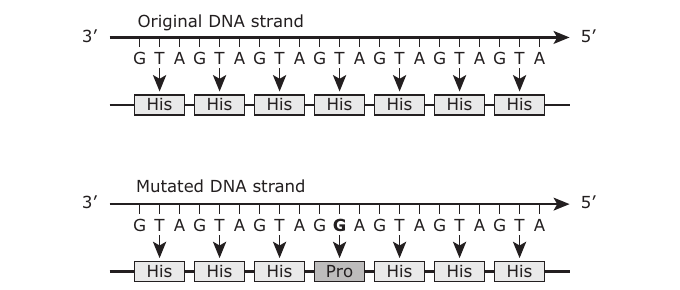
Released STAAR Biology EOC · 2021 · Item 3 · 1 point
An illustration of how a particular DNA mutation will most likely affect the polypeptide produced is shown. What type of mutation is illustrated?
- Insertion
- Translocation
- Substitution
- Deletion
Show STAAR answer and explanation
Substitution
One DNA base is replaced by another, changing one codon and the amino acid from His to Pro. This is a substitution.
Insertion: No extra base is added to the sequence.
Translocation: No chromosome segment moves to a different chromosome.
Deletion: No base is removed; one base is replaced.
Released STAAR Biology EOC · 2021 · Item 37 · 1 point
When a new mutation occurs in a somatic cell of a sexually reproducing organism, what percentage of the individual’s offspring are likely to inherit the mutation?
- 100%
- 75%
- 25%
- 0%
Show STAAR answer and explanation
0%
Somatic cells are body cells, not gametes. A mutation confined to a somatic cell is not passed to offspring.
100%: Only a mutation transmitted through gametes could be inherited; a somatic mutation is not.
75%: Inheritance percentages from a cross do not apply because the mutation is not in gametes.
25%: A somatic-cell mutation has no direct route into offspring.
Released STAAR Biology EOC · 2025 · Item 41 · 1 point
Some inherited health disorders are caused by nondisjunction. During nondisjunction, homologous chromosomes fail to separate properly during the formation of sex cells. Based on the images, which cells MOST LIKELY show examples of nondisjunction?
Show STAAR answer and explanation
The second cell from the left and the cell farthest to the right
The second and fifth cells both show unequal separation of homologous chromosome pairs, which is nondisjunction.
Released STAAR Biology EOC · 2023 · Item 19 · 2 points
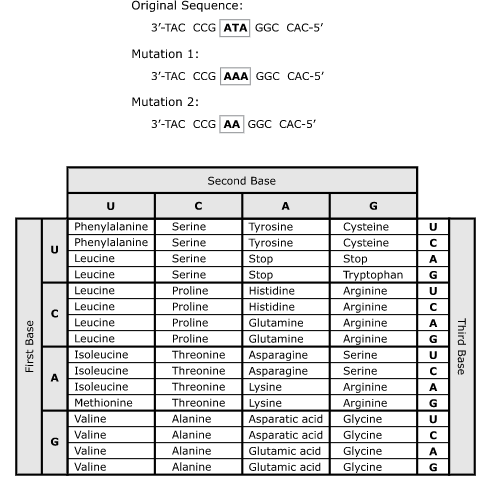
Two mutations of a genetic sequence are shown. A DNA codon chart is also shown. • Which mutation would have the MOST significant impact on the gene product? • Why would the impact be so significant? Review the diagram carefully. Then enter your answer and your explanation in the box provided.
Show STAAR answer and explanation
Mutation 2, because the deletion causes a frameshift and changes the downstream amino acid sequence.
Mutation 2 causes a frameshift: AAA GGC CAC becomes AAG GCC AC, changing the amino acid sequence. Naming Mutation 2 or explaining the frameshift earns one point; a complete response earns two.
Released STAAR Biology EOC · 2026 · Item 9 · 1 point
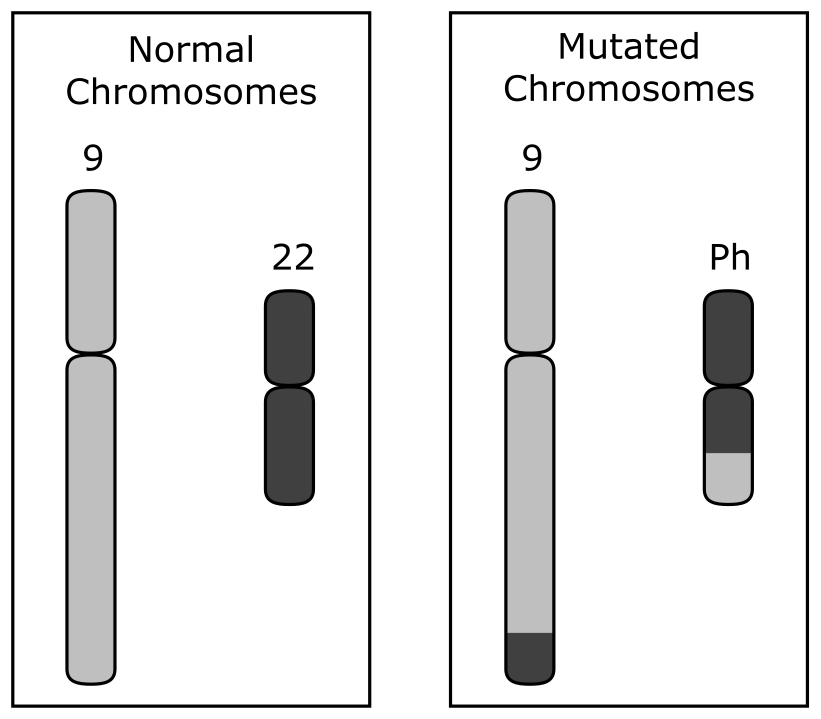
The Philadelphia chromosome (Ph) is a chromosomal abnormality that results in cancer in humans. This occurs when portions of chromosome 9 and chromosome 22 are switched, as shown in the image. Which type of chromosomal mutation must occur in order to form the Philadelphia chromosome?
- Translocation
- Deletion
- Insertion
- Nondisjunction
Show STAAR answer and explanation
Translocation
The exchange of genetic information between chromosome 9 and chromosome 22 is an example of a translocation mutation.
Deletion: A deletion mutation would show an overall loss of genetic information.
Insertion: An insertion mutation would show an overall increase in genetic information.
Nondisjunction: Nondisjunction is the failure of homologous chromosomes or sister chromatids to separate properly during meiosis.
Released STAAR Biology EOC · 2026 · Item 25 · 1 point
A student is creating a table with an example of a DNA sequence that experienced a mutation and a description of this mutation. Which table provides the BEST example and description of a frameshift mutation?
- Original DNA: 3’ CGT TAT GCT T 5’ Mutated DNA: 3’ CTC GTA TTG T 5’ Mutation description: A section of DNA breaks away and reattaches to the chromosome in the reverse order without affecting the resulting protein.
- Original DNA: 3’ CGT TAT GCT T 5’ Mutated DNA: 3’ CGT GTA TGC TT 5’ Mutation description: A single base is inserted, which could result in a protein with a different amino acid sequence and shape.
- Original DNA: 3’ CGT TAT GCT T 5’ Mutated DNA: 3’ CGT AAT GCT T 5’ Mutation description: One base is substituted for another, which could result in a stop codon and a protein with a different amino acid sequence and shape.
- Original DNA: 3’ CGT TAT GCT T 5’ Mutated DNA: 3’ CGT TAA GCT T 5’ Mutation description: A single base is changed and codes for the same amino acid without affecting the resulting protein.
Show STAAR answer and explanation
Original DNA: 3’ CGT TAT GCT T 5’ Mutated DNA: 3’ CGT GTA TGC TT 5’ Mutation description: A single base is inserted, which could result in a protein with a different amino acid sequence and shape.
A frameshift mutation changes the reading frame of the DNA being transcribed. The inserted base shifts every downstream codon and may produce a protein with a completely different amino acid sequence and shape.
Original DNA: 3’ CGT TAT GCT T 5’ Mutated DNA: 3’ CTC GTA TTG T 5’ Mutation description: A section of DNA breaks away and reattaches to the chromosome in the reverse order without affecting the resulting protein.: This describes an inversion mutation, where a stretch of bases appears in reverse order.
Original DNA: 3’ CGT TAT GCT T 5’ Mutated DNA: 3’ CGT AAT GCT T 5’ Mutation description: One base is substituted for another, which could result in a stop codon and a protein with a different amino acid sequence and shape.: A substitution can produce an early stop codon, but it is not a frameshift mutation.
Original DNA: 3’ CGT TAT GCT T 5’ Mutated DNA: 3’ CGT TAA GCT T 5’ Mutation description: A single base is changed and codes for the same amino acid without affecting the resulting protein.: This describes a silent mutation, not a frameshift mutation.
Released STAAR Biology EOC · 2025 · Item 34 · 1 point
A base sequence of the DNA from a gene is shown. ATC GGC TA Due to a mutation, the base sequence was changed as shown. ATT GGC TA Which type of mutation has occurred in the gene?
- Deletion
- Substitution
- Insertion
- Translocation
Show STAAR answer and explanation
Substitution
A substitution occurs when one base is replaced by a different base and the length of the DNA sequence is unchanged. Here, C was replaced by T.
Deletion: A deletion removes a base without replacing it, producing a shorter DNA sequence.
Insertion: An insertion adds a new base without removing one, producing a longer DNA sequence.
Translocation: A translocation moves an entire section of a chromosome to a different chromosome.
Learning objectives
By the end of the lesson, students can:
- Classify point mutations and insertion or deletion mutations.
- Explain silent, missense, nonsense, and frameshift outcomes.
- Trace a DNA change through protein structure to a possible trait effect.
Instructional sequence
- 1
Engage
5 minChange one letter in a short sentence, then insert one letter and shift all following groupings to preview frameshift.
- 2
Direct instruction
10 minDefine substitution, insertion, and deletion. Use codon frames to distinguish a single-codon change from a reading-frame shift.
- 3
Guided practice
13 minMutate identical starting sequences in different ways and compare every downstream codon and amino acid.
- 4
Application
11 minAnalyze sickle cell as a missense substitution and explain why a single amino-acid change can alter hemoglobin shape.
- 5
Closure
6 minStudents classify a final mutation and justify the predicted protein effect.
Misconceptions to address
Teacher move: Mutations can be neutral, harmful, or beneficial depending on the protein effect and environment.
Teacher move: An insertion of three nucleotides adds a complete codon and preserves the downstream reading frame.