

Genetic Crosses
Predict outcomes of monohybrid, dihybrid, and non-Mendelian crosses (codominance, incomplete dominance, sex-linked).
Students move from monohybrid probabilities to dihybrid and non-Mendelian crosses, keeping allele case, inheritance pattern, and the question's reference group explicit.
Lesson plan and worked examples by TEKSForge · not a TEA-issued lesson. Videos by independent educators.
Learn the concept
From gametes to probability
Each gamete carries one allele per gene. In , each parent produces B and b gametes. The four equally likely combinations are BB, Bb, Bb, and bb. With complete dominance, three show the dominant phenotype and one shows the recessive phenotype. These are probabilities, not a guaranteed birth order.
Different inheritance patterns
Incomplete dominance produces an intermediate heterozygote phenotype; codominance expresses both alleles. For an X-linked recessive trait, a son receives his X from his mother and Y from his father. Always distinguish a probability among sons from a probability among all children.
Two traits
For independently assorting, unlinked genes, multiply the separate probabilities. In , the probability of aabb is . The familiar 9:3:3:1 phenotype ratio requires complete dominance for both genes and independent assortment.
Visualize the concept
Original TEKSForge instructional diagrams, designed for this TEKS skill and clearly distinguished from released STAAR artwork.


Study released STAAR visuals
Use the original graphs, tables, and diagrams from released STAAR questions to practice reading labels, values, and relationships before answering the items below.
Released STAAR Biology EOC · 2019 · Item 26 · 1 point
Released STAAR Biology EOC · 2022 · Item 9 · 1 point
Released STAAR Biology EOC · 2021 · Item 41 · 1 point
Released STAAR Biology EOC · 2025 · Item 27 · 1 point
Worked example
A carrier mother and unaffected father have a son. What is the probability he is affected?
- Restrict the reference group to sons, so the paternal chromosome is Y.
- The mother contributes either her normal X or her recessive-allele X with equal probability.
- One of those two possibilities produces an affected son.
among sons; among all children assuming equal probability of either sex.
Watch the lesson
Texas public-school, Texas educator-created, and TEKS-aligned lessons, hosted by their creators. Each card names its source.
Biology: Predicting Genetic Outcomes Using Monohybrid Crosses
UT IPSI · Kid2Kid / Texas Education AgencySet up and interpret a one-trait Punnett square.
Watch on YouTubeDihybrid and Two-Trait Crosses
Amoeba Sisters · former Texas public school educatorApply independent assortment to two-trait crosses.
Watch on YouTubePunnett Squares and Sex-Linked Traits (UPDATED)
Amoeba Sisters · former Texas public school educatorChoose the correct reference group for X-linked probabilities.
Watch on YouTubeTry it yourself
TEKSForge practice · unscored
1. In , what percentage is heterozygous?
Show answer and reasoning
50%
Two of four equally likely boxes are Bb. Do not confuse the genotype percentage with the 75% dominant phenotype percentage.
2. Red and white flowers show incomplete dominance. What phenotype does their heterozygous offspring show?
Show answer and reasoning
An intermediate phenotype, such as pink.
Incomplete dominance differs from codominance, where both parental phenotypes are expressed rather than an intermediate appearance.
Released STAAR practice
Texas Education Agency · released EOC items · explanations adapted from TEA rationales. Original graphs, tables, and diagrams are shown where the released item includes one.
Released STAAR Biology EOC · 2022 · Item 30 · 1 point
In domesticated dogs, hair type is controlled by two different alleles. The allele for wire hair is (H) and the allele for smooth hair is (h). When two heterozygous dogs are crossed, what percentage of the offspring is expected to be homozygous for smooth hair?
- 0%
- 25%
- 50%
- 75%
Show STAAR answer and explanation
25%
gives 25% HH, 50% Hh, and 25% hh. Only hh is homozygous for smooth hair: 25%.
0%: Each parent carries h, so hh offspring are possible: 1 of 4 boxes in the Punnett square.
50%: 50% is the heterozygous (Hh) offspring, which have wire hair.
75%: 75% is the offspring with wire hair (HH and Hh).
Released STAAR Biology EOC · 2019 · Item 17 · 1 point
Mice have two unlinked allele pairs that affect fur color. Mice with the aa allele pair are albino, regardless of the second allele pair (B/b). Mice with AA or Aa are agouti or solid black depending on the B alleles. What is the probability of albinism in the offspring of a cross between two mice with AaBb alleles?
Show STAAR answer and explanation
In the 16-box dihybrid Punnett square, 4 of the 16 combinations have aa. Those mice are albino whatever their B alleles: .
: 1/16 is only aabb. All aa mice are albino, including aaBB and aaBb, which makes 4/16.
: All four aa combinations are albino, not three.
: 9/16 is the A_B_ (agouti) group, not the albino group.
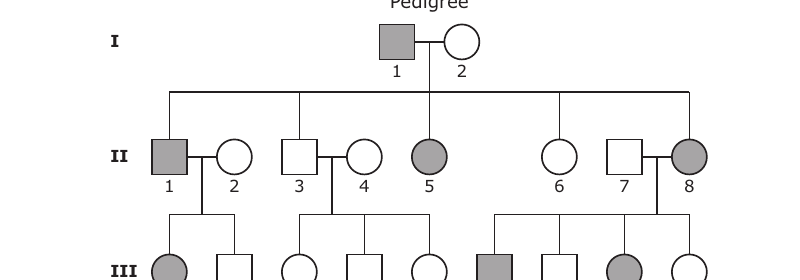
Released STAAR Biology EOC · 2019 · Item 26 · 1 point
The inheritance pattern for an autosomal dominant trait is shown in the pedigree. Shaded symbols represent individuals that express the dominant trait. Based on this pedigree, what are the most likely genotypes of individuals I-1 and I-2?
- I-1: aa; I-2: Aa
- I-1: AA; I-2: Aa
- I-1: Aa; I-2: aa
- I-1: aa; I-2: AA
Show STAAR answer and explanation
I-1: Aa; I-2: aa
I-2 is unshaded and therefore aa. I-1 expresses the dominant trait but has unshaded descendants, so I-1 must carry a and is Aa.
I-1: aa; I-2: Aa: This reverses the shaded dominant individual and unshaded recessive individual.
I-1: AA; I-2: Aa: I-2 is unshaded and must be aa; I-1 also has unshaded descendants and cannot be AA.
I-1: aa; I-2: AA: Both assignments conflict with the shading and the presence of unshaded descendants.
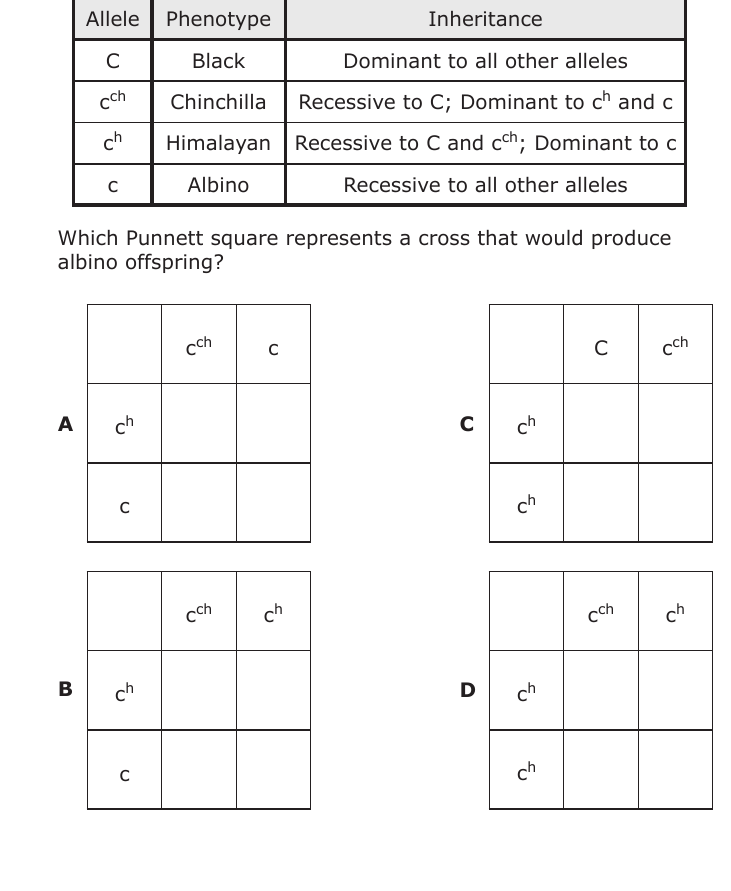
Released STAAR Biology EOC · 2022 · Item 9 · 1 point
A model of the genetic control of coat color in rabbits is shown. Which Punnett square represents a cross that would produce albino offspring?
- Punnett square A
- Punnett square B
- Punnett square C
- Punnett square D
Show STAAR answer and explanation
Punnett square A
Albino is recessive to all other alleles, so an albino offspring must inherit c from both parents. Square A includes c in each parent's gametes, allowing cc.
Punnett square B: This cross does not provide the c allele from both parents needed for cc.
Punnett square C: C is dominant to all other alleles, so offspring receiving C cannot be albino.
Punnett square D: Without c contributed by both parents, no cc albino offspring can be produced.
Released STAAR Biology EOC · 2021 · Item 25 · 1 point
A genetic cross involving two unlinked genes is represented. Which genotype is NOT possible in the offspring produced by the cross?
- AaGG
- Aagg
- aaGg
- aaGG
Show STAAR answer and explanation
Aagg
The first parent is GG and can contribute only G, so every offspring receives at least one G. The genotype gg is impossible.
AaGG: This is possible when the first parent contributes AG and the second contributes aG.
aaGg: This is possible when the first parent contributes aG and the second contributes ag.
aaGG: This is possible when both parents contribute aG.
Released STAAR Biology EOC · 2021 · Item 41 · 1 point
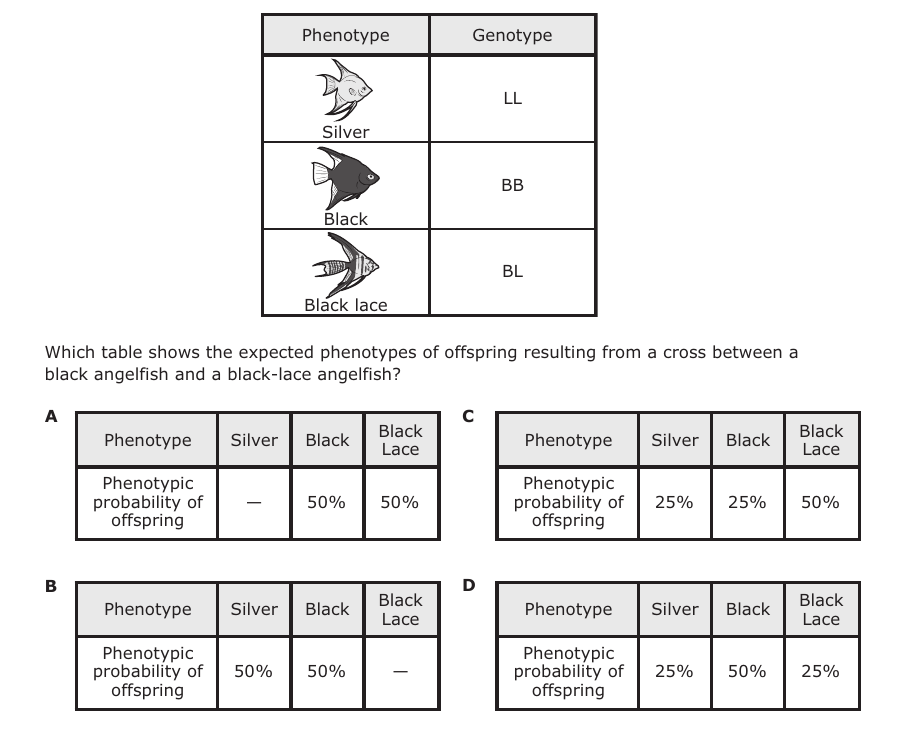
Some angelfish colors are determined by codominance. Possible phenotypes and genotypes of angelfish colors are shown. Which table shows the expected phenotypes of offspring resulting from a cross between a black angelfish and a black-lace angelfish?
- Table A
- Table B
- Table C
- Table D
Show STAAR answer and explanation
Table A
Black is BB and black lace is BL. A cross produces 50% BB (black) and 50% BL (black lace), with no silver LL offspring.
Table B: This predicts silver offspring, but neither parent contributes an L-only pair without B.
Table C: This predicts 25% silver, but a BB parent contributes B to every offspring.
Table D: The expected probabilities are 50% black and 50% black lace, not these values.
Released STAAR Biology EOC · 2023 · Item 10 · 1 point
Achondroplasia is an inherited condition that affects the formation of bone in humans. The allele for achondroplasia (A) is dominant to the unaffected allele (a). If a person who is homozygous dominant has children with a person who is homozygous recessive, what percentage of their children will likely have achondroplasia? Enter your answer as a whole number.
Show STAAR answer and explanation
100
The cross is AA × aa, so every child has genotype Aa. Because A is dominant, 100% of the children will have achondroplasia.
Released STAAR Biology EOC · 2026 · Item 4 · 1 point
Roan cattle have red-and-white fur evenly distributed on the hide and have the genotype . A roan cow is crossed with a red bull having the genotype . What is the probability of the genotype appearing in the offspring?
- 0%
- 25%
- 50%
- 100%
Show STAAR answer and explanation
50%
There is a 50% chance of offspring because the red bull always provides an allele and there is a 50% chance that the roan cow provides the allele.
0%: This is the probability of offspring. The red bull always provides an allele, so every offspring is either red or roan.
25%: This would be the probability of red or white offspring from a cross between two roan cattle.
100%: This would be the probability of from two red cattle or from two white cattle.
Released STAAR Biology EOC · 2026 · Item 20 · 1 point
A gardener is growing sunflowers, which have an incomplete dominance inheritance pattern. The sunflowers can produce red, orange, and yellow flowers. The gardener crosses a red sunflower with the genotype with a yellow sunflower with the genotype . Which outcome is the MOST LIKELY result of this cross?
- One-quarter of the sunflowers will be yellow.
- Half the sunflowers will be red.
- Three-fourths of the sunflowers will have both red and yellow petals.
- All the sunflowers will be orange.
Show STAAR answer and explanation
All the sunflowers will be orange.
Every offspring is . Incomplete dominance blends the phenotypes, so all the sunflowers will be orange.
One-quarter of the sunflowers will be yellow.: About one-quarter would be yellow from a cross between two hybrid red plants with dominant/recessive inheritance.
Half the sunflowers will be red.: About half would be red from a cross between a hybrid red plant and a recessive yellow plant with dominant/recessive inheritance.
Three-fourths of the sunflowers will have both red and yellow petals.: A mix of red and yellow petals would describe codominance, not incomplete dominance.
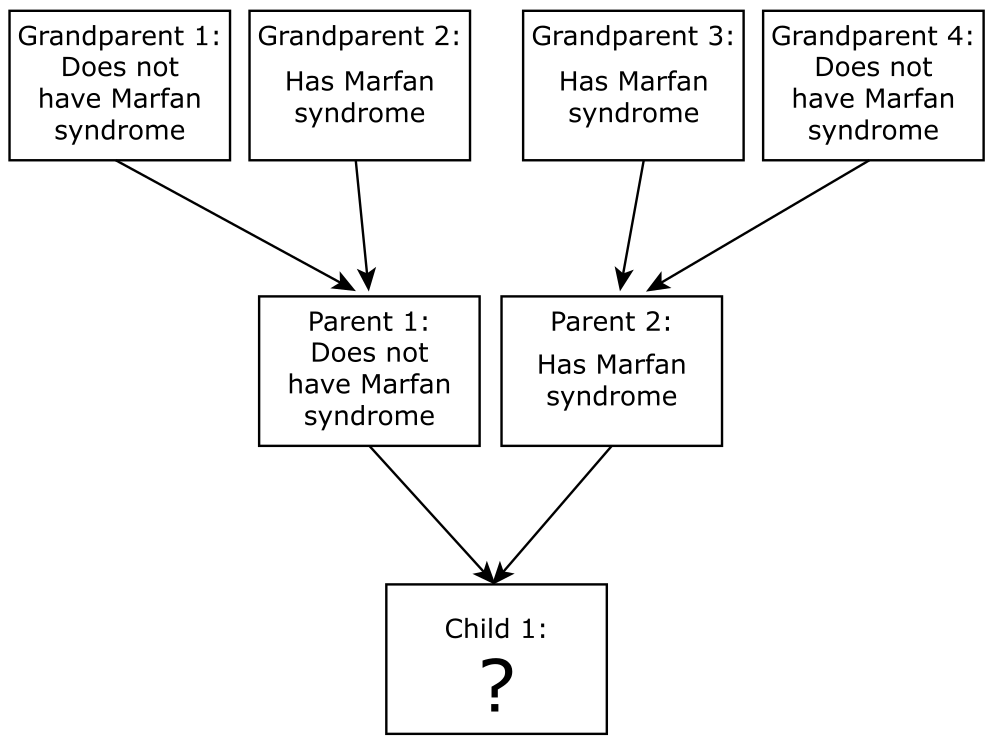
Released STAAR Biology EOC · 2025 · Item 27 · 1 point
Marfan syndrome is an autosomal dominant disorder that affects connective tissue in the skeletal system and skin. The figure shows a family affected by Marfan syndrome. What is the probability that Child 1 will have Marfan syndrome?
- 25%
- 50%
- 75%
- 100%
Show STAAR answer and explanation
50%
Parent 1 () does not carry the allele, and Parent 2 () carries one dominant allele. Child 1 has a 50% chance of inheriting the dominant allele from Parent 2 and having Marfan syndrome.
25%: A 25% probability would occur if the disorder were autosomal recessive and each parent were a carrier ().
75%: A 75% probability would occur if each parent were heterozygous ().
100%: A 100% probability would occur only if at least one parent were homozygous dominant ().
Learning objectives
By the end of the lesson, students can:
- Set up and interpret monohybrid and dihybrid crosses.
- Predict offspring genotypes and phenotypes for codominance, incomplete dominance, and sex-linked inheritance.
- Distinguish probabilities for all offspring from probabilities within a specified subgroup.
Instructional sequence
- 1
Engage
5 minAsk how two purple heterozygous parents can produce a white offspring. Collect predictions before drawing the square.
- 2
Direct instruction
12 minModel parent alleles → gametes → boxes → genotype ratios → phenotype ratios. Stress that uppercase and lowercase alleles are not interchangeable.
- 3
Guided practice
14 minComplete a monohybrid cross, then compare complete dominance with incomplete dominance and codominance using the same parental genotypes.
- 4
Advanced application
16 minIntroduce independent assortment for dihybrid crosses and X/Y notation for sex-linked crosses. Contrast “any child” with “given that the child is a son.”
- 5
Closure
8 minStudents self-check allele case, box counts, and whether the answer matches the requested phenotype or subgroup.
Misconceptions to address
Teacher move: Dominance describes heterozygote expression, not allele frequency or survival advantage.
Teacher move: Each fertilization is an independent probability; box ratios describe expectations over many offspring.
Teacher move: Restrict the sample to sons after sex is specified: one of two maternal X outcomes produces color blindness.